HOW-TO GUIDE
How to Test a Fuel Injector With a Multimeter: Resistance and Wiring Checks
By the OhmSavvy Research Team ·
Fuel system safety
- Fuel rails hold fuel under pressure even with the engine off. Every check below is done at the electrical connector; do not loosen fuel lines or injectors.
- Keep sparks and flames away from the engine bay, and do not make or break connections near a fuel leak. If you smell fuel, stop and have the leak repaired before any electrical testing.
- Disable the fuel pump or injectors as your service manual describes before any test that involves cranking, so raw fuel is not pumped into the cylinders.
- Direct injection systems use very high fuel pressure and high driver voltages. If your engine is direct injected and the manual's procedure is beyond your tools, take it to a qualified mechanic.
Symptoms and causes at a glance
Most people reach this test because of a misfire code on one cylinder, a rough idle, or an engine that stumbles under load. The table links each complaint to the electrical check that rules a cause in or out, and says when the job moves beyond a multimeter.
| Symptom | Likely cause | How to check | Fix or who to call |
|---|---|---|---|
| Misfire code on one cylinder, others fine | Open or shorted injector coil | Ohms across the injector, compared with the others | Replace the injector |
| Same cylinder misfires, coil reads normal | No ground pulse from the ECU or broken control wire | Noid light at the harness connector while cranking | Repair the wire; an ECU driver fault needs a specialist |
| Several injectors dead at once | Blown injector fuse, failed relay or open feed wire | DC volts at each connector, key on | Replace the fuse or relay, then find why it blew |
| Misfire only when hot | Coil resistance drifting with heat, or a cracked connector | Measure cold, then again at operating temperature | Replace the injector or connector |
| Rough idle, all electrical checks pass | Clogged, leaking or poor-spraying injector | Balance test, leak-down test or bench flow test | Fuel injection shop or mechanic |
| Fuel smell, hard hot start | Injector leaking or dripping | Fuel pressure leak-down test | Mechanic; stop driving if fuel is visible |
How a fuel injector is wired
A port fuel injector is a solenoid valve. Inside is a coil of fine wire around a spring-loaded pintle or ball. On most engines one terminal of the injector receives switched battery voltage, often shared by several injectors through one fuse or relay, whenever the key is on. The engine computer (ECU) controls the other terminal by switching it to ground. Each time the ECU completes that ground path, current flows through the coil, the valve lifts and fuel sprays for as long as the pulse lasts.
High-impedance vs low-impedance injectors
Injectors fall into two broad electrical families, and knowing which one your engine uses tells you roughly what number to expect before you open the manual.
High impedance (saturated)
Typically around 12–17 Ω. The coil itself limits current, so the ECU can switch it with a simple on-off driver. Common on most port-injected gasoline engines.
Low impedance (peak-and-hold)
Typically around 2–5 Ω. The ECU or an external resistor pack limits the current. Found on some older and performance applications.
Treat both ranges as a guide only. The actual specification, and the temperature it applies at, is in your service manual. Never swap a low-impedance injector onto a driver designed for high-impedance ones: the extra current can damage the ECU driver.
The numbers behind the test
A resistance reading matters because it sets how much current the injector draws, and current is what opens the valve. Ohm's law makes the link: current equals voltage divided by resistance. With the engine running, the charging system holds the feed somewhere around 13.5 to 14.5 V. Take 14 V as a round figure for the worked examples below; they are arithmetic, not specifications for any particular engine.
| Coil reading | Current at 14 V (I = V ÷ R) | What it means |
|---|---|---|
| 14 Ω (healthy high impedance) | 14 ÷ 14 = 1.0 A | Normal; the coil limits its own current |
| 7 Ω (half the turns shorted) | 14 ÷ 7 = 2.0 A | Double the current; the ECU driver runs hot |
| 2.5 Ω (low impedance, unlimited) | 14 ÷ 2.5 = 5.6 A | Why low-impedance injectors need a current-limiting driver |
| OL (open coil) | 0 A | The valve never opens; that cylinder gets no fuel |
Heat moves the reading too. Copper's resistance rises by roughly 0.39% for each degree Celsius. A coil that reads 14.0 Ω at 20 °C would read about 14.0 × (1 + 0.0039 × 70) = 14.0 × 1.27 ≈ 17.8 Ω at a 90 °C engine temperature. That is why manuals state the temperature their figure applies at, and why a cold engine gives the fairest comparison between cylinders.
Test lead resistance matters more on low readings. Leads that add 0.3 Ω inflate a 14 Ω reading by about 2%, which hardly matters, but on a 2.5 Ω low-impedance injector the same 0.3 Ω is a 12% error. Zero the leads, or subtract their reading, whenever the coil is a few ohms or less.
1Measure the coil resistance
With the ignition off, unplug the injector connector. Squeeze the release tab rather than pulling on the wires, as these clips go brittle with engine heat. Set the meter to its lowest ohms range and touch the probes together first; note the lead resistance (often a few tenths of an ohm) so you can subtract it, as explained in our guide to measuring resistance in ohms. Then put one probe on each injector terminal. Polarity does not matter for a resistance reading. An OL display means the coil is open, and a reading near zero means the windings have shorted together. The approach is the same one used for any solenoid coil.
2Compare the cylinders
Injectors on one engine are normally identical, so their readings should be close to each other when measured at the same temperature. One that sits well apart from the rest deserves a closer look even if it falls inside the manual's range. Measure them all with the engine cold so that heat soak does not skew the comparison, and write each reading down against its cylinder number. The chart shows an illustrative set from a four-cylinder engine where cylinder 3 is the odd one out.
The odd one out
3Check supply voltage at the connector
Leave the injector unplugged and turn the key to on with the engine not running. Set the meter to DC volts, put the black probe on a clean ground or the battery negative, and probe each terminal in the harness side of the connector. One terminal should show close to battery voltage, typically around 12.4 to 12.6 V on a charged battery; on most designs the other shows little or none at rest because the ECU has not yet grounded it. No voltage on either terminal points to the injector fuse, relay or feed wire, which often affects several injectors at once. If the fuse has blown, our guide to why a car keeps blowing fuses helps find the short before you fit another. A feed that reads a volt or more below the battery points to a corroded fuse terminal or connector; the voltage drop method pins it down.
4Check the ECU switching signal
A noid light is a small test lamp that plugs into the injector harness connector in place of the injector. While the engine cranks, it flickers each time the ECU grounds the circuit. A steady flicker shows the feed, the control wire and the ECU driver are all working. No flicker on one cylinder while others flash points to that cylinder's control wire or ECU driver. Check that wire for continuity from the connector to the ECU pin with the battery disconnected, as in our guide to finding a broken wire.
A multimeter is too slow to show individual pulses of a few milliseconds, but the numbers show what an averaging function can tell you. On a four-stroke engine with sequential injection, each injector fires once every two crankshaft turns. At an 800 rpm idle that is 800 ÷ 60 ÷ 2 ≈ 6.7 pulses a second, one every 150 ms. An illustrative 3 ms idle pulse is therefore a duty cycle of 3 ÷ 150 = 2%. At 6,000 rpm the gap shrinks to 20 ms, so a 12 ms pulse under load means 60% duty.
01
Ohms
Each coil, engine cold, leads zeroed
02
Compare
Look for the odd cylinder out
03
Feed
Battery volts at the harness, key on
04
Pulse
Noid light, duty cycle or a scope
05
Mechanical
Swap, balance or flow test
Meters with a duty-cycle or millisecond pulse-width function display those averages while the engine runs, which is enough to spot an injector that is never switched or one held open far too long. To see the actual pulse and the voltage spike as the coil switches off you need a scope. Our oscilloscopes for automotive diagnostics guide covers suitable models.
5Know what a multimeter cannot tell you
Once the coil, the feed and the switching signal all pass, the meter has done its job. What is left is mechanical: deposits restricting flow, a valve seat that leaks, or a spray pattern that streams instead of atomizing. Those need a fuel pressure gauge, a scan tool balance test, or a specialist with a flow bench, and the table shows where each check belongs.
| Fault | Found by meter? | How it is usually checked |
|---|---|---|
| Open coil | Yes: OL | Resistance across terminals |
| Shorted coil | Yes: near 0 Ω or well below others | Resistance and cylinder comparison |
| Missing 12 V feed | Yes | DC volts at the connector, key on |
| No ECU ground pulse | Partly | Noid light or oscilloscope |
| Clogged or restricted | No | Flow testing or balance test |
| Leaking or dripping | No | Fuel pressure leak-down test |
| Poor spray pattern | No | Bench flow and spray testing |
Meters for this job
Any meter with a low ohms range and DC volts covers steps 1 to 3. A meter with an injector pulse-width or duty-cycle function adds a running check of step 4 without a scope. These picks come from our verified automotive multimeter research.
Meters with injector pulse-width or duty-cycle functions

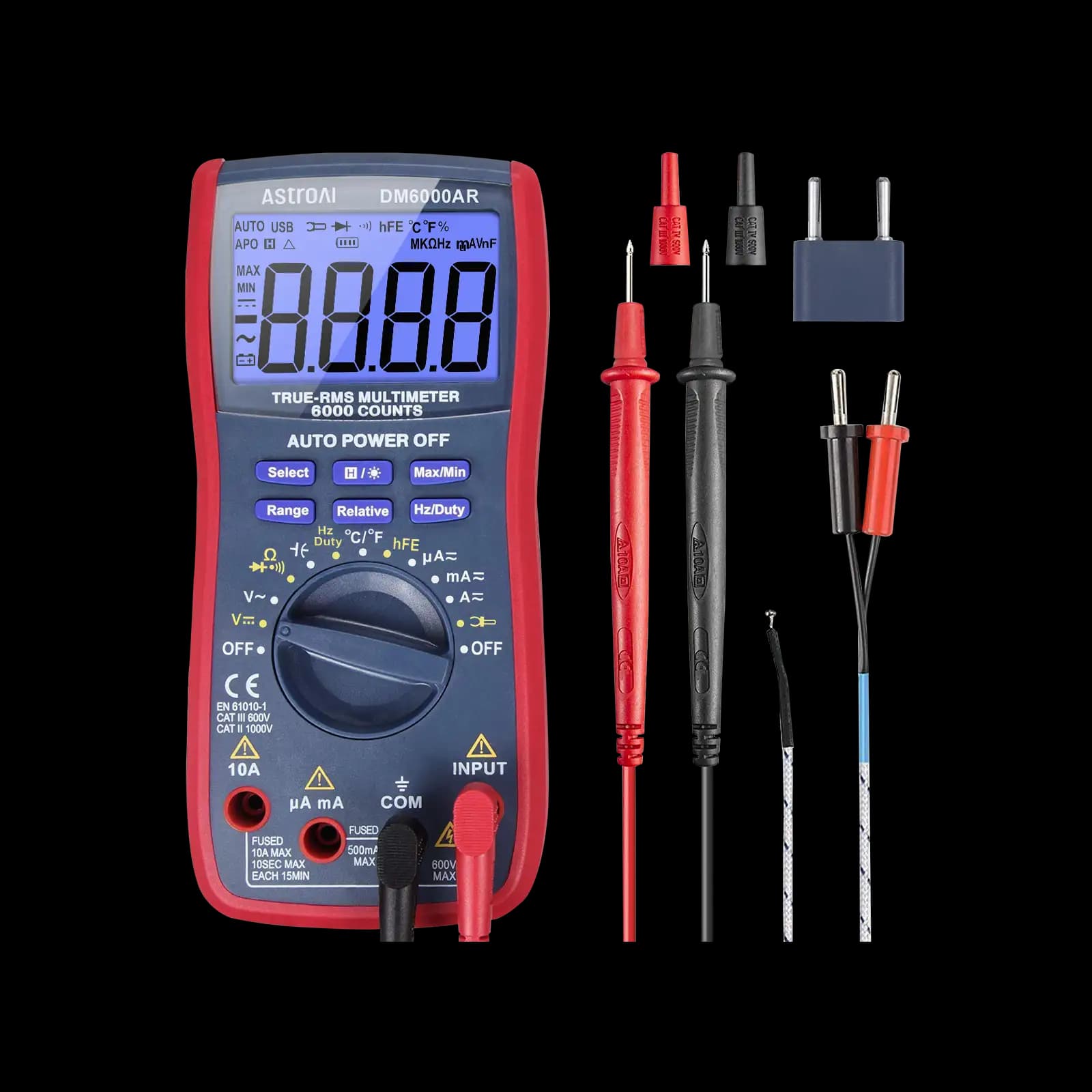
Millisecond pulse width and duty cycle, 250 µs Peak Min/Max, CAT IV 600V. Average-responding, not True RMS.

Budget True RMS meter with 0.1–10 ms injector pulse width and duty cycle; the RPM clamp is sold separately.
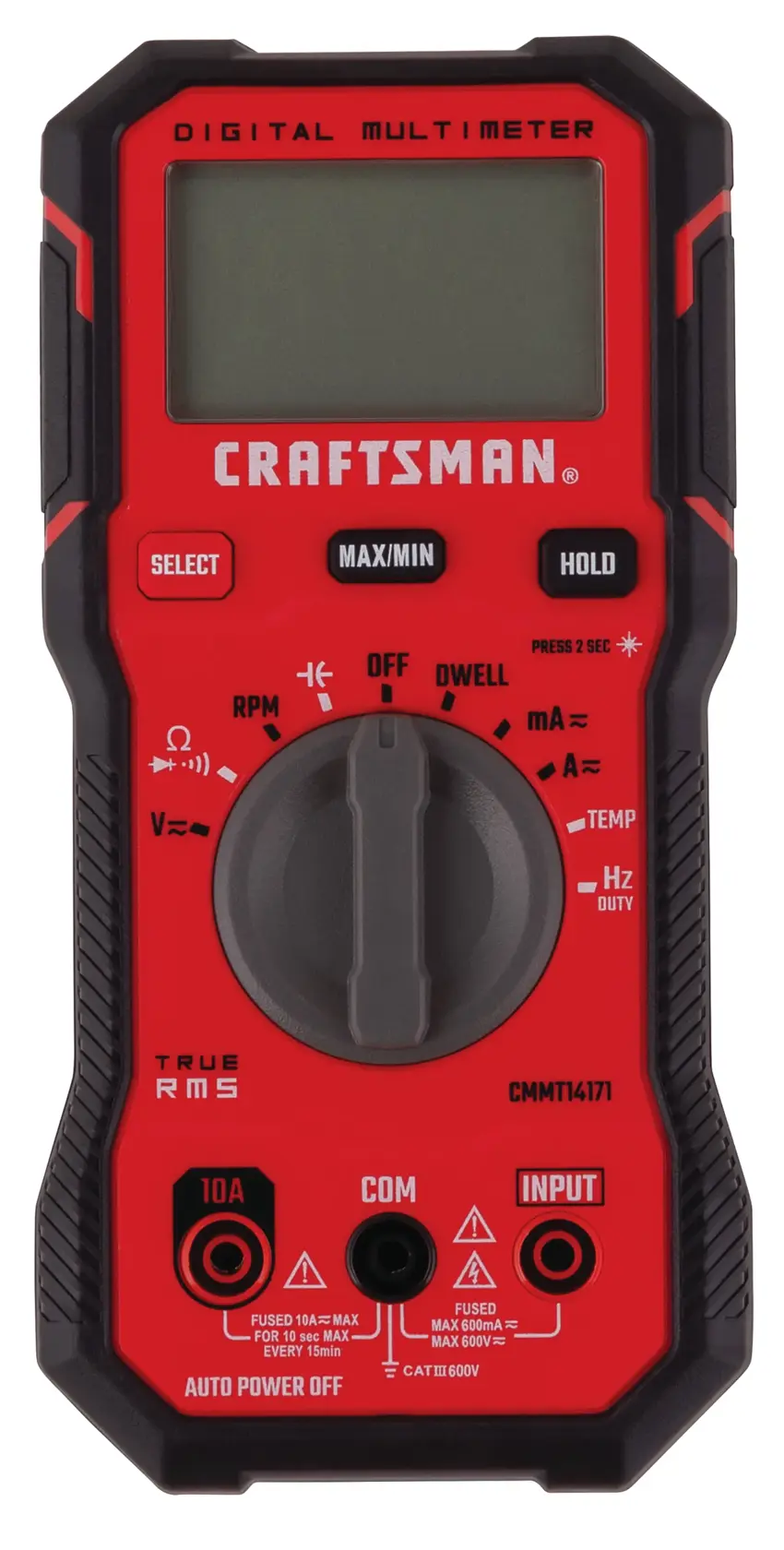
True RMS and CAT III 600V, with RPM, dwell and duty cycle for engine work.
As an Amazon Associate I earn from qualifying purchases. Prices and availability are shown on Amazon.
Frequently asked questions
What resistance should a fuel injector have?
Many port injectors are high impedance and typically read somewhere around 12 to 17 ohms, while low-impedance types typically read around 2 to 5 ohms. Those are general ranges, not a specification. The figure for your engine is in the service manual, and the reading also rises as the coil warms up, by roughly 0.4% for every degree Celsius.
Can I test a fuel injector without removing it?
Yes. Resistance, supply voltage and the ECU switching signal are all measured at the injector connector with the injector still in the engine. Unplug it for the resistance reading, then probe the harness side for voltage. Removing the injector is only needed for flow, leak-down or spray-pattern testing, which requires specialist equipment or a fuel injection shop.
Can a fuel injector pass a resistance test and still be bad?
Yes. A resistance test only checks the electrical coil. An injector with a healthy coil can still be partly blocked by deposits, drip when it should be closed, or produce a poor spray pattern. If the coil reads within spec and the wiring is good but the cylinder still misfires, the injector's mechanical condition is the next suspect, and a swap test helps confirm it.
Does this work on direct injection engines?
The idea of checking a coil for opens and shorts still applies, but gasoline direct injection systems drive the injectors at much higher voltages than battery voltage and run fuel pressures far above port systems. Do not back-probe a direct injector connector with the engine running, and follow the service manual's procedure and resistance values for that system.
How do I know which injector is causing a misfire?
Start with the scan tool's misfire code or counters, which usually name the cylinder. Measure that injector's resistance and compare it with the others, then check its connector with a noid light. If everything electrical passes, swap the injector with one from a healthy cylinder. If the misfire moves with the injector, the injector is at fault; if it stays, look at the spark or compression.
Can a multimeter measure injector pulse width?
Some automotive meters have a millisecond pulse-width function and most have duty cycle, which show an average of the injector signal while the engine runs. That is useful for spotting an injector that is never switched or one held open far too long. It will not show the shape of each pulse or the turn-off spike; for that you need an oscilloscope.
Where to go next
Best Oscilloscopes for Automotive Diagnostics →
Scopes that can show the injector pulse and its turn-off spike, which a meter cannot.
How to Measure Resistance in Ohms →
Lead compensation and range choice for accurate low-ohm readings.
How to Test an Ignition Coil →
The other half of a misfire diagnosis: primary and secondary winding checks.



