HOW-TO GUIDE
How to Test a Fuse With a Multimeter
By the OhmSavvy Research Team ·

Before you start
You need a digital multimeter with a continuity or low ohms range, and the fuse itself. Nothing else, apart from a replacement of exactly the same rating if the old one turns out to be blown. The four steps run in this order every time:
01
Isolate
Power off, remove the fuse
02
Set meter
Continuity or lowest Ω
03
Probe
One lead on each end
04
Read
≈0 Ω good, OL blown
1Isolate and remove the fuse
Switch the device off and unplug it, or turn off the circuit at the breaker or isolator. In a car, turn the ignition off. Then pull the fuse with a fuse puller or insulated pliers. Testing it out of its holder matters: left in place, the meter can read through other parts of the circuit connected in parallel with the fuse and report continuity across a fuse that is actually open.
Never resistance-test a fuse that is still in a live circuit
2Set the meter and check the leads
Plug the black lead into COM and the red lead into the VΩ jack. Turn the dial to continuity (the sound-wave icon) or, on a manual-ranging meter, the lowest ohms range, usually 200Ω. Touch the probe tips together: the meter should beep and show a fraction of an ohm. That figure is the resistance of your test leads; if your meter has a REL or Δ button, press it now to subtract it from the readings that follow. Not sure which icon is which? Our multimeter symbols guide decodes the dial.
3Probe both ends
Hold one probe on each metal end of the fuse. Polarity does not matter. Press firmly enough to cut through any tarnish on the caps or blades, and keep your fingers off the metal, since on the high ohms ranges your body resistance can show up in the reading.
4Read the result
A good fuse is just a short piece of conductor, so it reads very low resistance and the meter beeps. A blown fuse has a gap in its element, so there is no path at all and the display shows OL.
| Reading | Meaning | Next step |
|---|---|---|
| Beep, about 0–1 Ω | Fuse is intact | Look for the fault elsewhere: holder, wiring, switch, load |
| A few ohms, small mA-rated fuse | Usually normal for low-current fuses | Compare with a new fuse of the same rating |
| Value that jumps or flickers | Poor contact or a cracked element | Clean the caps, re-probe; replace if it persists |
| OL | Fuse is blown (open) | Replace like for like, then find why it blew |
OL here is the expected reading for an open circuit, not an error; our explainer on what OL means on a multimeter covers how its meaning shifts in other modes.
Fuse types and where to probe
| Fuse type | Where to probe | Notes |
|---|---|---|
| Glass cartridge | Both metal end caps | A visible break or dark smudge confirms it, but always measure |
| Ceramic cartridge | Both metal end caps | Element is hidden; the meter is the only check |
| Automotive blade | The two exposed test points on top, or the blades | Top test points let you check without pulling, but pull it for a clean reading |
| UK 13A plug fuse | Both end caps | Step by step in our 13 amp plug fuse guide |
| Thermal fuse (appliances) | Both leads | One-shot heat cut-off; see the thermal fuse guide |
Two of those have their own walkthroughs: testing a 13 amp plug fuse and testing a thermal fuse. Resettable PTC fuses and circuit breakers behave differently: a PTC rises to a high resistance while it is hot and recovers as it cools, so test it cold, and a breaker is checked with the circuit's own load, not as a removed part.
Readings that mislead
Most false results come from the setup, not the fuse. Probing a fuse still in its holder can show continuity through the rest of the circuit. A meter whose own battery is low may beep late or not at all. Dirty or corroded caps add resistance and can make a good fuse read open until you clean them. And if the meter shows nothing on any test, check that it isn't the meter's own fuse that has gone, which happens after a current measurement on the wrong jack. For a car circuit where one side of the fuse has power and the other doesn't, our guide to power on one side of a car fuse only works through the possibilities.
The rule of thumb
Meters with a fast continuity beeper
Affordable auto-ranging meter for home fuse checks.
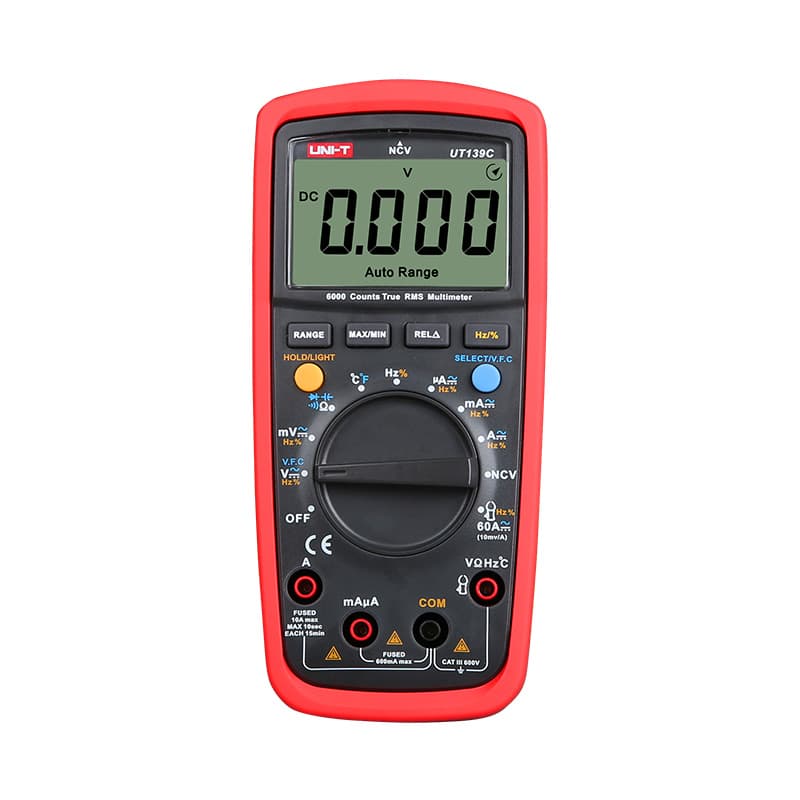
Budget True RMS meter with auto and manual ranging.

As an Amazon Associate I earn from qualifying purchases. Prices and availability are shown on Amazon.
Frequently asked questions
Should I use continuity mode or resistance mode to test a fuse?
Either works. Continuity is quicker because you only listen for the beep. Resistance mode tells you more: a healthy fuse reads a fraction of an ohm, and an unusually high value on a fuse that still beeps is worth noticing. On very small fuses, rated in milliamps, resistance mode is the better choice because their normal resistance can sit near the beep threshold.
Can a fuse look fine but still be blown?
Yes. Ceramic and sand-filled fuses hide the element completely, and a glass fuse can break right under the end cap where you cannot see it. The meter reading is what decides, not the appearance.
Why does my fuse beep but the circuit still has no power?
The fuse may be good and the fault elsewhere: a corroded or loose fuse holder, a broken wire, a tripped switch or a failed component downstream. Measure voltage on both sides of the fitted fuse with the circuit powered, as our guide to testing a fuse without removing it describes, to see where the supply stops.
Can I replace a blown fuse with a higher-rated one if it keeps blowing?
No. The rating protects the wiring and the device; a larger fuse lets a fault draw enough current to overheat cables or start a fire. A fuse that blows repeatedly is reporting a fault, such as a short or an overload, that needs finding first. Replace like for like: same current rating, voltage rating, speed (fast or slow-blow) and size.
How do I read the rating printed on a fuse before replacing it?
Glass and ceramic cartridges are usually stamped on an end cap with the current, often a letter for speed and the voltage, for example T2AL250V: T means time-delay (slow-blow), F means fast, 2A is the current, L means low breaking capacity and 250V is the maximum voltage. Blade fuses use color plus a molded number for amps. Match every part of that code.


