COMPARISON · MULTIMETERS
Fluke 17B+ vs Fluke 179
Both meters pack in features beyond basic voltage and resistance, including temperature and frequency, but they sit in different Fluke tiers. The 17B+ is a feature-rich entry-level meter that Fluke doesn't describe as True RMS. The 179 is the full-featured member of the 170 series: True RMS, a higher CAT rating, a wider capacitance range, tighter DC accuracy and Min/Max-Average recording. The AC measuring method matters more than the overlapping feature list suggests.
By the OhmSavvy Research Team ·
Disclosure: OhmSavvy earns a commission from qualifying Amazon purchases made through these links, at no extra cost to you. How we're funded.
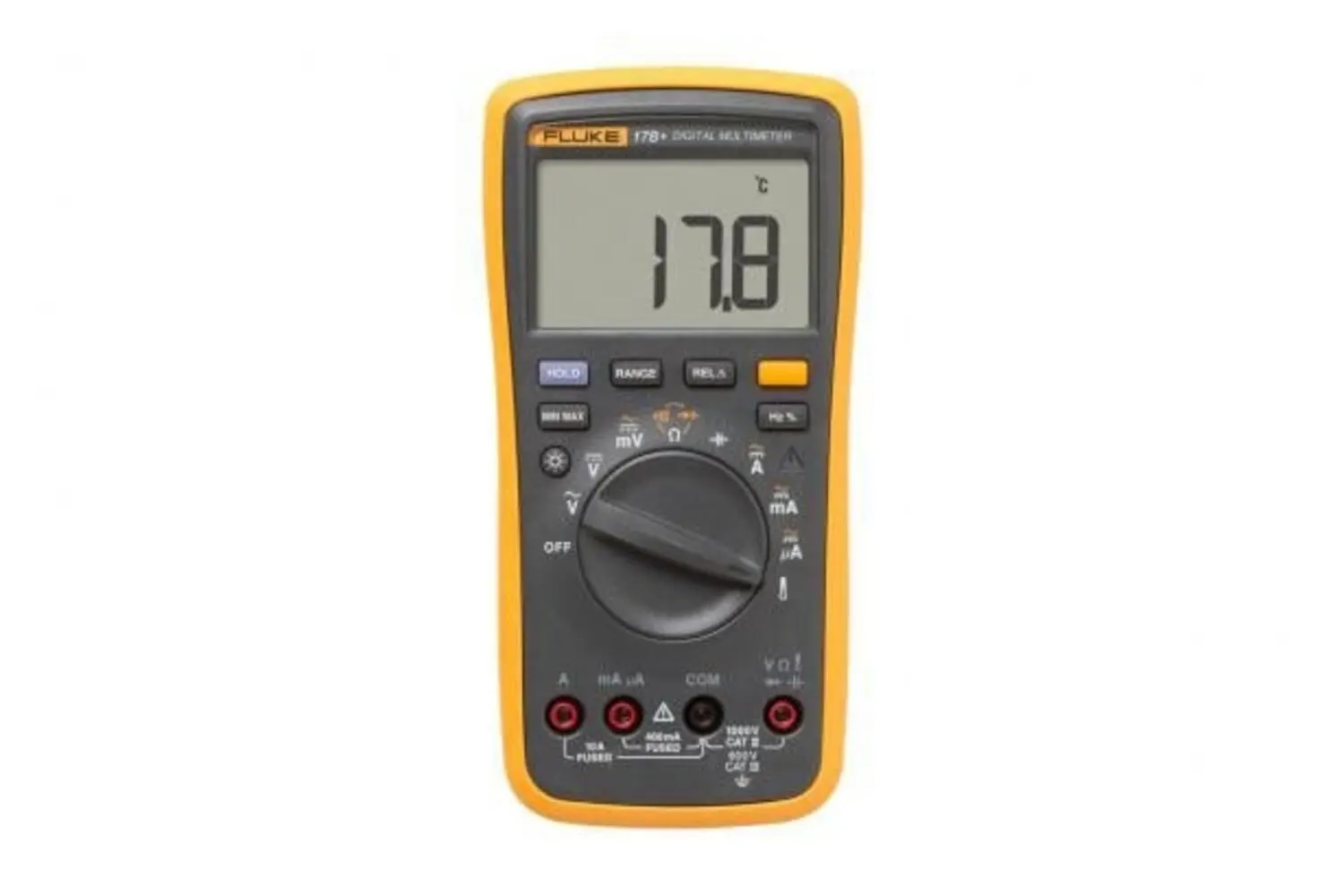
Fluke 17B+
4.5★★★★★A full-size Fluke with temperature, frequency, MIN MAX and relative mode, but not True RMS.

Fluke 179
4.7★★★★★Fluke's do-everything bench-and-field meter: CAT IV 600V, True RMS, temperature and a 6,000-count display with bar graph.
Specs side by side
| Fluke 17B+ | Fluke 179 | |
|---|---|---|
| Rating | 4.5★★★★★ | 4.7★★★★★ |
| Accuracy | Not stated as True RMS by Fluke | True RMS |
| Safety rating | CAT III 600V / CAT II 1000V | CAT III 1000V / CAT IV 600V |
| Auto-ranging | Yes (manual override) | Yes (manual override) |
| Best for | Electronics hobbyists, students, appliance repair | Industrial maintenance, electronics, HVAC |
| AC measurement | Not stated as True RMS by Fluke | True RMS |
| Safety rating | CAT III 600V / CAT II 1000V | CAT III 1000V / CAT IV 600V |
| Display | 4,000 counts | 6,000 counts with analog bar graph |
| Basic DC volts accuracy | ±(0.5% + 3) | ±(0.09% + 2) |
| Basic AC volts accuracy | ±(1.0% + 3) | ±(1.0% + 3) |
| Current | 400 µA to 10A, µA/mA/A ranges | Up to 10A, 0.01 mA finest step |
| Resistance | Up to 40 MΩ | Up to 50 MΩ |
| Capacitance | Up to 1,000 µF, ±(5% + 5) on µF ranges | Up to 10,000 µF, ±(1.2% + 2) |
| Temperature | −55 °C to 400 °C, Type K probe supplied | −40 °C to 400 °C, thermocouple supplied |
| Frequency | Up to 100 kHz | Up to 100 kHz |
| Min/Max recording | MIN MAX only | Min/Max-Average |
| Battery | 2 × AA, 500 h minimum | One 9V, about 200 h typical |
| Weight | 455 g | 420 g |
Specs checked against manufacturer documentation and official Amazon listings. Desk research, not bench testing. How we research.
Key differences
- →Fluke doesn't describe the 17B+ as True RMS, while the 179 is. On clean sine-wave circuits this rarely matters, but on variable-speed drives, dimmers and other non-sinusoidal loads the 17B+'s AC readings can be meaningfully off where the 179's aren't.
- →The 179 is rated CAT IV 600V on top of CAT III 1000V; the 17B+ tops out at CAT III 600V / CAT II 1000V, a lower safety margin for work near a service entrance.
- →The 179's capacitance range reaches 10,000 µF against the 17B+'s 1,000 µF, a 10x difference that matters for larger motor-run or power-supply capacitors.
- →The 179's basic DC accuracy is ±(0.09% + 2) against the 17B+'s ±(0.5% + 3), and its display resolves 6,000 counts with an analog bar graph against 4,000 counts.
- →The 17B+ has dedicated µA ranges and runs at least 500 hours on two AA cells; the 179 steps current in 0.01 mA and Fluke quotes about 200 hours on a 9V.
- →Both measure temperature and frequency, so those two functions aren't a differentiator.
Check which exact model your 17B+ listing ships
Fluke 17B+ vs 179 spec by spec
Both meters measure capacitance, but the range each covers is different enough to matter for real component testing. The same goes for DC accuracy, where the 179 is in a different class.
Bars use a logarithmic scale: each step is ten times the last.
Put into volts: on a 12.6 V battery, the 17B+ reads on its 40.00 V range and its spec allows ±(0.063 + 0.03) = ±0.093 V. The 179 reads on 60.00 V and allows ±(0.011 + 0.02) = ±0.031 V. Both figures come from Fluke's published specifications, not from testing. A 0.09 V window is fine for deciding whether a battery is charged; for the small voltage-drop readings used to find a bad cable connection, the 179's tighter window helps.
Fluke 17B+ vs 179 feature by feature
Counted function by function, neither meter simply has more. The 179 offers better features for anyone who measures power, while the 17B+ keeps a few the 179 doesn't list at all: microamp ranges, duty cycle, relative mode and a hazardous-voltage LED. The table lists every function Fluke publishes for either meter. Where Fluke states nothing for a model, we write "Not stated" rather than guess.
| Feature | Fluke 17B+ | Fluke 179 |
|---|---|---|
| True RMS | Not claimed by Fluke | Yes, AC volts and AC amps |
| Temperature | −55 to 400 °C, Type K bead probe | −40 to 400 °C, 80BK probe |
| Capacitance | 40 nF to 1,000 µF | Up to 10,000 µF |
| Frequency | 10 Hz to 100 kHz, ±(0.1% + 3) | To 100 kHz, ±(0.1% + 1) |
| Duty cycle | 1 to 99% | Not stated |
| Microamp ranges | 400.0 µA and 4000 µA | None; finest step 0.01 mA |
| Highest current | 10.00 A | 10 A |
| Min/Max | MIN MAX | Min/Max-Average |
| Hold | HOLD | Hold and Auto Hold |
| Relative mode | Yes, except resistance and continuity | Not stated |
| Backlight | Yes | Yes |
| Display | 4,000 counts | 6,000 counts |
| Analog bar graph | Not listed | Yes, 33 segments |
| Continuity beeper | Below 70 Ω | Yes; threshold not stated |
| Hazardous-voltage LED | Lights at 30 V or more | Not stated |
| CAT rating | CAT III 600V / CAT II 1000V | CAT III 1000V / CAT IV 600V |
| Battery | 2 × AA, 500 h minimum | 9 V, about 200 h without backlight |
| Warranty | 1 year | Lifetime |
| OhmSavvy hands-on tested | No (desk research) | No (desk research) |
Which of those features matter depends on the work. An HVAC or appliance technician gets temperature on both, so the deciders are the 179's 10,000 µF capacitance for motor-run capacitors, True RMS for variable-speed blowers and Auto Hold for one-handed readings at an awkward cabinet. A technician chasing an intermittent fault benefits from the 179's Min/Max-Average plus a bar graph that moves faster than the digits, which shows a contact that flickers. Anyone working at a meter base or outdoor feeder needs the CAT IV 600V line, which only the 179 carries.
The 17B+'s list favors the bench. Its 400.0 µA range resolves 0.1 µA, a hundred times finer than the 179's best 0.01 mA step, which decides sleep-current and sensor work. Duty cycle reads PWM fan and motor-speed signals in percent, and relative mode zeroes out a baseline (Fluke excludes resistance and continuity from it). Two AA cells rated for at least 500 hours also beat a 9 V rated at roughly 200. The warranty runs the other way: one year on the 17B+ against Fluke's lifetime cover on the 179.
Feature verdict
Average-responding vs True RMS, shown
A meter that isn't True RMS rectifies the AC signal, takes its average, and multiplies by 1.111, the ratio that converts a sine wave's average to its RMS value. That shortcut is exact for a pure sine and wrong for everything else, because other waveforms have a different ratio. The 179 computes the RMS value directly, so its reading tracks the heating effect of the waveform whatever its shape.
| Waveform | Where you meet it | Average-responding error (typical textbook value) |
|---|---|---|
| Pure sine | Utility power, resistive loads | None |
| Square wave | Some inverters and UPS outputs | About 11% high |
| Triangle | Some test and control signals | About 4% low |
| Narrow current pulses | Switch-mode supplies, LED drivers, drives | Low, often by a large margin |
The figures are standard form-factor arithmetic, not readings from either meter, and real equipment adds its own bandwidth and crest-factor limits. The point stands: if a 17B+ shows an odd current on a variable-speed fan or an LED fixture, the meter may be the cause, not the load. Our page on why a multimeter shows the wrong voltage covers this and other causes.
Fluke 17B+ vs 179 for electrical maintenance
Maintenance work is repetitive by design: the same switchgear, motors and control panels checked on a schedule, with readings compared against last quarter's. That shifts the priorities away from the longest feature list and toward three things: where on the system the meter is allowed to probe, whether its readings stay trustworthy on drive-fed equipment, and whether it will still be in the bag, and covered, in ten years.
| Routine | What it needs | Fluke 17B+ | Fluke 179 |
|---|---|---|---|
| Voltage at the service entrance or main disconnect | CAT IV rating | Not rated: CAT III 600V / CAT II 1000V | CAT IV 600V |
| Feeder and panel checks up to 1000 V | CAT III at the working voltage | CAT III only to 600 V | CAT III 1000V |
| Running amps on a drive-fed motor | True RMS | Not claimed by Fluke | Yes |
| Motor frame and lug temperature | Thermocouple input | Type K, −55 to 400 °C | 80BK, −40 to 400 °C |
| Contactor that drops out at random | Recording plus a fast display | MIN MAX, digits only | Min/Max-Average, 40/s bar graph |
| Motor start or run capacitor | Capacitance range | To 1,000 µF | To 10,000 µF |
| Reading taken at arm's length | Hold that captures on its own | HOLD | Hold and Auto Hold |
| 4–20 mA control loop | Milliamp resolution | 0.01 mA on 40.00 mA | 0.01 mA on 60.00 mA |
The first row decides the matter for many plant electricians. Quarterly checks often begin at the incoming supply, and that is CAT IV territory: the 179 is rated for it at 600 V, while the 17B+ is not rated for it at any voltage. The second row matters on 480 V systems, where the 179's CAT III 1000V gives headroom and the 17B+ sits close to its 600 V CAT III ceiling.
Temperature is where both meters earn a place on a motor round. Fluke specifies the 179 at ±(1.0% + 10) with 0.1 °C resolution, so ten counts add 1.0 °C; the 17B+ uses ±(2% + 1 °C) from 50 to 400 °C. On an illustrative 70 °C reading at a motor frame, the 179 allows 0.7 + 1.0 = ±1.7 °C and the 17B+ allows 1.4 + 1 = ±2.4 °C. On a 90 °C lug, it is ±1.9 °C against ±2.8 °C. Either is tight enough to spot one phase connection running much hotter than its neighbors, which is the useful comparison. Check the probe too: Fluke's 179 page doesn't state the 80BK's own range, and another Fluke source cited on our Fluke 87V vs Fluke 179 page gives −40 to 260 °C.
On durability, the published record favors the 179. Fluke's 170 Series detailed specifications list 8 kV surge protection and an operating range of −10 to +50 °C for the family; we have no equivalent surge or operating-temperature figure for the 17B+ in our sources, so treat those as not stated. Both meters protect their current inputs with 440 mA and 11 A fuses rated at 1000 V. The warranty gap is the starkest line on the page: one year on the 17B+, lifetime on the 179, which for a maintenance department means a meter that can be returned for defects long after a 17B+ would have fallen out of cover. The 17B+ keeps one maintenance advantage: two AA cells rated for at least 500 hours, against roughly 200 hours from the 179's 9 V.
Which should you buy?
| Situation | Better fit | Why |
|---|---|---|
| Student or hobbyist learning electronics basics | Fluke 17B+ | Lower price, still has temperature and frequency |
| Working on drives, dimmers, or electronic loads professionally | Fluke 179 | True RMS matters on non-sinusoidal AC |
| Work near a service entrance or utility connection | Fluke 179 | CAT IV 600V rating the 17B+ doesn't have |
| Testing larger motor-run or supply capacitors | Fluke 179 | 10,000 µF range vs the 17B+'s 1,000 µF |
| Microcontroller sleep current and sensor loops | Fluke 17B+ | Dedicated 400 µA range with 0.1 µA steps |
| Budget-conscious, mostly clean sine-wave circuits | Fluke 17B+ | The True RMS gap rarely matters here |
True RMS is the deciding factor more than any single feature
Choose the Fluke 17B+ if…
- ✓You're a student, hobbyist, or doing appliance repair on mostly clean sine-wave circuits
- ✓You want temperature, frequency, relative mode and µA ranges at a lower price than the 179
- ✓You value battery life: Fluke quotes 500 hours minimum on two AA cells
- ✓You've confirmed your specific unit ships as the 17B+, not the newer 17B MAX shown in some listing photos
Choose the Fluke 179 if…
- ✓You need True RMS accuracy on variable-speed drives, dimmers, or other electronic loads
- ✓You need CAT IV 600V protection, not just CAT II 1000V / CAT III 600V
- ✓You work with larger capacitors (up to 10,000 µF) than the 17B+'s 1,000 µF range covers
- ✓You want Min/Max-Average recording and a lifetime warranty
The bottom line
These two meters share more features than their price gap implies, since both measure temperature and frequency, but the 179 wins on the things that affect measurement reliability: True RMS, tighter DC accuracy, a higher CAT rating and a far wider capacitance range. If your work only touches clean sine-wave circuits and budget matters, the 17B+ is a reasonable, feature-rich entry meter with better battery life and µA ranges. For anything involving variable-speed drives, dimmers or larger capacitors, the 179's accuracy and range earn its higher price.
Frequently asked questions
Does the 17B+ give wrong readings, or just less accurate ones?+
On clean, sinusoidal AC such as most outlets and simple resistive circuits, it reads within its published spec. The gap shows up on non-sinusoidal loads like variable-speed drives, dimmers and switch-mode supplies, where an average-responding meter can read noticeably off the true value, high on square waves and low on narrow pulses.
Is the 17B MAX the same as the 17B+?+
No, they're different products. Some Amazon listings for the 17B+ show a photo of the 17B MAX instead, so check the listing title and any visible model markings before buying. If the model matters to your work, confirm with the seller which one ships before you order.
Why would anyone choose the 17B+ if the 179 is more capable overall?+
Price, battery life and small currents. For work that never touches non-sinusoidal loads or CAT IV locations, the 17B+'s lower cost buys enough capability, and its dedicated µA ranges and 500-hour battery are genuine advantages. Paying more for accuracy and range you won't use isn't a better choice.
Do both meters include the temperature probe, or is it sold separately?+
Both include one. Fluke supplies a Type K thermocouple probe with the 17B+, reading −55 °C to 400 °C on the meter, and a thermocouple with the 179, which reads −40 °C to 400 °C. Supplied bead probes suit air and surface checks; immersion or high-heat work needs a dedicated probe.
Which is more accurate for DC voltage, the 17B+ or the 179?+
The 179, by a wide margin. Fluke lists ±(0.09% + 2) basic DC accuracy for the 179 against ±(0.5% + 3) for the 17B+. On a 12.6 V reading that works out to about ±0.03 V versus ±0.09 V. Both share the same ±(1.0% + 3) basic AC voltage figure.
Which has more features, the Fluke 17B+ or the Fluke 179?+
Neither wins outright. The 179 adds True RMS, CAT IV 600V, capacitance to 10,000 µF, Auto Hold, Min/Max-Average, an analog bar graph and a lifetime warranty. The 17B+ keeps microamp ranges, duty cycle, relative mode and a hazardous-voltage LED that Fluke doesn't list for the 179. Both have temperature, frequency to 100 kHz and a backlight.
Does the Fluke 179 have a microamp range like the 17B+?+
No. Fluke's spec table gives the 179 a finest current step of 0.01 mA, which is 10 µA, and no dedicated microamp range, although one comparison table on Fluke's page mentions µA. The 17B+ has 400.0 µA and 4000 µA ranges with 0.1 µA resolution at the bottom, so it suits small sensor and standby currents better.
Can I use the Fluke 17B+ at a service entrance or main disconnect?+
No. Fluke rates the 17B+ CAT III 600V and CAT II 1000V, with no CAT IV rating, so it isn't meant for the meter base, service drop or line side of the main disconnect. The Fluke 179 carries CAT IV 600V for those points. Use leads rated at least as high as the meter, and leave service-entrance work to qualified electricians.
Is the Fluke 179 or 17B+ better for motor maintenance?+
The 179 for most maintenance rounds. It is True RMS for drive-fed motors, reads capacitors to 10,000 µF, adds Auto Hold and a fast bar graph, and has a lifetime warranty. Both measure motor and connection temperature with a thermocouple; on a 70 °C reading Fluke's specs allow about ±1.7 °C on the 179 and ±2.4 °C on the 17B+, before probe error.
Related


