HOW-TO GUIDE
What Multimeter Accuracy Do You Need for Electronics Repair?
By the OhmSavvy Research Team ·
Accuracy is not a safety rating
How multimeter accuracy is specified
Manufacturers state accuracy separately for each function and range, in the form ±(% of reading + counts). Some manuals write "digits" or "dgt" instead of counts; they mean the same thing. The two parts add together:
% of reading
An error that scales with the value shown. 0.5% of 5 V is 25 mV; 0.5% of 1 V is only 5 mV.
Counts (digits)
A fixed error in steps of the last digit on that range. 2 counts on a 0.001 V range is 2 mV, whatever the reading.
Conditions
Specs usually apply within a stated temperature band and calibration period. Outside them, the manual often adds extra error.
AC voltage, current, resistance and capacitance each carry their own figures, and they are normally looser than DC voltage. AC specs also only hold over a stated frequency range. So a meter advertised with a headline "basic accuracy" is quoting its best function, almost always DC volts on one range.
A worked accuracy example
Take a 6,000-count meter with an illustrative DC voltage spec of ±(0.5% + 2 counts) on its 6 V range, where the last digit is 0.001 V. You measure a supply rail and the display reads 5.000 V.
01
Read the spec
±(0.5% + 2) on the 6 V range
02
% of reading
0.5% × 5.000 V = 0.025 V
03
Counts
2 × 0.001 V = 0.002 V
04
Add them
±0.027 V
05
Error band
4.973 V to 5.027 V
For a 5 V logic rail that is typically allowed to vary by a few percent, a ±0.027 V band (about 0.54% of the reading) is more than enough. You can confidently say the rail is healthy. The same meter would not let you tell a 5.010 V reference from a 5.020 V one, but repair work rarely asks that question.
Why the range you use matters
Because the counts term is fixed, it becomes a larger share of small readings. Keep the same ±(0.5% + 2 counts) spec and the same 6 V range, and look at what happens as the reading shrinks:
| Reading (6 V range) | % term | Counts term | Total error | As % of reading |
|---|---|---|---|---|
| 5.000 V | ±0.025 V | ±0.002 V | ±0.027 V | 0.54% |
| 1.000 V | ±0.005 V | ±0.002 V | ±0.007 V | 0.7% |
| 0.100 V | ±0.0005 V | ±0.002 V | ±0.0025 V | 2.5% |
The fix is to measure on the lowest range that holds the value. On a 600 mV range with 0.1 mV steps, the same 100 mV signal reads as 100.0 mV with an error of 0.5 mV + 0.2 mV = ±0.7 mV, or 0.7%. Auto-ranging meters pick the lowest suitable range for you, which is one reason they suit repair work; if you range manually, step down until the display is as full as possible.
Resolution, accuracy and counts are different things
Counts are the largest number the display can show before moving to the next range. Resolution is the size of one step of the last digit on the range in use. Accuracy is how close the reading is guaranteed to be to the true value. A meter can show many digits that are not all trustworthy.
| Display | Typical maximum reading | Range for a 5 V rail | Resolution on that range |
|---|---|---|---|
| 3½-digit (2,000-count) | 1999 | 20 V | 0.01 V |
| 6,000-count | 5999 | 6 V | 0.001 V |
| 4½-digit (20,000-count) | 19999 | 20 V | 0.001 V |
The 6,000-count meter shows the rail to the nearest millivolt where the 2,000-count meter shows only the nearest 10 mV. That is a resolution advantage. Whether those millivolts are correct is set by the accuracy spec, which the multimeter buying guide also flags as the number to check before the count.
How much accuracy common repair tasks need
A commonly used metrology guideline is that the instrument should be several times more accurate than the tolerance you are checking, with a 4:1 ratio often quoted. In repair you rarely need to meet that formally, but it is a good way to judge whether a reading is conclusive. The figures below are typical guidelines; component datasheets and service manuals give the real limits.
| Repair task | Typical tolerance being checked | Meter accuracy that is usually enough |
|---|---|---|
| Supply and logic rails (3.3 V, 5 V, 12 V) | Often a few percent | ±0.5% to ±1% DC V |
| Linear or switching regulator output | Commonly 1% to 5%, per datasheet | ±0.5% DC V or better |
| 5% resistors | ±5% | Around ±1% resistance |
| 1% resistors | ±1% | ±0.25% or better for a conclusive 4:1 check, part out of circuit |
| Electrolytic capacitors | Often ±20% | Typical capacitance-mode accuracy |
| Thermistors and sensors | Set by the part's datasheet | ±1% resistance is usually enough |
| Diodes, fuses, continuity, shorts | Pass or fail | Any working meter |
Here is why the resistor rows differ. Say a 10 kΩ resistor reads 9.98 kΩ on a 60 kΩ range with 0.01 kΩ steps, and the meter's illustrative resistance spec is ±(0.8% + 3 counts). The error is 0.8% × 9.98 kΩ ≈ 0.08 kΩ plus 3 × 0.01 kΩ = 0.03 kΩ, about ±0.11 kΩ, so the true value lies roughly between 9.87 kΩ and 10.09 kΩ. A 5% part is allowed anywhere from 9.5 kΩ to 10.5 kΩ, so the reading clearly passes. A 1% part must sit between 9.9 kΩ and 10.1 kΩ, and the meter's band overlaps the lower limit, so the same reading cannot prove the part is in tolerance.
Most of the table sits comfortably within the reach of a decent handheld meter. For capacitor checks see how to test a capacitor with a multimeter, and for wiring faults how to test electrical wires.
Where True RMS fits in
True RMS is about AC accuracy on waveforms that are not clean sine waves. An average-responding meter measures the average of the rectified signal and scales it as if the wave were a sine, so it misreads square waves, chopped waveforms and the distorted current drawn by many power supplies. A True RMS meter calculates the effective value directly, within the crest-factor and frequency limits in its manual.
Only matters on AC
When better accuracy pays off
- Small differences. Voltage drops across a current sense resistor, a connector or a PCB trace are often only millivolts. Use the lowest range and, where the meter has one, relative (REL) mode.
- Low resistances. Below a few ohms, test lead resistance becomes part of the reading. Short the leads, note or null the value, then measure.
- Calibration and reference voltages. Adjusting a trimmer to a service-manual value, or verifying a voltage reference, is where a tighter DC spec earns its price.
- High-impedance circuits. On DC volts a digital meter typically presents an input impedance of around 10 MΩ, which can pull down a voltage divider or bias network built from high-value resistors. The reading drops because the meter loads the circuit, not because the meter is inaccurate, and no accuracy spec will fix it. The manual lists the actual input impedance.
- Matching parts. Sorting resistors or comparing two readings taken minutes apart relies more on resolution and repeatability than on absolute accuracy.
If your work leans toward waveforms rather than levels, a scope may be the better tool; see oscilloscope vs multimeter.
Calibration and checking your meter
A published accuracy spec normally assumes the meter is within its stated calibration period and operating temperature. Professional users send meters to a calibration lab on a fixed interval, often yearly, and get a certificate. For a home or hobby bench that is rarely necessary, but a quick sanity check is worthwhile, especially after a drop.
- Measure a precision voltage reference or a 0.1% resistor and compare against its stated value and tolerance.
- Cross-check a stable source against a second meter you trust; agreement within both accuracy bands is a good sign.
- Short the leads on the ohms range; a reading much above a fraction of an ohm points to worn leads.
- Replace the battery when the low-battery symbol appears, since readings may drift before the meter shuts off.
Meters that suit electronics repair
For board-level repair, a True RMS, auto-ranging meter with a 6,000-count display covers nearly every task in the table above. Step up when you need higher resolution readings every day, or a higher CAT rating for work on the mains side. The full comparison is in our best multimeters roundup.
Meters in our reviews for repair work
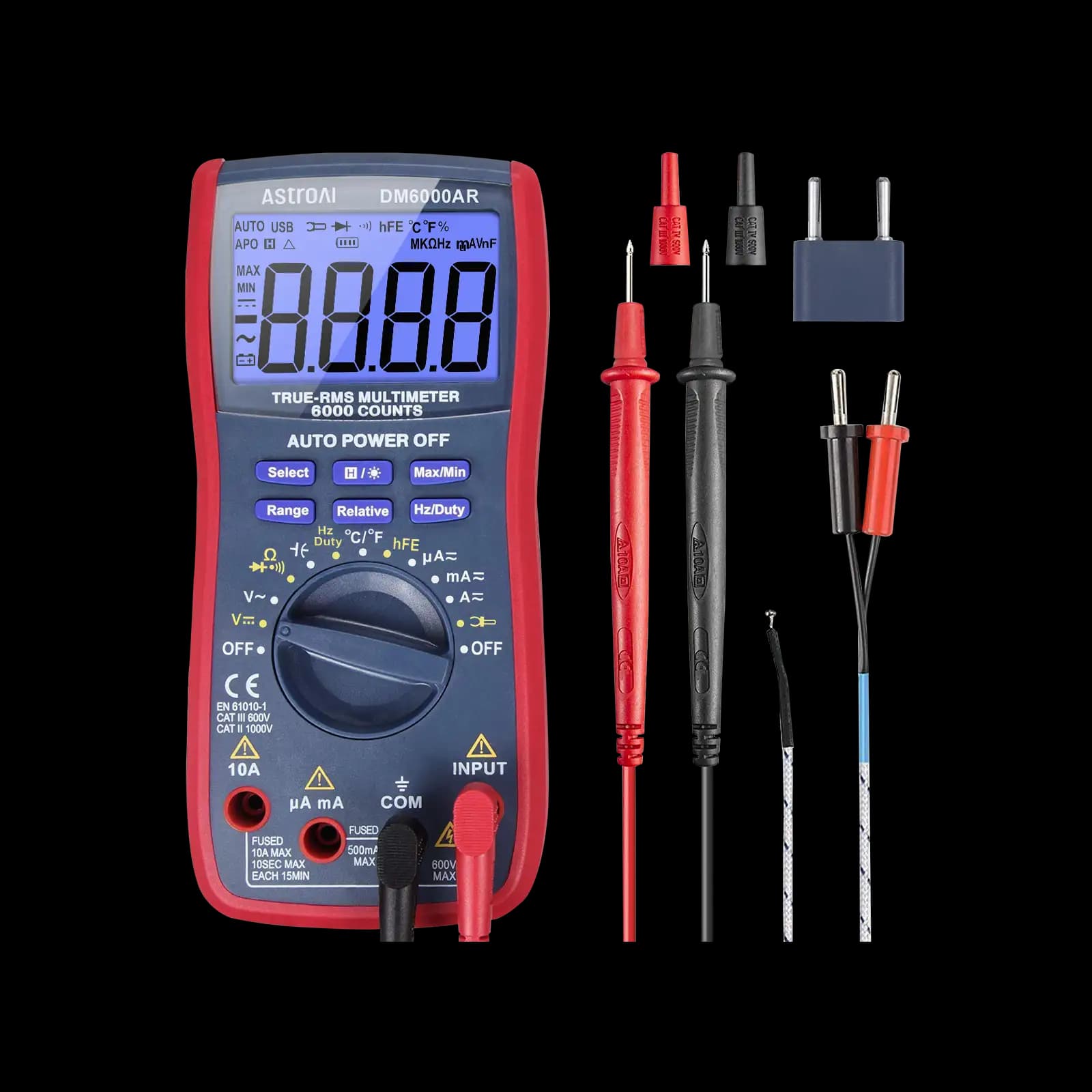
True RMS, 6,000-count, auto-ranging. Aimed at low-voltage microcontroller and electronics projects.
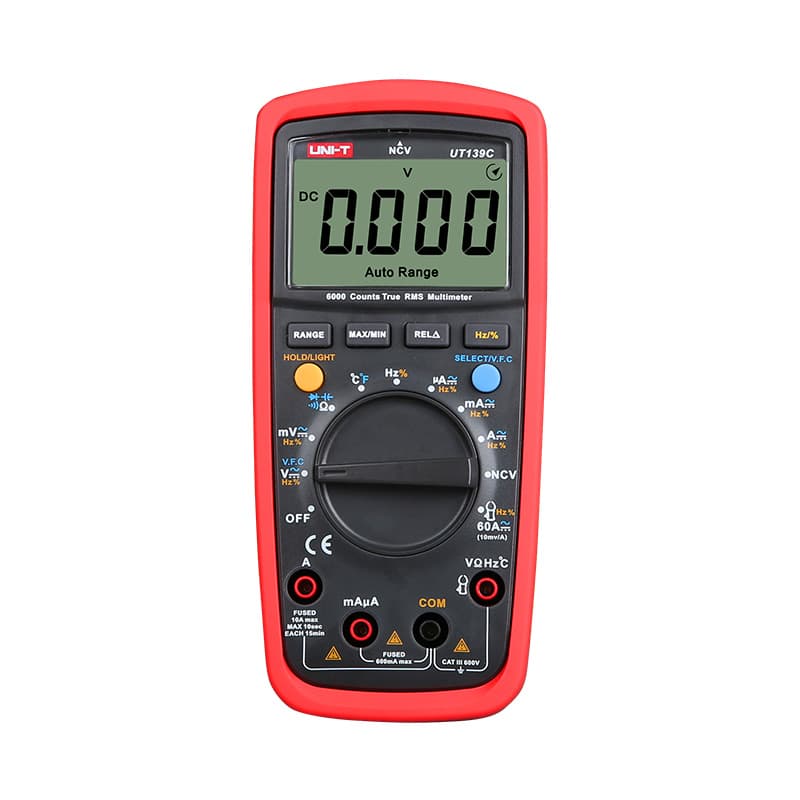
True RMS, 6,000-count, CAT III 600V and auto-ranging, for budget-conscious buyers who still want True RMS.

True RMS, CAT III 1000V / CAT IV 600V. The step-up pick for high-resolution readings and CAT IV protection daily.
As an Amazon Associate I earn from qualifying purchases. Prices and availability are shown on Amazon.
Frequently asked questions
Is a 6,000-count multimeter good enough for electronics repair?
For most bench repair work, yes. A 6,000-count meter shows a 5 V rail to the nearest millivolt on its 6 V range, which is far finer than the tolerance of typical supply rails and resistors. The count only sets resolution, though; check the published accuracy for each range in the manual before trusting the last digit.
Why do two multimeters show different readings on the same circuit?
Each meter is allowed an error band set by its accuracy spec, so two meters can disagree and both be within specification. Differences in range, input impedance, lead resistance, battery condition and whether the meter is True RMS add more spread. If the difference is larger than both accuracy bands combined, one of the meters probably needs checking.
Is a cheap multimeter accurate enough for checking resistors?
Usually, for 5% parts. A budget meter with roughly 1% resistance accuracy can confirm a 5% resistor is in tolerance with margin to spare. For 1% resistors the meter error is about the same size as the part tolerance, so treat a borderline reading as inconclusive and remove the part from the circuit before measuring.
What is the difference between a 3½-digit and a 4½-digit multimeter?
A 3½-digit meter displays up to 1999, about 2,000 counts, while a 4½-digit meter displays up to 19,999. The extra digit gives ten times finer resolution on the same range. It does not automatically mean better accuracy, which is a separate specification listed in the manual for every range and function.
Does a low battery affect multimeter accuracy?
It can. Many meters are only specified to read within their accuracy limits while the battery is above a certain level, which is why they show a low-battery symbol. Once that symbol appears, readings may drift or become unreliable, so replace the battery before taking any measurement you need to trust.


