COMPARISON · MULTIMETERS
Fluke 117 vs Fluke 117/323 Kit
This isn't a comparison between two different meters: the 117/323 kit includes the 117 itself, plus a 323 True RMS clamp meter, an extra set of TL175 test leads, a TPAK magnetic hanger and a carrying case. The real question is whether you'll use the 323's clamp current capability, which reaches 400A AC without opening the circuit, enough to justify the kit's higher price over the 117 on its own.
By the OhmSavvy Research Team ·
Disclosure: OhmSavvy earns a commission from qualifying Amazon purchases made through these links, at no extra cost to you. How we're funded.

Fluke 117
4.8★★★★★The meter working electricians actually buy with their own money, not just the one brands push.
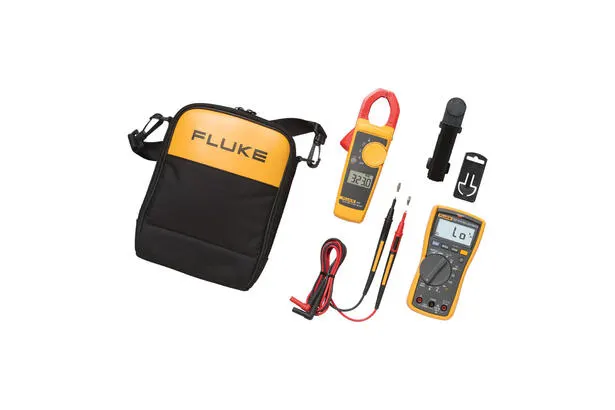
Fluke 117/323 Kit
4.6★★★★★The Fluke 117 and 323 clamp meter bundled together, covering both general multimeter work and clamp current checks in one purchase.
Specs side by side
| Fluke 117 | Fluke 117/323 Kit | |
|---|---|---|
| Rating | 4.8★★★★★ | 4.6★★★★★ |
| Accuracy | True RMS | Fluke 117 multimeter + Fluke 323 clamp meter |
| Safety rating | CAT III 600V | CAT III 600V (both tools) |
| Auto-ranging | Yes | Included soft case |
| Best for | Electricians, serious hobbyists | Electricians who want both tools in one purchase |
| Includes | Fluke 117 with test leads and holster | Fluke 117 + Fluke 323 (with leads and soft case) + TL175 leads + TPAK + carrying case |
| Clamp AC current | No | Yes, 400.0 A AC True RMS (via the 323) |
| Series current (meter in circuit) | 6.000 A and 10.00 A AC/DC; 20 A for 30 s | Same, via the included 117 |
| DC current by clamp | No | No (the 323 reads AC current only) |
| Largest conductor clamped | Not applicable | 30 mm (600 MCM) |
| Safety ratings | 117: CAT III 600V | 117: CAT III 600V; 323: CAT III 600V / CAT IV 300V |
| Weight | 550 g | 550 g (117) + 265 g (323) |
| Warranty | 3 years | 3 years (117); 2 years (323) |
| Carrying case | Not included | Included soft case |
Specs checked against manufacturer documentation and official Amazon listings. Fluke 117 is hands-on tested by OhmSavvy; the Fluke 117/323 Kit assessment is desk research. How we research.
Key differences
- →The kit is the 117 plus a Fluke 323 True RMS clamp meter, TL175 test leads, a TPAK magnetic hanger and a carrying case, not a different or upgraded multimeter.
- →Buying the kit costs more upfront than the 117 alone; whether it beats buying the 117 and a 323 separately depends on the day's prices for all three listings.
- →The 323 adds no-disconnect AC current measurement up to 400A, 40 times the 117's 10A continuous limit.
- →The 323 cannot read DC current, so DC loads above 10A (battery banks, vehicle starters) still need a different tool.
- →If you don't need clamp current measurement, the kit's extra cost buys you a tool you won't use.
Fluke 117 vs 117/323 kit spec by spec
The 117 in the box is identical, so the only specs that differ are the ones the 323 brings. Two numbers sum it up: how much current you can read, and how you have to connect to read it.
Bars use a logarithmic scale: each step is ten times the last.
The clamp is not a second multimeter. Fluke lists the 323 with 600 V AC and DC, resistance on 400 Ω and 4000 Ω ranges, and continuity, but no capacitance, frequency, diode test or DC current. Its AC current accuracy is ±(2% + 5 digits) at 45 to 65 Hz. Treat it as the current tool and the 117 as everything else.
Series meter vs clamp: what changes on the job
To read current with the 117 you switch off, open the circuit, wire the meter into the gap so the load current runs through its fused A input, then power up. That works on a lamp circuit or a small motor, but it's slow and it's capped at 10A continuous. The 323 reads the magnetic field around one conductor, so you close the jaw around a live wire and read the current without disturbing anything.
Clamp one conductor at a time. Around a whole cable the outgoing and returning currents cancel and the display reads near zero, which is the most common clamp-meter mistake. Our guide to measuring AC current with a clamp meter covers line splitters and reading small currents, and the no-break current explainer shows what a multimeter alone can and can't do.
Respect the ratings on each tool
Which should you buy?
| Your situation | Better choice | Why |
|---|---|---|
| You'll read motor, feeder or appliance amps regularly | 117/323 Kit | 400A AC by clamp, no circuit break |
| You only need general multimeter functions | Fluke 117 alone | No reason to pay for a clamp meter you won't use |
| You already own a clamp meter from another brand | Fluke 117 alone | The kit's 323 would be redundant |
| Your current work is mostly DC (solar, vehicles) | Fluke 117 alone | The 323 has no DC current; look at a DC clamp instead |
| You're equipping a toolkit from scratch | 117/323 Kit | Both measurement types and a case in one purchase |
Still deciding if you need a clamp meter at all?
A useful test: think of the last ten electrical jobs you did. If two or more involved finding out how many amps a breaker, motor or appliance was drawing, the kit earns its place. If current only came up when you were checking a fuse or a battery, the 117 alone is the better spend.
Choose the Fluke 117 if…
- ✓You rarely need AC current on live circuits, or loads stay under 10A where series measurement works
- ✓You want the lowest-cost way into the 117's True RMS, VoltAlert and LoZ feature set
- ✓You already own a separate clamp meter, or don't need one
- ✓You'd rather add a clamp later once you know you need it
Choose the Fluke 117/323 Kit if…
- ✓You want both a general multimeter and a clamp meter from day one, without separate purchases
- ✓You regularly read motor, feeder or appliance current above 10A
- ✓You want the included carrying case and TPAK hanger for keeping both tools organized
- ✓You'd otherwise buy a 323 separately within the year
The bottom line
There's no meaningful downside to the 117 itself in either option: the kit simply adds a 323 clamp meter, TL175 leads, a TPAK hanger and a case on top of it. Buy the kit if you have a real, regular need for AC current above 10A or without breaking the circuit. Buy the 117 alone if you don't, rather than paying for a clamp meter you won't use.
Frequently asked questions
Is the Fluke 117 inside the kit a different or lesser version?+
No. Fluke lists the same 117 in the kit, with its own silicone test leads and holster, so its True RMS, VoltAlert, LoZ and 3-year warranty are unchanged. The kit simply bundles the 323 clamp meter and accessories alongside it rather than selling it alone.
Does the kit save money compared to buying both tools separately?+
Often, but not always: street prices for the kit and both tools move independently. Compare the current Amazon price of the kit against the 117 and the 323 listed separately on the day you buy, since a promotion on either can change the answer.
Can I buy just the 323 clamp meter later if I start with the 117 alone?+
Yes. The 323 is sold on its own, so starting with the 117 and adding a 323 later is a sensible path if you're not sure you'll need clamp current. You give up the bundled case and TPAK, but you avoid paying for a tool that might sit unused.
What's the TPAK included in the kit?+
It's Fluke's ToolPak magnetic meter hanger. A strap and magnet let you hang the meter on a steel panel door or enclosure at eye level, leaving both hands free for the probes. It's a small accessory, but it makes panel work noticeably easier and safer.
Can the Fluke 323 measure DC current from a car or solar system?+
No. Fluke lists AC current only for the 323, so it reads nothing useful around a battery cable or solar string. For DC current under 10A you can wire the 117 in series; above that you'd need a clamp meter that specifically lists DC amps.
Related


