HOW-TO GUIDE
Why Does My Car Battery Light Stay On While Driving?
By the OhmSavvy Research Team ·

Working around a running engine and battery
- Most of these checks need the engine running. Keep leads, hands, hair and loose clothing away from the belt, pulleys and the cooling fan, which can start on its own. Set the parking brake and select Park or neutral.
- Never disconnect a battery cable with the engine running to "test" the alternator: the voltage spike can damage electronics.
- A battery can vent explosive hydrogen, especially when overcharged. If it is hot, swollen, smells of rotten eggs or the running voltage is well above specification, switch off and get a mechanic to look at it. If the light comes on with a burning smell or the temperature gauge climbing, pull over safely and call for roadside assistance rather than driving on.
Causes at a glance
| Symptom | Likely cause | How to check | Fix or who to call |
|---|---|---|---|
| Light on with a squeal, or after a belt noise | Slipping, glazed or broken drive belt | Look at the belt with the engine off | Replace the belt or tensioner; a mechanic if it snapped |
| Running voltage stays near resting voltage | No output reaching the battery | DC volts across the posts, engine off then running | Work through fuse, sense feed, cable, then alternator |
| No voltage at the alternator B+ stud | Open output fuse, fusible link or cable | B+ stud to ground, engine off | Replace the link or cable; find why it blew |
| Good voltage at alternator, low at battery | High resistance in the charge cable or grounds | Voltage drop test, loaded | Clean or replace the cable or ground strap |
| Running voltage above about 15 V | Regulator fault or lost sense signal | DC volts at idle and fast idle | Alternator or regulator repair; stop driving far |
| Voltage normal, light still on | Lamp circuit, feedback wiring or a module code | Scan tool, AC ripple check | A shop with a scan tool if codes are module-level |
| Light flickers, dims with load | Failing rectifier diode or worn brushes | AC ripple at the battery, engine running | Rebuild or replace the alternator |
What the battery light actually monitors
The battery-shaped lamp is really a charging-system light. On older systems the lamp sits between the ignition feed and the alternator's excite (or lamp) terminal. When the alternator is not producing, that terminal is near ground, current flows through the bulb and it lights. Once the alternator starts charging, both sides of the bulb sit at about the same voltage and it goes out. Newer vehicles let the engine computer or body module control the lamp based on alternator feedback, battery voltage and sometimes a battery current sensor.
How far can you drive with the light on?
Not far, and it depends on the load. With the alternator out of the picture, the battery is the only supply. As an illustrative worked example, take a 60 Ah battery that starts fully charged and a running load of about 20 A (ignition, fuel pump, fans and modules, before lights or wipers). Lead-acid batteries deliver noticeably less than their rated capacity at that rate, and the engine's systems start misbehaving long before the battery is flat, so treat roughly half the capacity as usable: 30 Ah ÷ 20 A = 1.5 hours at best. Add headlights, blower and wipers and the load can double, halving the time.
In practice that means switching off everything you don't need and driving straight to a safe stop, a parts store or home. If the light came on together with a loud squeal followed by silence, or the temperature gauge starts to rise, the belt may have broken. On many engines the same belt drives the water pump, so stop and switch off before the engine overheats.
1Check the battery at rest
With the engine off for a few hours (or after switching the headlights on for a minute to remove surface charge), measure across the battery posts on DC volts. A fully charged 12 V flooded lead-acid battery commonly rests at about 12.6 V. Commonly cited approximate state-of-charge figures are shown below; AGM and EFB batteries read a little differently, so treat these as a guide. Charge it and test it properly using our guide on testing a car battery with a multimeter, because a failing battery can make the charging system look worse than it is.
The differences are small: a quarter of the battery's charge is only about 0.2 V. That is why a meter that resolves hundredths of a volt matters here, and why a meter that reads 0.2 V high can make a half-charged battery look nearly full.
2Measure voltage with the engine running
Start the engine and measure across the battery posts again. A typical charging system holds roughly 13.5 to 14.7 V, but the correct range varies by vehicle, and many modern cars vary the target deliberately with temperature and load, so check your service manual. Then switch on the headlights, blower and rear defroster and raise the engine speed a little. The voltage should stay within the specified range rather than sinking toward the resting figure.
A reading that barely rises above resting voltage means no charge is reaching the battery. A reading well above the specified maximum points to a regulator fault or a lost sense signal, and can damage the battery and electronics.
3Check the belt, fuse and fusible link
With the engine off, inspect the drive belt for glazing, cracks, contamination and correct tension; a slipping belt can make a squeal on start-up or under load. Next, find the alternator output fuse or fusible link between the B+ terminal and the battery, and the smaller fuse for the ignition or excite circuit. With the engine off, measure from the alternator B+ stud to ground: you should see battery voltage. If the battery has voltage but the B+ stud does not, the link or cable between them is open. A blown output fuse rarely fails on its own; a shorted alternator diode or a crossed jump-start are common reasons, so find the cause before replacing it.
4Check the sense wire, grounds and charge cable
Unplug the alternator's small connector and, with the key on, measure the ignition or sense terminal to ground; the expected reading depends on the system, so follow the wiring diagram. A missing feed means the regulator never switches on. On computer-controlled alternators, the control and feedback wires are best checked with the procedure in the manual.
Then load the system and run a voltage drop test from the alternator B+ terminal to the battery positive, and from the alternator case to the battery negative. Commonly used limits are a few tenths of a volt on each path: many technicians look for less than about 0.2 to 0.5 V on the positive side and less than about 0.2 V on the ground side, but your manual may set its own.
Ohm's law shows why small resistances matter. An alternator delivering 100 A through a charge cable and terminals that add up to 0.004 Ω drops 100 × 0.004 = 0.4 V before the battery sees anything. If the alternator regulates to 14.2 V at its own terminal, the battery gets about 13.8 V. Double the resistance with a corroded ring terminal and the battery sees 13.4 V, which on many cars is not enough to recharge it fully.
01
Rest voltage
~12.6 V means a charged battery
02
Running voltage
Rises to spec? Then output is arriving
03
B+ to battery
Fuse, link and cable drop
04
Case to battery −
Ground path drop
05
Ripple and codes
Diodes, feedback, module
5Check for AC ripple
An alternator makes three-phase AC and rectifies it with diodes. When a diode fails, output drops and the DC at the battery carries extra ripple, which some modules flag as a charging fault even when the average voltage looks normal. With the engine running and loads on, switch the meter to AC volts and measure across the battery posts. Commonly quoted limits sit somewhere between about 0.1 and 0.5 V AC depending on the source; a reading well above that points to the rectifier. See how to check a car alternator diode for the follow-up test, and our alternator test guide for a full output check.
Matching readings to likely causes
| What you measured | Likely area to check next |
|---|---|
| Running voltage close to resting voltage | Belt, output fuse or link, excite/sense feed, or the alternator |
| Battery voltage absent at the B+ stud | Open fusible link, fuse or charge cable |
| Running voltage above the specified range | Regulator or a lost sense signal |
| Good voltage at alternator, low at battery | High resistance in the charge cable or grounds |
| High AC ripple at the battery | Failed rectifier diode in the alternator |
| Voltage normal, light still on | Lamp circuit, module feedback wiring or stored codes |
Read the voltage before you buy parts
Meters for this job
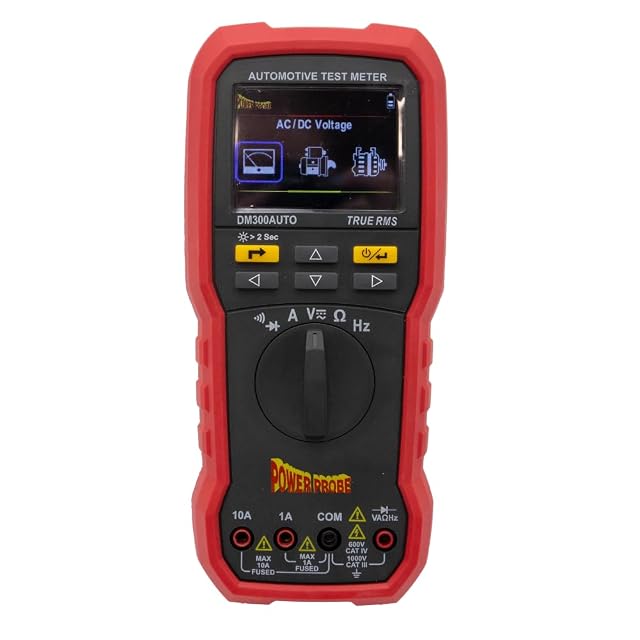
A meter that resolves 0.01 V on DC and has an AC volts range covers every test above. These picks from our verified car battery testing list add guided tests or fast capture for charging problems.
Meters for charging-system checks
True RMS, CAT III 600V and a 6,000-count backlit display, with frequency and capacitance. Hands-on Tested.
Guided cranking-voltage and normal or smart alternator tests for 12 V and 24 V systems, with on-screen pass/fail. Voltage accuracy ±(2% + 3).

Min/Max/Average with a 250 µs Peak Min/Max and ±(0.1% + 1) DC accuracy. Average-responding, not True RMS.
As an Amazon Associate I earn from qualifying purchases. Prices and availability are shown on Amazon.
Frequently asked questions
Can I keep driving with the battery light on?
Only as far as it takes to get somewhere safe. With the alternator not charging, everything runs from the battery, and once it drops too low the ignition, fuel pump and electric power steering can cut out. If the light came on with a squeal or a rising temperature gauge, the belt may have failed, which can also stop the water pump on many engines.
Why does the battery light flicker at idle and go out when I rev?
That pattern often means output is marginal at low speed: a slipping belt, worn brushes in the regulator, or a high-resistance connection that only matters at low engine speed. Measure battery voltage at idle with the headlights and blower on, then at a fast idle, and compare the two readings with your service manual range.
Can a bad battery turn on the charging light?
Indirectly. A battery with a shorted cell or very high internal resistance can drag system voltage down or upset the regulator, and some vehicles monitor battery condition through a current sensor. Test the battery on its own first, so you don't replace an alternator that was never at fault, and charge it fully before judging the charging system.
Why is the battery light on but the voltage reads normal?
On many cars the light is driven by a module that also watches alternator feedback signals, not just battery voltage. A fault in the lamp circuit, the alternator's field or feedback wiring, or a stored module code can light it with normal voltage. A scan tool reading of charging-system codes is the next step, followed by an AC ripple check.
Will a new battery fix the battery light?
Rarely. The light reports a charging problem, and a new battery only hides it until the new one runs down too. Fit a new battery only if the old one fails a proper test after charging. Otherwise measure running voltage first: if it stays near resting voltage with the engine running, the fault is in the belt, fuses, wiring or alternator.
What voltage means the alternator is bad?
As a rule of thumb, running voltage that stays at or near resting voltage, roughly 12.6 V or lower, means nothing is charging, and a reading well above about 15 V suggests a regulator fault. Neither proves the alternator itself has failed: rule out the belt, output fuse, sense feed and cable voltage drop first, and check your vehicle's specified range.
Where to go next
How to Test an Alternator with a Multimeter →
A full output test once you have narrowed the fault to the alternator.
How to Check a Car Alternator Diode →
If the output looks low or ripply, test the rectifier diodes next.
How to Test a Car Battery with a Multimeter →
Rule the battery in or out before blaming the alternator.


