HOW-TO GUIDE
Why Does My Car Have a No-Crank Problem Even With a New Battery?
By the OhmSavvy Research Team ·

Safety when testing a starting circuit
- The starter circuit carries very high current. Keep tools and jewelry away from the battery positive terminal and the starter's main stud; a ring or wrench across them can burn through to the bone.
- Lead-acid batteries can give off hydrogen. Keep flames and sparks away, connect and disconnect clamps with everything switched off, and wear eye protection.
- Set the parking brake and keep the transmission in Park or neutral. If you bridge any starter terminals, the engine can turn over, so stay clear of the belts and fan.
- Leave the red lead in the V jack. Never use the current jacks on a starter circuit.
- Hybrids and many newer cars have high-voltage systems and push-button start logic. If yours is a hybrid or the wiring diagram is beyond you, call a mechanic or roadside assistance.
No-crank is not the same as no-start
No-crank means the engine does not rotate at all when you turn the key: you hear silence, a click, or rapid clicking. No-start means the engine turns over normally but does not fire, which is a fuel, spark or immobilizer question. Everything below applies to the first case, where the starting circuit itself is not delivering enough current to the starter motor. This page focuses on what a battery swap can disturb; for a deeper look at a clicking starter, see why a starter clicks but the engine won't start, and if the battery reads fine but the car still won't go, see a battery that reads 12 volts but won't start.
Causes at a glance
| Symptom | Likely cause | How to check | Fix or who to call |
|---|---|---|---|
| Nothing at all, dash dark | Clamp not tight, blown main fuse or fusible link | Volts from battery post to clamp; volts across main fuses | Tighten the clamp; replace the fuse and find why it blew |
| Dash lights dim to nothing when you turn the key | Battery flat, or a bad clamp contact | Resting volts, then volts while cranking at the posts and clamps | Charge the battery; clean and tighten the clamps |
| Single heavy click, no crank | Cable or ground voltage drop, burnt solenoid contacts | Voltage drop on each side while cranking | Repair the cable or ground; replace the starter |
| Rapid clicking | Battery or connection cannot hold voltage under load | Volts at the starter main stud while cranking | Charge or replace the battery; clean connections |
| No click, dash normal | Starter relay, neutral or clutch switch, start signal | Volts at the relay coil and at the S terminal in start | Swap the relay, adjust or replace the switch |
| No click, security light flashing | Immobilizer not recognizing the key | Spare key; scan tool for security codes | Dealer or auto locksmith |
| Full voltage at S and main stud, no crank | Failed starter motor | Rule out the ground side first | Replace or rebuild the starter (mechanic if access is hard) |
What changed when the battery went in
A no-crank that appears right after a battery swap almost always traces back to the swap itself, or to a fault that was there all along and was blamed on the old battery. Before testing the whole circuit, go over the things a battery change can disturb:
- Clamps that look tight but aren't. A clamp that turns on the post by hand can light the dash, which only draws a few amps, but cannot pass starter current. Different post sizes, a stretched clamp or a shim left out make this common.
- A ground strap knocked loose. Battery trays sit near the engine-to-body and body-to-battery grounds. One bolt disturbed during the swap can open the ground side.
- A blown main fuse or fusible link. A wrench bridging the positive post to the body, or clamps reversed for a moment, can open the main fuse. The battery reads normal but the car is dead.
- A battery that was never charged. Batteries sit on shelves and self-discharge. One fitted at 12.2 V and then cranked repeatedly may be flat within minutes.
- The original fault. If the old battery was replaced because the car would not crank, the real cause may be a starter, cable or relay that is still there.
The diagnostic order
Work from the battery outward. Each check is quick, and the order puts the most common and cheapest faults first.
01
Battery
Resting volts and volts while cranking
02
Cables
Clamps, positive and ground voltage drop
03
Control
Relay, neutral or clutch switch, start signal
04
Starter
S-terminal volts, then the motor itself
1Confirm the battery's state of charge
New does not mean charged. Measure across the posts with everything off, ideally after the battery has rested for an hour or more. The table gives the approximate resting voltages for a 12 V flooded lead-acid battery at room temperature; AGM batteries sit slightly higher, so check the maker's chart for yours.
| Resting voltage (approx.) | State of charge (approx.) | What to do |
|---|---|---|
| 12.6 V or more | Fully charged | Battery is not the obvious cause; move on |
| About 12.4 V | About 75% | Should crank; charge it anyway |
| About 12.2 V | About 50% | May only click; charge before testing further |
| About 12.0 V | About 25% | Charge fully, then retest |
| 11.9 V or less | Discharged | Charge; if it won't hold charge, return the battery |
Then watch the meter while a helper turns the key. If voltage collapses far below the commonly used 9.6 V guideline, charge and load-test the battery as described in how to test a car battery and testing a 12 V battery under load. If it barely moves from resting voltage, very little current is flowing, so the problem lies further along. The chart compares illustrative cranking readings for the common cases.
2Check terminals and cable voltage drop
A fresh battery is often fitted onto old clamps. Corrosion between post and clamp, or under the insulation of the cable, adds resistance that only shows up when the starter tries to draw heavy current. Clean both clamps to bright metal and tighten them, then test each side of the circuit while cranking. A quick first check: put one probe on the battery post and the other on its own clamp while cranking. Any reading above a few tenths of a volt means that joint is bad.
Commonly used guidelines are about 0.5 V or less on the positive side and about 0.2–0.3 V or less on the ground side; your service manual may give its own limits. The numbers explain why such small readings matter. Suppose the starter draws 150 A, an illustrative figure for a small engine. A 0.5 V drop at 150 A is a resistance of 0.5 ÷ 150 ≈ 0.0033 Ω, about 3 milliohms. A corroded clamp adding just 10 milliohms more drops another 150 × 0.010 = 1.5 V and turns 150² × 0.010 = 225 W into heat at the post. That is enough to stop a starter, yet the same clamp passes the 2 or 3 amps the dash lights need with almost no loss, which is why the lights come on and the engine doesn't turn.
The full procedure, including how to split a cable into sections to find the exact bad joint, is in our guide on checking voltage drop on a car, and testing a car ground wire covers the straps between engine, body and battery.
3Check the starter relay and safety switches
Most cars route the start signal through a starter relay in the underhood fuse box. Swapping it with an identical relay is a fast check, and our guide on testing an automotive relay covers bench testing. In the socket, the relay's coil should receive voltage when the key is turned to start, and the contact-side feed terminal should have battery voltage all the time.
No signal at the relay coil points upstream. An automatic transmission has a neutral safety or range switch that only allows cranking in Park or neutral; a manual usually has a clutch pedal switch. Try starting in neutral, or with the pedal pressed firmly to the floor. The ignition switch itself, or a push-button start module, is the next link back. Many newer cars send the start request through the body or engine computer, so a wiring diagram for your vehicle is essential at this stage, and a dealer or auto electrician is the right call if the start request is handled by a module you can't test.
4Measure the signal at the solenoid S terminal
The starter solenoid has a small terminal, often marked S, that receives the start signal, and a large stud that carries battery current to the motor. Back-probe the S terminal with the black lead on the engine block, and have a helper hold the key in start for a moment.
The reading that splits the circuit
5Check the starter motor, fusible links and immobilizer
If S has voltage, the main stud has battery voltage while cranking and both voltage drops are within limits, the starter itself is the most likely fault: worn brushes, burnt solenoid contacts or a seized armature. Fusible links or a main fuse between the battery and the rest of the car can also open; when one fails, the dash may stay dark while the battery posts read normally. Check across them with DC volts the same way as an ordinary fuse: battery voltage on both sides to ground means it is intact, voltage on one side only means it is open. Our guide to power on one side of a car fuse explains that reading.
Finally, some anti-theft immobilizers block the starter circuit when they do not recognize the key, and a few vehicles need a security or idle relearn after the battery has been disconnected. That needs a scan tool or the owner's manual procedure, so rule out the electrical path above before suspecting it. Starter replacement on many engines means working under the car near the exhaust; if you can't support the car safely on stands, leave it to a mechanic.
Summary of readings
| Measurement | Points to |
|---|---|
| Battery well below 12.4 V at rest | Charge the battery and retest |
| Battery collapses very low while cranking | Battery or a shorted starter |
| Voltage between post and its own clamp while cranking | That clamp: clean and tighten |
| High voltage drop on positive or ground side | Clamp, cable or ground strap |
| Battery voltage on one side of the main fuse only | Blown main fuse or fusible link |
| No voltage at relay coil in start | Safety switch, ignition switch or start request |
| No voltage at S terminal | Relay contacts or wire to starter |
| Voltage at S and main stud, no crank | Starter motor or solenoid |
Meters for this job
Every reading on this page is DC volts, so any working meter will do. A meter that records the lowest voltage during a crank saves you from watching the display and turning the key at the same time. These picks come from our verified battery-testing research.
Meters that capture what happens during a crank
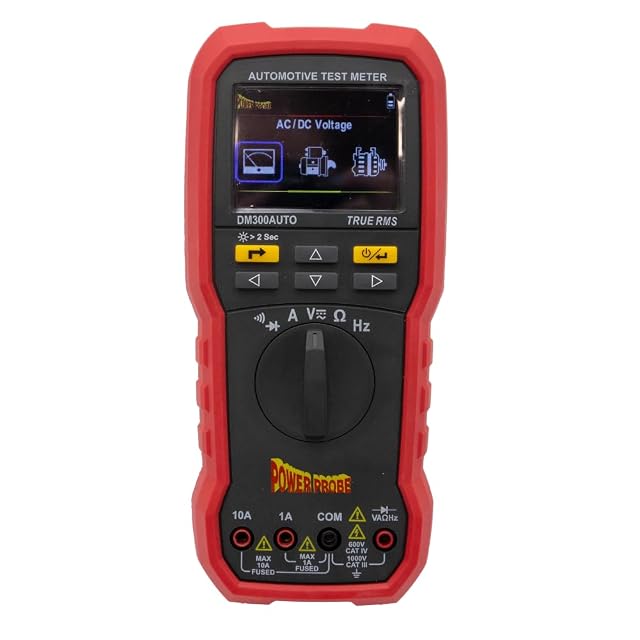
Guided cranking-voltage and alternator tests with on-screen pass/fail, True RMS, CAT IV 600V. Voltage accuracy is ±(2% + 3).

Min/Max/Average recording with a 250 µs Peak Min/Max to catch the lowest cranking dip; ±(0.1% + 1) DC.

Simple auto-ranging meter with a green/yellow/red battery-load LED test. Marked CAT I only, so keep it on the car.
As an Amazon Associate I earn from qualifying purchases. Prices and availability are shown on Amazon.
Frequently asked questions
Can a new battery be the cause of a no-crank?
It can. A new battery may not have been fully charged when fitted, may have been run down during repeated attempts to start, or can occasionally be faulty from the start. Measuring its resting voltage, then its voltage while someone tries to crank, rules it in or out in a minute. Around 12.6 V at rest and above about 9.6 V while cranking points elsewhere.
Why do I hear a single click but the engine does not turn?
A single click usually means the starter solenoid is receiving its control signal and trying to close, but not enough current is reaching the motor. Common causes are a voltage drop in the main cables or grounds, burnt solenoid contacts, or a starter motor that has failed. A voltage drop test while cranking separates the cables from the starter in a few minutes.
Can the immobilizer stop the engine cranking?
On some vehicles, yes. If the anti-theft system does not recognize the key, it may block the starter circuit, while on others it allows cranking but stops the engine from running. A flashing security light on the dash is a clue. Some cars also need a relearn after battery power is lost. Diagnosis needs a scan tool or dealer procedure, not a multimeter.
Does tapping the starter prove it is faulty?
If the engine cranks after a light tap on the starter body, the brushes or solenoid contacts are likely worn and sticking, which points to a starter that needs repair or replacement. It is a clue, not a test, so confirm that the starter is receiving full voltage at its main stud and S terminal and has a good ground before condemning it.
What should battery voltage drop to while cranking?
A commonly quoted rule of thumb is that a healthy battery stays above about 9.6 V while cranking at normal temperature. If voltage stays near 12.6 V and nothing turns, current is not flowing at all, which points to the control side, an open cable or the starter rather than the battery. A collapse far below 9.6 V points to the battery or a shorted starter.
Could I have blown a fuse when I changed the battery?
Yes. If a wrench touched the positive post and the body at the same time, or the clamps went on the wrong posts even briefly, the main fuse or a fusible link can open. The battery then reads normal but the dash stays dark or the starter gets nothing. Check the main fuses with a meter from each side to ground, and if polarity was reversed have the charging system checked too.
Where to go next
How to Check Voltage Drop on a Car →
The full method for testing cables and grounds under cranking load.
How to Test an Automotive Relay →
Bench-test the starter relay's coil and contacts.
Why Does My Car Starter Click but the Engine Won't Start? →
Compare cranking voltage at the battery with voltage at the starter terminal.


