HOW-TO GUIDE
How to Test a 12V Battery Under Load: Multimeter vs. Battery Tester
By the OhmSavvy Research Team ·
Keep clear while cranking, and never load-test a damaged battery
- Keep hands, tools, and loose jewelry away from the battery terminals and engine moving parts while cranking.
- Don't load-test a battery that's cracked, leaking, swollen, or visibly damaged — have it replaced instead.
- A battery can release explosive hydrogen gas; avoid sparks near the terminals.
1Why resting voltage isn't enough
Resting voltage reflects state of charge, which is only part of the picture. A battery with internal plate damage or sulfation can still show a reasonable resting voltage because it's measured with essentially no current flowing, then collapse the instant it's asked to supply the hundreds of amps a starter demands. That collapse is exactly what a load test is designed to reveal.
2Load-test with a multimeter: cranking voltage
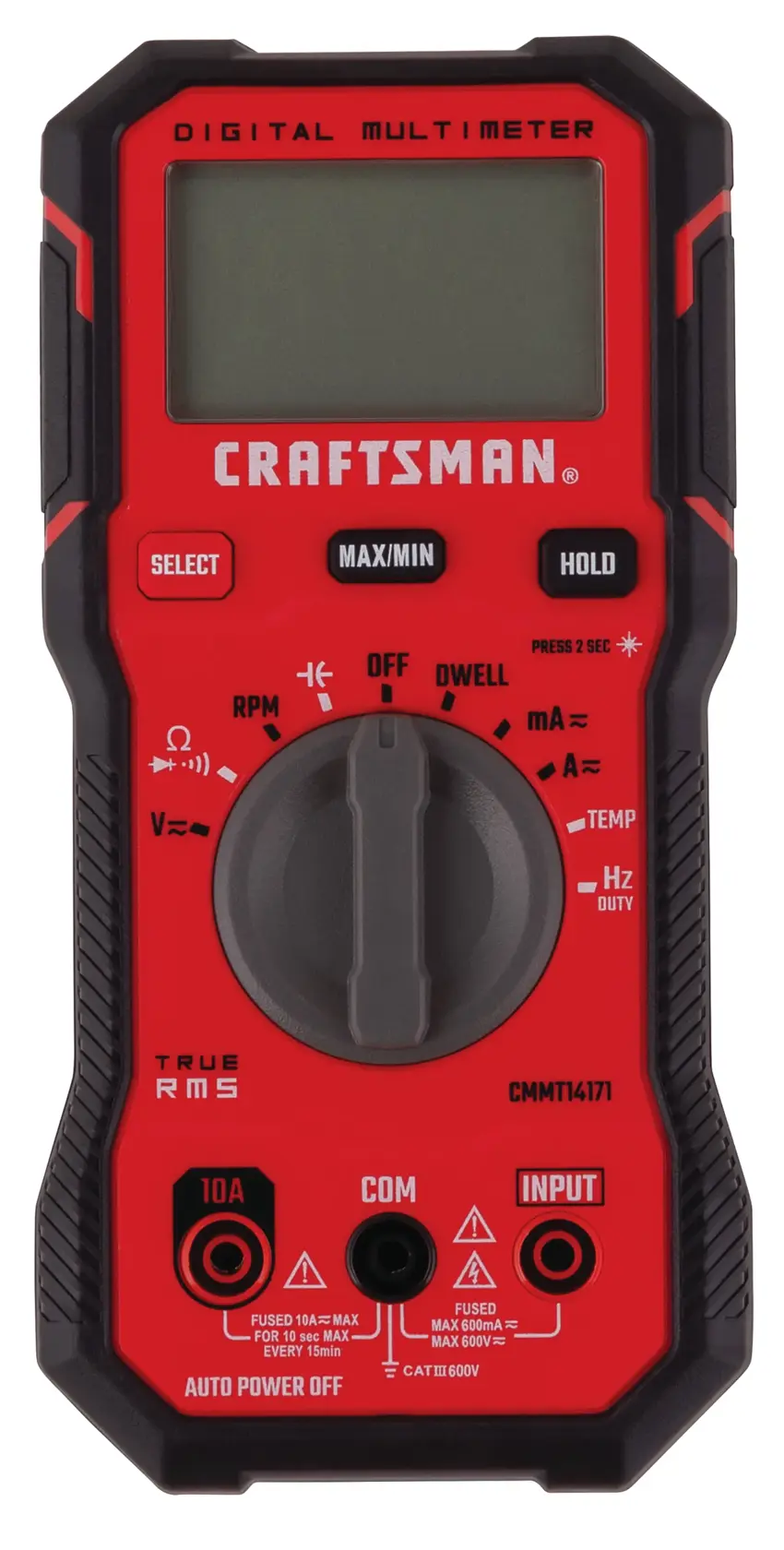
Connect the meter across the battery terminals, set to DC volts, and have someone crank the engine while you watch (or capture with min/max) the lowest voltage reached during cranking. This uses the starter itself as the load, so no extra equipment is needed — see the full steps in how to test a car battery with a multimeter.
| Cranking voltage (12V battery, ~70°F / 21°C) | Interpretation |
|---|---|
| Stays above about 9.6 V | Passes — adequate cranking capacity at this temperature |
| Drops below 9.6 V but engine still starts | Marginal — consider a dedicated load test to confirm |
| Drops well below 9.6 V, slow or failed crank | Fails — battery likely needs replacing |
Two details in that picture change how you read the meter. First, the opening dip lasts only a fraction of a second, so a meter's min/max mode often records it as the minimum even on a good battery; judge the battery on the voltage it holds while the engine is turning over, not on that first spike alone. Second, the weak battery keeps sliding downward the longer it cranks, which is why a shop carbon-pile test holds its load for a fixed period rather than taking an instant reading. A commonly used carbon-pile procedure applies a load of about half the battery's CCA rating for 15 seconds: on a 600 CCA battery that's 300 A, and a healthy battery at around 70°F should stay at or above the same 9.6 V line for the full 15 seconds. In cold weather the pass line is set lower, so check the tester's temperature table before failing a battery on a cold morning.
3Dedicated battery or conductance testers
A carbon-pile load tester applies a known, heavy electrical load (often set relative to the battery's rated capacity) for a fixed time and reads the voltage under that load. A conductance tester instead sends a small AC signal through the battery and estimates its health electronically, without drawing a heavy current — faster and more convenient, widely used in shops, and generally considered accurate enough for routine pass/fail diagnosis.
Comparing the two methods
Multimeter cranking test
No extra tools beyond what you already own; uses the real starter as the load; needs a helper to crank while you read the meter.
Carbon-pile load tester
Applies a known, controlled load matched to the battery's rating; the traditional shop-standard test, but a dedicated tool you may not own.
Conductance tester
Fast, doesn't discharge the battery, widely used in shops; estimates health electronically rather than measuring real load capacity directly.
Use whichever test you can do correctly
Which meter to use
Any meter with DC volts and, ideally, min/max capture works for the cranking-voltage method. See the full best multimeter for automotive picks.
Meters in our reviews
Built for automotive battery and charging-system testing.

Fast enough response to catch a cranking voltage dip accurately.
As an Amazon Associate I earn from qualifying purchases. Prices and availability are shown on Amazon.
Frequently asked questions
What resting voltage should a healthy 12V battery show?
A fully charged, resting 12V lead-acid battery typically reads about 12.6-12.8 V after sitting for a few hours with no load or charge applied. Readings around 12.4 V suggest a partial charge, and anything near or below 12.0 V suggests a significantly discharged battery — but none of these numbers alone confirm the battery can hold up under cranking load.
Can a battery pass a cranking-voltage test but still be weak?
A single successful cold start doesn't guarantee long-term health, especially in mild weather where even a weakening battery can usually still crank the engine. A dedicated load or conductance tester gives a more complete picture of the battery's actual capacity, which is why shops typically use one rather than relying only on a cranking-voltage check.
Is a conductance tester as accurate as a true load tester?
Modern conductance testers are widely used and generally reliable for a quick pass/fail/marginal reading, especially the professional-grade ones used in shops. A true carbon-pile load tester, which draws real current for a set time, remains the more direct test of actual load capacity, but conductance testers are faster, don't discharge the battery, and are accurate enough for most routine diagnosis.
Why does cold weather matter for battery testing?
Cold reduces a battery's ability to deliver current and increases the current an engine needs to crank, so a marginal battery that starts the car fine in summer can fail in winter. Cranking amps ratings (like CCA) are specifically about cold-weather starting capability for this reason — test and compare against the battery's rated CCA when cold-weather performance is the concern.
Can I load-test a battery that's still installed in the car?
Yes, for the multimeter cranking-voltage method — that's exactly how it's done, with the battery connected and the starter doing the loading. A dedicated load or conductance tester can usually also test an installed battery, though very low charge can affect a load tester's reading; charge the battery first if it's significantly discharged, then retest.


