HOW-TO GUIDE
How to Find a Broken Wire With a Multimeter: Continuity vs. Voltage Drop
By the OhmSavvy Research Team ·

De-energize for continuity, energize for voltage drop
- Never use the resistance/continuity function on a live circuit — it can give a false reading and risks damaging the meter.
- For a voltage-drop test, keep hands and probes clear of moving parts if the load involves a motor or fan.
- Set the meter to DC millivolts or a low DC volts range for voltage-drop testing; a coarse range can hide a small but real drop.
1The continuity test
With the circuit de-energized and disconnected at both ends (or at least the load disconnected), set the meter to continuity and touch a probe to each end of the wire. A beep and a low resistance reading mean the wire is intact end to end; no beep and an open (OL) reading mean it's broken somewhere along its length.
2The voltage-drop test
With the circuit switched on and doing its normal job, set the meter to DC volts (millivolts if available) and measure across each connector or splice along the wire's length, one at a time.
Read the diagram as a series circuit. The battery's 12 V is shared between everything in the loop, so the voltage that appears across the damaged connector is voltage the lamp no longer gets. In this illustrative case, 1.8 V lost at the joint leaves roughly 10.2 V for the lamp, which is why it glows dim instead of going fully dark. The same joint would beep on a continuity test, because the meter's tiny test current passes through a few strands without any measurable loss.
3When to use which test
| Situation | Better test |
|---|---|
| Suspected complete open, circuit can be de-energized | Continuity — faster, no load needed |
| Symptom only shows under real operating load | Voltage drop — catches partial/marginal connections |
| Circuit can't be safely de-energized | Voltage drop, done carefully |
| Long harness, quick first pass needed | Continuity first, voltage drop if that passes but the fault persists |
4Narrowing down the location
Whichever test applies, work from a midpoint connector outward rather than testing every inch of wire from one end. Once you've confirmed which half of the run contains the fault, repeat at the midpoint of that half, continuing to divide the remaining distance until you've isolated the exact section.
A break often hides right at a connector or bend
Which meter to use
A meter with continuity beep and a DC millivolt range covers both tests. See the full best multimeters roundup.
Meters in our reviews
Continuity beep plus fine-resolution DC volts for voltage-drop work.
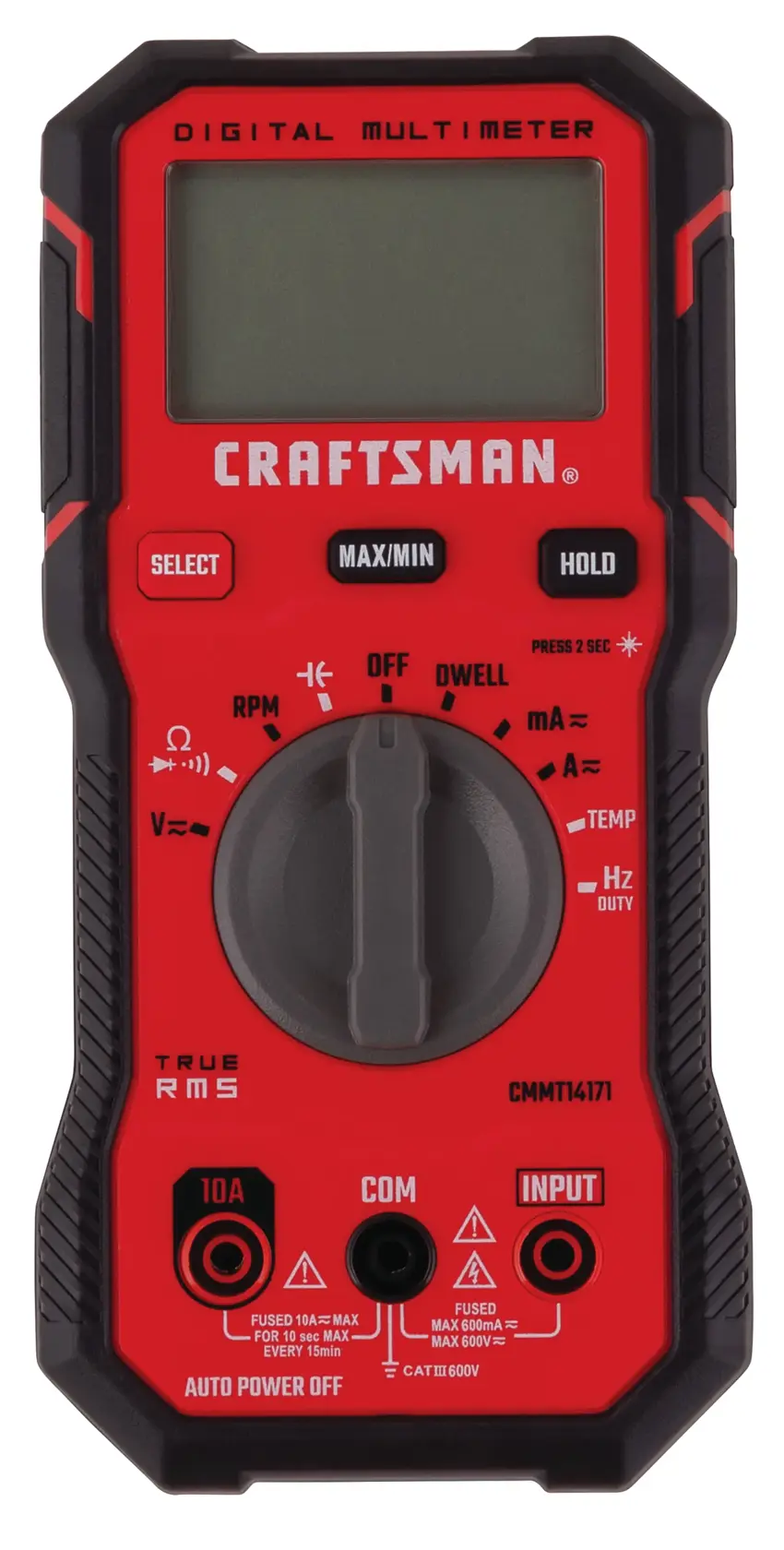
A budget-friendly option built for this kind of automotive harness chasing.
As an Amazon Associate I earn from qualifying purchases. Prices and availability are shown on Amazon.
Frequently asked questions
Why would a wire pass a continuity test but still cause problems?
A continuity tester's current is tiny, often just a few milliamps, so even a few strands of a partially broken wire can pass it easily. The same connection can still produce a significant voltage drop, and real heat, once the circuit's actual operating current — which can be many times larger — tries to pass through it.
Can I do a voltage-drop test on a wire with no load connected?
No — voltage drop only appears when current is actually flowing, so the circuit needs to be switched on and doing its normal job (a light actually lit, a motor actually running) during the test. With no load, you'll read 0 V across a damaged wire exactly the same as a perfect one.
Is continuity testing ever the better choice?
Yes — for a wire you can safely de-energize and where you suspect a complete open rather than a partial one, continuity testing is faster and doesn't require operating the circuit at all. Use it as the quick first check, and move to voltage drop if continuity passes but the symptom persists.
How do I find exactly where along a wire it's broken?
Test continuity or voltage drop (whichever applies) at a midpoint connector or splice first, then repeat on whichever half still shows the fault, halving the search distance each round rather than checking every point individually from one end.
Can moisture cause a wire to test fine when dry but fail when wet?
Yes, particularly at a connector or splice with corrosion that only becomes conductive-through-corrosion-products when damp, or a break that's intermittently bridged by moisture. If the fault only shows up in wet conditions, test with the connector wet, or at least suspect this specifically and inspect for moisture ingress.


