COMPARISON · MULTIMETERS
Fluke 117 vs AstroAI DM6000AR: Professional Meter or Budget Alternative?
Fluke 117 vs AstroAI DM6000AR splits cleanly by where you work. If any of your measurements are on building wiring, buy the Fluke 117: it's rated CAT III 600V and adds the LoZ mode, AutoVolt and VoltAlert that electricians rely on, and we bought and tested one on our own bench. If your work stays on low-voltage benches, cars and battery packs, the DM6000AR costs roughly a sixth as much on Amazon at our last check and adds temperature, duty cycle and a fused 400 mA input the 117 lacks. AstroAI states no CAT rating at all, and that one gap decides most purchases.
By the OhmSavvy Research Team ·
Disclosure: OhmSavvy earns a commission from qualifying Amazon purchases made through these links, at no extra cost to you. How we're funded.

Fluke 117
4.8★★★★★The meter working electricians actually buy with their own money, not just the one brands push.
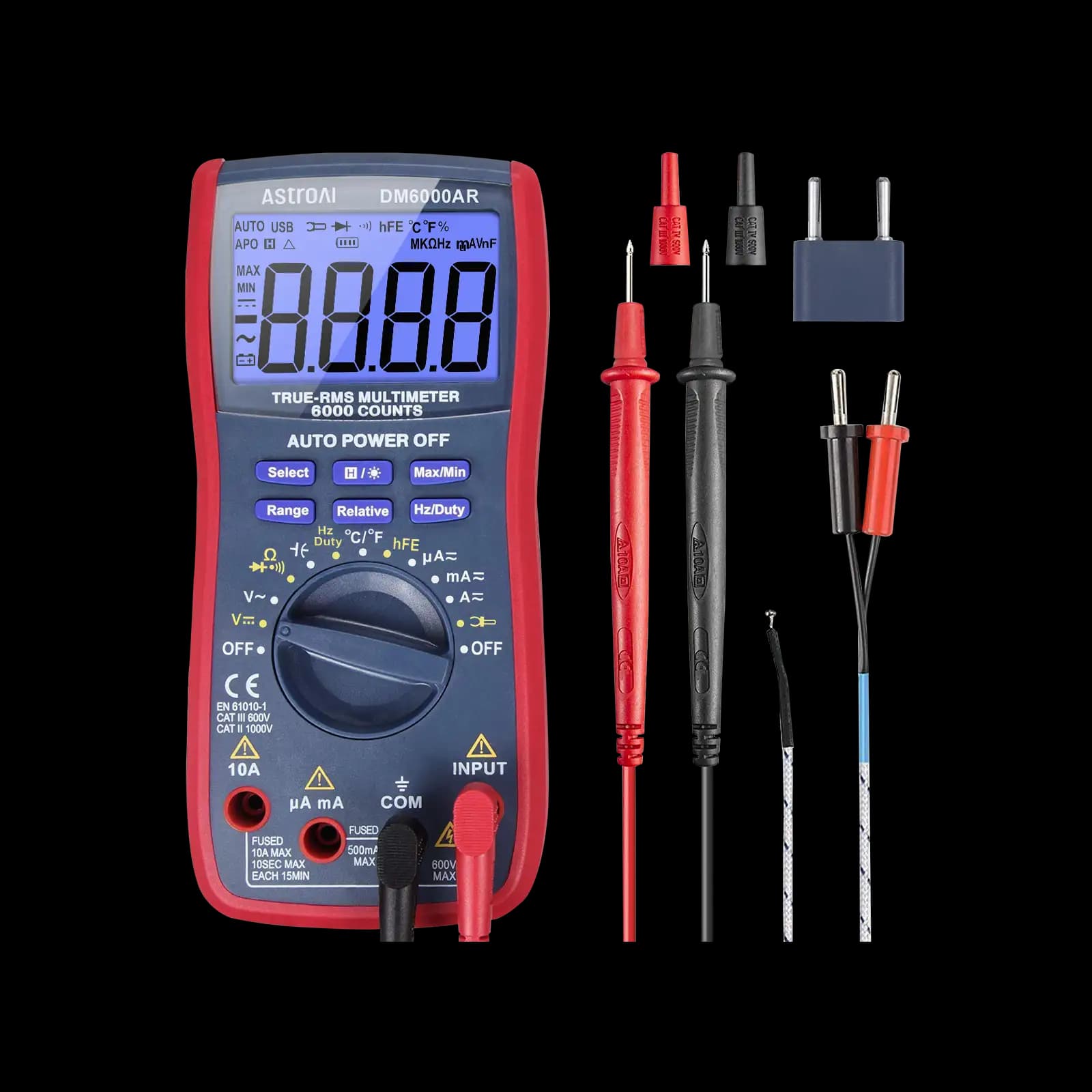
AstroAI DM6000AR
4.3★★★★☆The go-to recommendation for Arduino and Raspberry Pi tinkering — cheap enough not to worry about.
Specs side by side
| Fluke 117 | AstroAI DM6000AR | |
|---|---|---|
| Rating | 4.8★★★★★ | 4.3★★★★☆ |
| Accuracy | True RMS | True RMS, 6,000-count |
| Safety rating | CAT III 600V | Not stated by AstroAI |
| Auto-ranging | Yes | Yes |
| Best for | Electricians, serious hobbyists | Microcontroller & electronics projects |
| Display | 6,000 counts + 33-segment bar graph | 6,000 counts |
| Max voltage | 600V AC/DC | 750V AC / 1000V DC (AstroAI table), with no CAT rating |
| AC volts accuracy | ±(1.0% + 3), 45 to 500 Hz | Not stated |
| Current | 6 A and 10 A, AC and DC (1 mA best resolution) | AC and DC; ranges not stated; fused at 400 mA and 10 A |
| Low impedance (LoZ) | Yes, AutoVolt | No (per AstroAI's table) |
| Non-contact voltage | VoltAlert | No (per AstroAI's table) |
| Temperature | No | Yes; range not stated |
| Frequency / duty cycle | To 50 kHz (Fluke's manual says 99.99 kHz); no duty cycle | Both listed; ranges not stated |
| Capacitance | Up to 9,999 µF | Yes; range not stated |
| Ranging | Auto | Auto and manual |
| Size / weight | 167 × 84 × 46 mm, 550 g | Not stated for the meter alone |
| Battery | One 9V, about 400 hours | Not stated |
| Warranty | 3 years | Term not stated |
Specs checked against manufacturer documentation and official Amazon listings. Fluke 117 is hands-on tested by OhmSavvy; the AstroAI DM6000AR assessment is desk research. How we research.
Key differences
- →Safety rating: the Fluke 117 is CAT III 600V; AstroAI states no CAT rating for the DM6000AR on its site or its Amazon listing, even though its table lists 1000V DC.
- →Electrician features: the 117 has LoZ mode, AutoVolt automatic AC/DC selection and VoltAlert non-contact detection; AstroAI's own table marks NCV and LoZ as absent on the DM6000AR.
- →Bench features: the DM6000AR reads temperature and duty cycle and has manual ranging; the 117 lists none of the first two.
- →Small currents: the DM6000AR has a separate input fused at 400 mA; the 117's current function starts at its 6 A range, with 1 mA as its finest step.
- →Published accuracy: Fluke prints accuracy for every function; AstroAI's pages give no accuracy figures for the DM6000AR.
- →Both are True RMS with 6,000-count displays, so neither has a resolution edge on voltage.
No CAT rating: the line the DM6000AR shouldn't cross
The DM6000AR is an odd case. AstroAI's own comparison table credits it with 750 V AC and 1000 V DC, and its fuses are marked 600 V, yet neither AstroAI's product page nor its Amazon listing names a CAT category. A CAT rating is the maker's statement of what transient spike the meter's input was designed to survive at a given point in a building's wiring; a voltage range is only what the display can show. Without the first, the second tells you nothing about safety on a live panel.
The Fluke 117 is rated CAT III 600V, which covers the panel, the feeders and the branch circuits out to every hardwired load in a house or small commercial building. That rating, rather than the badge, is the main thing the higher price buys if you're an electrician or a serious DIYer.
Worked scenario: checking a 240 V water-heater circuit
A water heater is hardwired, so you're measuring at a disconnect or junction box, not an outlet. On the Fluke 117's 600.0 V range, a 240.0 V reading carries Fluke's published tolerance of ±(1.0% × 240.0 + 3 × 0.1) = ±2.7 V. The DM6000AR could display a number there too, but with no CAT rating and no published accuracy, there's no spec that says it's built for that spot or how close the number is. The chart below runs the same arithmetic for common North American supply voltages.
Ghost voltage: what the 117's LoZ mode solves
Electricians pay for the 117 as much for LoZ as for the CAT rating. When a dead conductor runs beside a live one in the same conduit or cable, stray capacitance couples a weak voltage onto it. A meter with a normal high-impedance input, more than 10 MΩ on the 117's regular volts setting, barely loads that source, so it can show a convincing phantom reading on a wire that can't power anything. The 117's AutoVolt LoZ input, about 3 kΩ per Fluke's datasheet, draws enough current to collapse the phantom toward zero while a real feed holds up.
AstroAI's table marks VFD/LoZ as absent on the DM6000AR, and it has no non-contact detector either, so you have no quick way to sort a coupled reading from a live one. That doesn't matter on a breadboard, where there's no long parallel run to couple anything. It matters a great deal when you're deciding whether a switch leg in an old house is safe to cut. Our explainer on why a multimeter shows voltage on a disconnected circuit covers the effect in depth.
Where the DM6000AR is the better tool: the low-voltage bench
Turn to a microcontroller project and the comparison flips. The 117's current function begins at its 6 A range, so an Arduino drawing 45 mA shows as 0.045 A: one count is 1 mA, more than 2% of the reading before accuracy is even counted. The DM6000AR has a separate low-current input fused at 400 mA, which points to milliamp ranges, though AstroAI doesn't publish them. It also reads temperature and duty cycle, useful for checking a regulator heatsink or a PWM fan signal, and it lets you lock a range manually when auto-ranging hunts on a slowly changing voltage.
| Bench or field job | Better fit | Why |
|---|---|---|
| Arduino and Raspberry Pi current draw | AstroAI DM6000AR | Fused 400 mA input; the 117 resolves only 1 mA |
| PWM fan or LED dimming signal | AstroAI DM6000AR | Duty cycle listed; the 117 lists frequency only |
| Heatsink or battery temperature | AstroAI DM6000AR | Temperature function; the 117 has none |
| 12 V car circuits and fuses | Either | Low voltage, no CAT rating needed; both are True RMS |
| Outlets, panels, hardwired loads | Fluke 117 | CAT III 600V; the DM6000AR states no rating |
| Dead-or-live checks in old wiring | Fluke 117 | LoZ and VoltAlert; the DM6000AR has neither |
| Motor-run and supply capacitors | Fluke 117 | Published range to 9,999 µF; AstroAI's isn't stated |
When the budget meter is the right call
Keep a meter with no CAT rating off mains wiring
If you're weighing the 117 against other Fluke options rather than a budget meter, the Fluke 117 review covers our bench time with it, and Fluke 115 vs Fluke 117 shows what you give up by dropping LoZ and VoltAlert.
Choose the Fluke 117 if…
- ✓You work on panels, branch circuits or hardwired equipment and need a CAT III 600V rating
- ✓You need LoZ to tell ghost voltage from a real feed in shared conduit and old wiring
- ✓You want VoltAlert non-contact detection and AutoVolt AC/DC selection built in
Choose the AstroAI DM6000AR if…
- ✓Your work is Arduino, Raspberry Pi, hobby electronics or 12 V automotive circuits
- ✓You want temperature and duty cycle readings that the Fluke 117 doesn't offer
- ✓You want manual ranging and a fused milliamp input on a meter that's cheap to replace
Neither if…
You need both mains safety and bench-grade small-current readings. The 117 has no milliamp or microamp range and the DM6000AR has no CAT rating. The Fluke 87V covers both with a CAT IV 600V / CAT III 1000V rating and a microamp range; for low-current work on a budget, see our microamp meter roundup.
The bottom line
Buy the Fluke 117 if you measure building wiring at all: its CAT III 600V rating, LoZ mode and VoltAlert are the professional features that justify paying several times more, and it's a meter we've tested ourselves. Buy the AstroAI DM6000AR if your work stays on low-voltage electronics and cars, where its temperature, duty cycle, manual ranging and fused 400 mA input make it the more useful meter for far less money.
Frequently asked questions
Is the Fluke 117 worth it over the AstroAI DM6000AR?+
Yes, if you work on household or commercial wiring. The 117's CAT III 600V rating, LoZ ghost-voltage mode and VoltAlert detector are features the DM6000AR doesn't have, and AstroAI states no CAT rating at all. If you only work on hobby electronics and 12 V systems, the DM6000AR covers more of what you'll use for much less.
Can I use the AstroAI DM6000AR on household outlets?+
We don't recommend it. AstroAI lists a 750 V AC maximum but publishes no CAT safety rating on its product page or Amazon listing, so there's no stated assurance the input will survive the voltage spikes found on mains wiring. Keep it to low-voltage and battery circuits, and use a CAT III meter such as the Fluke 117 for outlets.
Which meter is better for Arduino projects?+
The AstroAI DM6000AR. Its separate 400 mA fused input suits the tens of milliamps a microcontroller board draws, while the Fluke 117 resolves current only to 1 mA through its 6 A range. The DM6000AR also adds temperature, duty cycle and manual ranging. Both have 6,000-count displays, so voltage readings on a 3.3 V or 5 V rail look alike.
Are both the Fluke 117 and AstroAI DM6000AR True RMS?+
Yes. Fluke specifies True RMS for the 117, with AC volts accuracy of ±(1.0% + 3) from 45 to 500 Hz. AstroAI's Amazon listing says the DM6000AR is True RMS for both AC voltage and AC current, but it doesn't publish an accuracy figure or frequency range, so you can't work out a tolerance for its readings.
Does the AstroAI DM6000AR have a low-impedance mode like the Fluke 117?+
No. AstroAI's own comparison table marks VFD/LoZ as absent on the DM6000AR, and it has no non-contact voltage detector either. The 117's AutoVolt LoZ input, about 3 kΩ per Fluke, loads a de-energized wire enough to collapse ghost voltage, which helps electricians decide whether a conductor is really live.
Has OhmSavvy tested the Fluke 117 and the DM6000AR?+
We bought and tested the Fluke 117 on our own bench, which is why it carries our Hands-on Tested badge. The AstroAI DM6000AR is desk research from AstroAI's product page and its official Amazon listing. The tolerances on this page are arithmetic on Fluke's published specs, and the ghost-voltage diagram is illustrative, not a measurement.
Related


