COMPARISON · MULTIMETERS
KAIWEETS KM200s vs UNI-T UT139C
For most buyers the UNI-T UT139C is the better budget meter, because it is rated CAT III 600V for panels and building wiring, while the KAIWEETS KM200s is rated CAT II 600V for outlet-connected equipment. Both are True RMS with non-contact voltage detection and a backlit display. The UT139C adds a 6,000-count display, manual ranging, a temperature probe and published accuracy figures; the KM200s answers with smart auto-ranging that picks AC or DC for you, a flashlight and a pocket-sized body.
By the OhmSavvy Research Team ·
Disclosure: OhmSavvy earns a commission from qualifying Amazon purchases made through these links, at no extra cost to you. How we're funded.

KAIWEETS KM200s
4.5★★★★★Covers the fundamentals of the Fluke at under half the price — the sensible first meter.
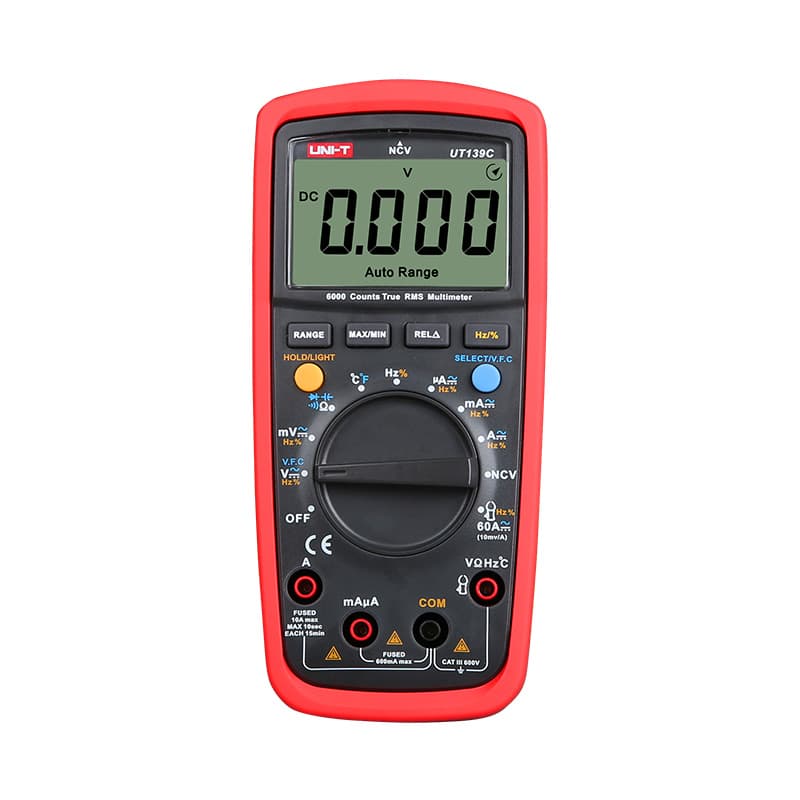
UNI-T UT139C
4.4★★★★☆True RMS and auto-ranging at a price that undercuts most of this list.
Specs side by side
| KAIWEETS KM200s | UNI-T UT139C | |
|---|---|---|
| Rating | 4.5★★★★★ | 4.4★★★★☆ |
| Accuracy | True RMS | True RMS, 6,000-count |
| Safety rating | CAT II 600V | CAT III 600V |
| Auto-ranging | Yes | Yes |
| Best for | Home use, beginners | Budget-conscious buyers who still want True RMS |
| Display | 4,000 counts, backlit LCD | 6,000 counts, LED backlight, 31-segment bar (series) |
| Ranging | Smart auto (auto-selects AC/DC, Ω, continuity) | Auto and manual |
| DC volts accuracy | Not stated on the listing | ±(0.5% + 2), to 600 V |
| AC volts accuracy | Not stated on the listing | ±(0.8% + 3), 45 Hz to 1 kHz |
| Current | Not stated on the listing | To 10 A AC/DC |
| Resistance | Yes (range not stated) | To 60 MΩ |
| Capacitance | Yes (range not stated) | Yes |
| Frequency / temperature | Not stated on the listing | 10 Hz to 10 MHz / -40 to 1000°C, probe included |
| Non-contact voltage | Yes, visual and audible | Yes |
| Flashlight | Yes | Not stated |
| Batteries | 2 × AAA | 2 × 1.5 V AA (R6) |
| Size / weight | 4.33 × 2.36 × 1.06 in; weight not stated | 170 × 80 × 48 mm; 354 g |
| Warranty | 3 years (per listing) | Not stated on UNI-T's page |
Specs checked against manufacturer documentation and official Amazon listings. Desk research, not bench testing. How we research.
Key differences
- →Safety rating: the KM200s is CAT II 600V; the UT139C is CAT III 600V, the minimum for panels and fixed building wiring.
- →Resolution: 4,000 counts on the KM200s against 6,000 on the UT139C, which matters most between 4 and 6 V, for example on USB rails and lithium cells.
- →Ranging: the KM200s's smart mode chooses AC or DC volts, resistance or continuity on its own; the UT139C offers conventional auto ranging plus a manual override.
- →Published detail: UNI-T lists accuracy, 10 A current, 60 MΩ resistance, frequency to 10 MHz and a temperature probe. The KM200s listing gives no accuracy figures and doesn't mention current, frequency or temperature.
- →Both are True RMS with non-contact voltage detection and a backlit display. Only the KM200s lists a flashlight.
- →The KM200s is smaller and runs on two AAA cells; the UT139C is larger at 354 g and runs on two AA cells.
At a glance
Shared basics
True RMS, non-contact voltage, backlit display, 600 V maximum.
Safety gap
CAT II 600V on the KM200s, CAT III 600V on the UT139C.
UT139C extras
6,000 counts, manual ranging, temperature, frequency, 10 A.
KM200s extras
Smart mode picks the function, plus a flashlight and a smaller body.
Documentation
UNI-T publishes accuracy figures; the KM200s listing doesn't.
Verdict
Panel work or more functions: UT139C. Outlets, cars, simplicity: KM200s.
This is desk research: we compared UNI-T's UT139 series page with the official Amazon listing for the KM200s and have not bench-tested either meter. Full single-meter write-ups: the KAIWEETS KM200s review and the UNI-T UT139C review.
KM200s vs UT139C spec by spec
Two numbers separate these meters: the measurement category and the display count. The first decides where you are allowed to probe; the second decides how fine a reading you get on low voltages.
A 4,000-count meter typically steps from a 4 V range to a 40 V range, so anything just above 4 V, such as a fully charged 4.2 V lithium cell or a 5 V USB rail, is read with two decimals. A 6,000-count meter stays on its 6 V range up to 5.999 V and shows three. Above that the advantage fades: 12.6 V and 120 V read with the same resolution on both. UNI-T's ±(0.5% + 2) DC accuracy on a 5.000 V reading works out to ±0.027 V, or 25 thousandths plus two counts of 0.001 V.
CAT II vs CAT III in a house
Measurement categories rate a meter for the size of voltage spike it can survive at a given point in the wiring. CAT II covers circuits on the far side of a receptacle: the appliance, the power tool, the extension cord. CAT III covers the fixed installation: the breaker panel, the feeders, hardwired equipment and the branch wiring inside the walls. A spike that a CAT II meter's protection is not built for can arc across inside the meter while it is in your hands. That is why, for anyone who will ever open a panel cover, the UT139C is the default.
Smart mode is convenience, not accuracy
KAIWEETS KM200s vs UNI-T UT139C: which should you buy?
| You are… | Better fit | Why |
|---|---|---|
| Homeowner replacing a light switch | UNI-T UT139C | Switch boxes are fixed wiring; CAT III is the right rating |
| Checking outlets and appliance cords | Either | Both are True RMS with NCV; CAT II covers plug-in loads |
| Car and motorcycle 12 V work | KAIWEETS KM200s | Smart mode, a flashlight for engine bays, and a small body |
| Electronics and battery hobbyist | UNI-T UT139C | 6,000 counts resolve 4–6 V rails; published accuracy |
| HVAC and appliance repair | UNI-T UT139C | Temperature probe, capacitance and 10 A current |
| First meter for a non-technical user | KAIWEETS KM200s | Fewest choices to get wrong at the dial |
To widen the shortlist, see the best multimeter for home use and the best multimeter for beginners, or compare the UT139C with another CAT III budget meter in Extech EX330 vs UNI-T UT139C. Our multimeter buying guide explains CAT ratings in more depth.
Safety: match the rating to the job
Choose the KAIWEETS KM200s if…
- ✓Your work stays at outlets, appliances, batteries, cars and hobby circuits
- ✓You want a meter that picks AC, DC, resistance or continuity for you with no range dial to learn
- ✓You'll use the built-in flashlight in engine bays, crawl spaces and under sinks
Choose the UNI-T UT139C if…
- ✓You might ever work in a breaker panel: it's rated CAT III 600V
- ✓You want 6,000-count resolution and the option to lock a range manually
- ✓You need temperature, frequency or 10 A current with published accuracy
The bottom line
For most buyers the UNI-T UT139C is the safer default: CAT III 600V covers panel and building-wiring work the KM200s isn't rated for, and it adds 6,000 counts, manual ranging, temperature and published accuracy. The KAIWEETS KM200s makes sense if you'll stay at outlets, appliances and cars and value its smart mode, flashlight and smaller size.
Frequently asked questions
What's the difference between CAT II and CAT III?+
CAT II covers equipment plugged into outlets, such as appliances and power tools. CAT III covers distribution panels, feeders and fixed building wiring, where transient spikes can be larger; a CAT III 600V meter is typically tested against a 6 kV impulse versus about 4 kV for CAT II 600V. A CAT III meter can be used on CAT II circuits, not the reverse.
Does the UNI-T UT139C have a backlight?+
Yes. UNI-T's UT139 series page lists an LED backlight among the series features, alongside data hold and auto power off, and describes a 31-segment analog bar. The KAIWEETS KM200s also has a backlit LCD, and adds a flashlight for lighting the work area, which UNI-T doesn't list for the UT139C.
Can the KAIWEETS KM200s measure current?+
The official Amazon listing doesn't say. Its title and feature bullets mention AC and DC voltage, resistance, continuity, capacitance and non-contact voltage, but no amp ranges. If you need to measure current, the UNI-T UT139C lists up to 10 A AC and DC, or check the KM200s manual before buying.
Is 4,000 counts enough for a home multimeter?+
For most household jobs, yes. Outlet voltage, car batteries and appliance resistance read with the same resolution on a 4,000-count and a 6,000-count meter. The extra counts help between about 4 and 6 volts, such as USB rails and lithium cells, where a 6,000-count meter shows one more decimal place.
Can I use the KAIWEETS KM200s on a breaker panel?+
We don't recommend it. Its CAT II 600V rating covers outlet-connected equipment, while breaker panels and fixed building wiring call for at least CAT III. For panel work, choose a CAT III 600V meter such as the UNI-T UT139C, Klein Tools MM400 or Fluke 117.
Related



