COMPARISON · MULTIMETERS
Fluke 115 vs Klein MM400
The Fluke 115 vs Klein MM400 question comes down to accuracy versus extras. Both are auto-ranging, CAT III 600V meters for household and light commercial electrical work, but only the Fluke is True RMS, and its 6,000-count display resolves finer steps. The Klein answers with a temperature input, duty cycle and a lighter body, and Klein has now discontinued it.
By the OhmSavvy Research Team ·
Disclosure: OhmSavvy earns a commission from qualifying Amazon purchases made through these links, at no extra cost to you. How we're funded.

Fluke 115
4.8★★★★★The same Fluke reliability as the 117, in the same body, without the electrician-specific extras (NCV, AutoVolt, LoZ).
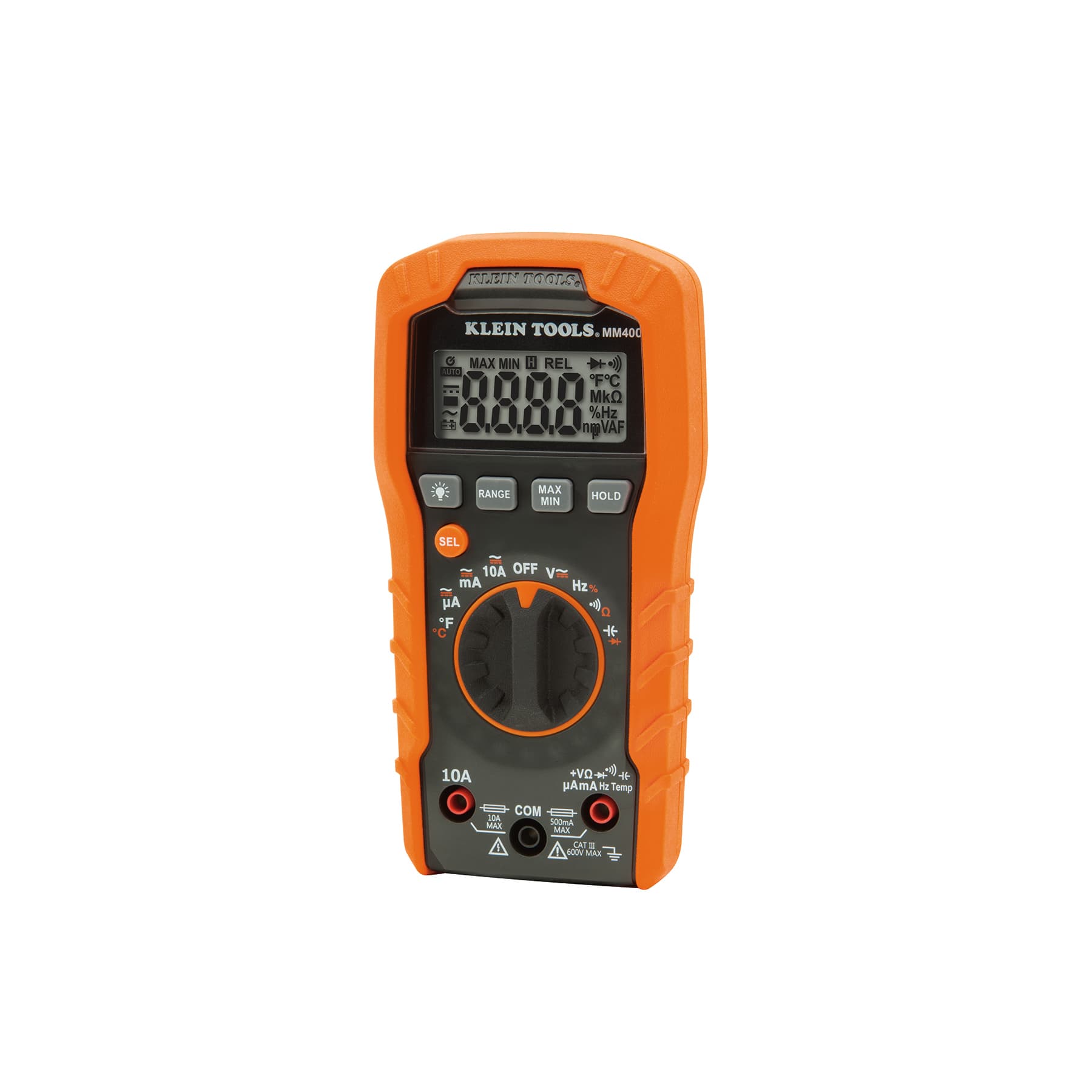
Klein Tools MM400
4.4★★★★☆A solid auto-ranging CAT III meter with temperature and capacitance, but not True RMS, and Klein has now discontinued it.
Specs side by side
| Fluke 115 | Klein Tools MM400 | |
|---|---|---|
| Rating | 4.8★★★★★ | 4.4★★★★☆ |
| Accuracy | True RMS | Auto-ranging (not True RMS) |
| Safety rating | CAT III 600V | CAT III 600V |
| Auto-ranging | Yes | Yes |
| Best for | Field technicians, general electrical and electronics work | Tradespeople, home electrical work |
| Display | 6,000 counts + 33-segment bar graph | 4,000 counts |
| Max voltage | 600V AC/DC | 600V AC/DC |
| Current ranges | 6A and 10A AC/DC (no mA/µA) | 10A AC/DC, plus a fused 500 mA input |
| Resistance | Up to 40 MΩ | Up to 40 MΩ |
| Capacitance | Up to 9,999 µF | Up to 200 µF |
| Frequency | Up to 50 kHz | 1 Hz to 50 kHz, plus duty cycle |
| Temperature | No (Fluke 116 only, per the datasheet) | 0°F to 1000°F, thermocouple included |
| Weight | 550 g | 232 g |
| Battery | One 9V, about 400 hours | 2 × AAA |
| Warranty / status | 3 years; current model | Discontinued (replaced by the MM420) |
Specs checked against manufacturer documentation and official Amazon listings. Fluke 115 is hands-on tested by OhmSavvy; the Klein Tools MM400 assessment is desk research. How we research.
Key differences
- →The Fluke 115 is True RMS; Klein's own feature chart shows the MM400 is not, so its AC readings on distorted waveforms are less reliable.
- →The Fluke's 6,000-count display and 33-segment bar graph resolve finer steps than the MM400's 4,000-count display.
- →The MM400 measures temperature with an included thermocouple and adds duty cycle; Fluke's datasheet gives temperature to the 116, not the 115.
- →The Fluke measures capacitance up to 9,999 µF against the MM400's 200 µF, useful for motor-run and power-supply capacitors.
- →The MM400 weighs 232 g against the Fluke's 550 g.
- →Klein lists the MM400 as no longer in production; the Fluke 115 is current, with a 3-year warranty.
Display resolution and capacitance range compared
Two numbers separate these meters more than any others. Display counts decide how finely a reading is shown: on its 6V range the Fluke shows 5.999 V, where a 4,000-count meter switches ranges and shows fewer digits sooner. Capacitance range decides which components you can test at all.
Bars use a logarithmic scale: each step is ten times the last.
In practice the count difference shows up on 5 V logic rails and small batteries. A 4,000-count meter tops out at 3.999 on its lowest volts range, so a 4.5 V or 5 V reading drops to the next range up, typically with one fewer decimal place. The capacitance gap is more decisive: an HVAC dual run capacitor sits well inside both meters, but the large electrolytics in amplifier and inverter power supplies often exceed the MM400's 200 µF limit, and then it simply shows an overload.
Why True RMS changes the reading on modern loads
An average-responding meter rectifies the AC signal, takes its average and multiplies by 1.11, the ratio between RMS and average that holds only for a pure sine. A True RMS meter like the Fluke 115 computes the heating value of whatever waveform it sees, so it needs no assumption about shape. On a clean utility sine the two agree; on the current drawn by a switch-mode power supply, a dimmer or a drive they don't.
The arithmetic behind the diagram: take rectangular current pulses of height P that are on for 25% of the time. The true RMS value is P × √0.25 = 0.50 P. The rectified average is 0.25 P, and an average-responding meter displays 1.11 × 0.25 P ≈ 0.28 P. That is a 44% under-read, enough to make an overloaded circuit look comfortable. Real loads are rarely this extreme, but a computer power supply or LED driver draws narrow current peaks of this general shape. The reverse error happens too: on a square wave the average equals the RMS, so the 1.11 factor makes an average-responding meter read about 11% high.
When the MM400 is still accurate enough
Which should you buy?
| Job | Better fit | Why |
|---|---|---|
| Outlets, breakers and household circuits | Either | Both are CAT III 600V and auto-ranging |
| Variable-speed drives, LED drivers, inverters | Fluke 115 | True RMS reads distorted waveforms correctly |
| Duct, pipe and appliance temperatures | Klein MM400 | Thermocouple included; the 115 has no temperature input |
| Motor-run and supply capacitors | Fluke 115 | Capacitance to 9,999 µF vs 200 µF |
| PWM fan or dimmer control signals | Klein MM400 | Reads duty cycle; the 115 reads frequency only |
| Carrying the meter in a pouch all day | Klein MM400 | 232 g against 550 g |
| A meter you'll keep for a decade | Fluke 115 | Current model with a 3-year warranty |
Neither meter suits HVAC flame-sensor work: the 115 has no microamp range at all, and Klein's product page lists no dedicated µA range for the MM400 either. For that job, see our best multimeters for measuring microamps or the Fluke 116 discussed in Fluke 115 vs Fluke 117.
Buying a discontinued meter
Klein's own page says the MM400 is no longer in production and points buyers to the MM420. On Amazon it is still sold through third-party offers, so stock and condition vary by seller. That isn't a reason to avoid it outright, since replacement 10 A and 500 mA fuses are still listed by Klein, but it makes the price the deciding factor: the MM400 is only good value at a clear discount to the Fluke. The 115, by contrast, is a current Fluke model that carries our Hands-on Tested badge; read the Fluke 115 review and the Klein MM400 review for the full picture.
Same CAT rating, same limits
Choose the Fluke 115 if…
- ✓You measure on variable-speed drives, LED drivers or other electronic loads, where True RMS matters
- ✓You want a 6,000-count display and a 33-segment bar graph for changing readings
- ✓You want a model that is still in production, with a 3-year warranty
Choose the Klein Tools MM400 if…
- ✓You want temperature readings from the included thermocouple
- ✓You want duty cycle as well as frequency for checking PWM controls
- ✓You find one at a clear discount and mostly measure ordinary sine-wave mains
The bottom line
For most buyers the Fluke 115 is the better meter: True RMS, a finer 6,000-count display, far wider capacitance range and a current model with a 3-year warranty. The Klein MM400 makes sense only if you need its temperature input or duty cycle and can buy one at a clear discount before stock runs out.
Frequently asked questions
Is the Klein MM400 True RMS like the Fluke 115?+
No. Klein's multimeter feature chart lists True RMS only for the MM700 in that range, so the MM400 is average-responding. The Fluke 115 is True RMS, which makes it the safer choice on variable-speed drives, LED lighting and other electronic loads, where an average-responding meter can read well off the true value.
Which is lighter, the Fluke 115 or the Klein MM400?+
The Klein MM400, at 232 g against the Fluke's 550 g per each maker's specifications. The Fluke runs on a single 9V battery rated for about 400 hours typical; the Klein uses two AAA cells, and Klein doesn't publish a battery life figure on the product page we checked.
Can the Fluke 115 measure temperature?+
No. Fluke's 114/115/116/117 datasheet lists the K-type thermocouple function for the Fluke 116 only, even though a comparison table on Fluke's product pages suggests otherwise. Don't buy the 115 for temperature work. The Klein MM400 includes a thermocouple and reads 0°F to 1000°F (-18°C to 538°C).
Is the Klein MM400 still made?+
No. Klein lists it as no longer in production and points to the MM420 as its replacement, so remaining stock comes from third-party sellers and may be limited. The Fluke 115 is a current model with a 3-year warranty, which matters if you want parts and support for years to come.
Which meter is better for HVAC work?+
It depends on the task. The MM400's thermocouple helps with supply and return air and line temperatures. The Fluke 115's True RMS and 9,999 µF capacitance range help with variable-speed blowers and run capacitors. Neither has a dedicated microamp range for flame sensors, so see our HVAC multimeter guide for meters that do.
Related


