Disclosure: OhmSavvy earns a commission from qualifying Amazon purchases made through the links below, at no extra cost to you. How we're funded.
At a glance
Our top picks

Fluke 289
The only handheld here with a 50 Ω range at 1 mΩ resolution, plus 0.01 µA current resolution and on-screen trend logging.
Check price on Amazon →Why we picked it ↓
EEVblog Brymen BM786
A 60,000-count Brymen with 0.01 µA and 0.01 Ω resolution and CAT IV 600V, for about a third of a Fluke 287.
Check price on Amazon →Why we picked it ↓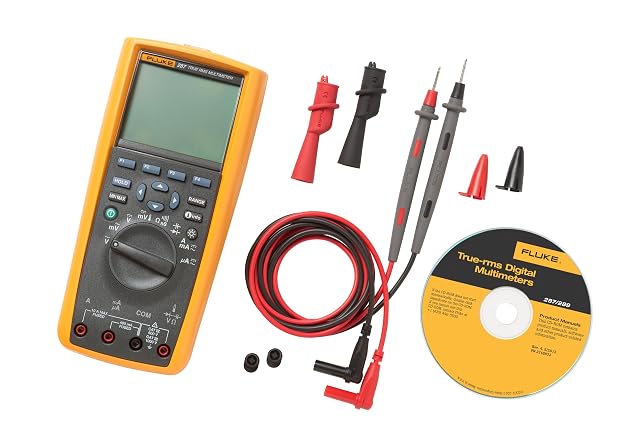
Fluke 287
Fluke's electronics logging meter: 50,000 counts, 0.01 µA resolution and graphs on the meter, without the 289's industrial extras.
Check price on Amazon →Why we picked it ↓Also great
- 4
 UNI-T UT181ACheck pricePrice →Best Color-Screen Data Logger4.4★★★★☆
- 5
 Fluke 87VCheck pricePrice →Best for Professionals4.8★★★★★
- 6
 UNI-T UT61E+Check pricePrice →Best Budget Meter for Electronics4.5★★★★★
- 7
 OWON B41T+Check pricePrice →Best Budget Bluetooth Logger4.2★★★★☆
- 8
 Brymen BM235Check pricePrice →Best Features for the Money4.6★★★★★
- 9
 OWON OW18ECheck pricePrice →Best Budget µA Meter4.1★★★★☆
- 10
 Fluke 179Check pricePrice →Best for Industrial Work4.7★★★★★
Quick shopping
Compare at a glance
Swipe sideways on mobile to see every spec.
| Model | Award | Rating | Accuracy | Safety rating | Auto-ranging | |
|---|---|---|---|---|---|---|
 #1Fluke 289 | Best for Low Resistance | 4.7★★★★★ | True RMS, 0.025% basic DC V | CAT IV 600V / CAT III 1000V | Yes (manual override) | Check price → |
 #2EEVblog Brymen BM786 | Best Brymen for Electronics | 4.6★★★★★ | AC+DC True RMS, 0.03% DC V | CAT III 1000V / CAT IV 600V | Yes (manual override) | Check price → |
 #3Fluke 287 | Best Logging Meter for Electronics | 4.6★★★★★ | True RMS, 0.025% basic DC V | CAT IV 600V / CAT III 1000V | Yes (manual override) | Check price → |
| #4UNI-T UT181A | Best Color-Screen Data Logger | 4.4★★★★☆ | True RMS, ±(0.025%+5) DC V | CAT III 1000V / CAT IV 600V | Yes (manual override) | Check price → |
| #5Fluke 87V✓ Tested | Best for Professionals | 4.8★★★★★ | True RMS | CAT III 1000V / CAT IV 600V | Yes | Check price → |
| #6UNI-T UT61E+ | Best Budget Meter for Electronics | 4.5★★★★★ | True RMS, ±(0.05%+5) DC V | CAT III 1000V / CAT IV 600V | Yes (manual override) | Check price → |
| #7OWON B41T+ | Best Budget Bluetooth Logger | 4.2★★★★☆ | True RMS, ±(0.1%+2) DC V | 1000V CAT III (case marking) | Yes | Check price → |
| #8Brymen BM235 | Best Features for the Money | 4.6★★★★★ | True RMS | CAT III 600V / CAT IV 300V | Yes (manual override) | Check price → |
| #9OWON OW18E | Best Budget µA Meter | 4.1★★★★☆ | True RMS, ±(0.1%+2) DC V | 1000V CAT III / 600V CAT IV (case marking) | Yes | Check price → |
| #10Fluke 179 | Best for Industrial Work | 4.7★★★★★ | True RMS | CAT III 1000V / CAT IV 600V | Yes (manual override) | Check price → |
In depth
Detailed reviews
Fluke 289
The only handheld here with a 50 Ω range at 1 mΩ resolution, plus 0.01 µA current resolution and on-screen trend logging.
Best for:Low-ohm, µA and logged electronics work
The Fluke 289 is a 50,000-count True RMS logging meter rated CAT IV 600V / CAT III 1000V. Its two-terminal 50 Ω range resolves 1 mΩ using a 10 mA test current, and relative mode removes test-lead resistance, so you can check shunts, contacts and PCB traces without a separate milliohm meter. The 500 µA range resolves 0.01 µA with a published burden of about 102 µV per µA. TrendCapture graphs logged readings on the meter itself, and LoZ and a low-pass filter cover electrical work too. The catch is the price, roughly three times a good hobby meter.
Why it fits: First place goes to the only meter here with a 50 Ω range at 1 mΩ resolution, which turns hunting for a shorted capacitor on a rail into a matter of following falling readings. It adds 0.01 µA resolution and TrendCapture logging for intermittent faults; the drawback is price, and the low-ohm range is two-wire rather than Kelvin.
- Accuracy
- True RMS, 0.025% basic DC V
- Safety rating
- CAT IV 600V / CAT III 1000V
- Auto-ranging
- Yes (manual override)
- Best for
- Low-ohm, µA and logged electronics work
Reasons to buy
- +50 Ω range with 1 mΩ resolution and REL lead zeroing
- +500 µA range with 0.01 µA resolution and published burden voltage
- +Logs and graphs readings on screen (TrendCapture)
Reasons to avoid
- −Expensive, and sold here by a third-party seller
- −Two-terminal low-ohm range, not true 4-wire Kelvin
EEVblog Brymen BM786
A 60,000-count Brymen with 0.01 µA and 0.01 Ω resolution and CAT IV 600V, for about a third of a Fluke 287.
Best for:Bench electronics and PCB repair
The BM786 is a Brymen meter made for the EEVblog: AC+DC True RMS, 60,000 counts, CAT III 1000V / CAT IV 600V, and 0.03% best DC voltage accuracy. Its 600.00 µA range resolves 0.01 µA at ±(0.075%+20 digits), and its 600.00 Ω range resolves 0.01 Ω. Brymen publishes a burden of 0.2 mV per µA, twice the BM235's, so in very low-voltage circuits it drops more voltage than you may expect. The BeepLit continuity responds in under 100 µs. It has no logging or PC link, but for hands-on bench work and PCB repair it's a strong all-rounder.
Why it fits: Sixty thousand counts, 0.01 Ω on the 600.00 Ω range and latching BeepLit continuity in under 100 µs make it the fastest diagnostic meter in this list. It ranks second because it can't log or connect to a PC, so intermittent faults have to happen while you watch.
- Accuracy
- AC+DC True RMS, 0.03% DC V
- Safety rating
- CAT III 1000V / CAT IV 600V
- Auto-ranging
- Yes (manual override)
- Best for
- Bench electronics and PCB repair
Reasons to buy
- +0.01 µA and 0.01 Ω resolution at 60,000 counts
- +Fast latching BeepLit continuity (<100 µs)
- +Relative zero, Max/Min/Avg and crest capture
Reasons to avoid
- −0.2 mV/µA burden is higher than the BM235's
- −No data logging or PC connection
Fluke 287
Fluke's electronics logging meter: 50,000 counts, 0.01 µA resolution and graphs on the meter, without the 289's industrial extras.
Best for:Electronics design, µA and logging
The 287 shares the 289's 50,000-count display, 500 µA range with 0.01 µA resolution, 100 mF capacitance and TrendCapture logging, and it carries the same CAT IV 600V / CAT III 1000V rating. It drops the 289's 50 Ω low-ohm range, LoZ and low-pass filter, so its finest resistance resolution is 0.01 Ω on the 500 Ω range (with relative mode to zero the leads). For bench electronics, sleep-current checks and logging a drifting supply overnight, it does the job for less than the 289.
Why it fits: It shares the 289's 50,000 counts, 100 mF capacitance and on-screen logging, so it can watch a supply rail for dropouts overnight. Without the 289's 50 Ω range, its finest resistance step is 0.01 Ω, which is still fine for most short hunting.
- Accuracy
- True RMS, 0.025% basic DC V
- Safety rating
- CAT IV 600V / CAT III 1000V
- Auto-ranging
- Yes (manual override)
- Best for
- Electronics design, µA and logging
Reasons to buy
- +0.01 µA resolution on the 500 µA range
- +On-screen trend logging with real-time clock
- +Limited lifetime warranty
Reasons to avoid
- −No 50 Ω low-ohm range (that's the 289)
- −Third-party seller and an Amazon listing with wrong CAT wording
UNI-T UT181A
A 60,000-count colour-screen logging meter that stores 20,000 readings and graphs them, for well under Fluke 287 money.
Best for:Logging battery drain and drift
The UT181A is a True RMS logging meter with a 3.5-inch colour TFT, 60,000 counts and CAT III 1000V / CAT IV 600V. Its lowest ranges are 600 µA and 600 Ω, so at 60,000 counts it reads to 0.01 µA and 0.01 Ω, though UNI-T doesn't print a per-range resolution. It logs 20,000 readings with a real-time clock and trend graph, measures two thermocouples at once, and runs on a rechargeable Li-ion pack. It has IP65 sealing and a 1 kHz low-pass filter. Bluetooth needs UNI-T's optional adaptor, despite what the listing implies.
Why it fits: The color screen graphs up to 20,000 logged readings, and the two thermocouple inputs with a T1 minus T2 reading help find the part that runs hotter than its neighbor. UNI-T doesn't publish per-range resolution, so the 0.01 Ω figure is inferred from its 600 Ω range and 60,000 counts.
- Accuracy
- True RMS, ±(0.025%+5) DC V
- Safety rating
- CAT III 1000V / CAT IV 600V
- Auto-ranging
- Yes (manual override)
- Best for
- Logging battery drain and drift
Reasons to buy
- +20,000-reading logger with trend graph on a colour screen
- +60,000 counts, 600 µA and 600 Ω lowest ranges
- +Rechargeable battery and IP65 sealing
Reasons to avoid
- −Bluetooth needs an optional adaptor
- −UNI-T doesn't publish per-range resolution or burden voltage
Fluke 87V
The step-up pick for anyone who needs CAT IV protection and high-resolution readings daily.
Best for:Industrial technicians, daily professional use
The 87V is Fluke's industrial-grade step up from the 117 — a 1000V CAT III / 600V CAT IV rating, a 6,000-count main display with a 19,999-count high-resolution mode, and a 32-segment analog bar graph for watching signals change in real time.
Why it fits: It carries our Hands-on Tested badge and switches to a 19,999-count HiRes mode, with 0.1 Ω resolution and relative mode to remove lead resistance. It suits shops that repair mains equipment as well as boards, but for milliohm short hunting the meters above it resolve ten times finer.
- Accuracy
- True RMS
- Safety rating
- CAT III 1000V / CAT IV 600V
- Auto-ranging
- Yes
- Best for
- Industrial technicians, daily professional use
Reasons to buy
- +Joint-highest CAT rating in this list (CAT IV 600V / CAT III 1000V)
- +19,999-count high-resolution mode
- +Analog bar graph tracks fast-changing signals
Reasons to avoid
- −Among the most expensive picks here
- −Overkill for casual home use
UNI-T UT61E+
A budget 22,000-count True RMS meter with 0.01 µA and 0.01 Ω resolution, REL mode and a USB link.
Best for:Arduino, hobby electronics, PCB repair
The UT61E+ is UNI-T's 22,000-count version of the UT61+ series: True RMS, CAT III 1000V / CAT IV 600V, with a 220.00 µA range at 0.01 µA resolution and a 220.00 Ω range at 0.01 Ω (±0.5% + 10 digits). REL mode subtracts lead resistance, which UNI-T's manual tells you to do for low-ohm readings. It also adds capacitance to 220 mF, frequency to 220 MHz, hFE, NCV and a USB cable for PC readout. It has no temperature function (that's the UT61D+), and UNI-T doesn't publish its burden voltage.
Why it fits: A 220.00 Ω range at 0.01 Ω with REL, capacitance to 220 mF, an hFE socket for quick transistor checks and a USB link give it most of what a repair bench needs. It ranks behind the Fluke and Brymen meters because UNI-T publishes less, including no burden voltage.
- Accuracy
- True RMS, ±(0.05%+5) DC V
- Safety rating
- CAT III 1000V / CAT IV 600V
- Auto-ranging
- Yes (manual override)
- Best for
- Arduino, hobby electronics, PCB repair
Reasons to buy
- +0.01 µA and 0.01 Ω resolution at a budget price
- +REL mode to zero test-lead resistance
- +USB PC link, capacitance to 220 mF, frequency to 220 MHz
Reasons to avoid
- −No temperature measurement
- −Burden voltage not published
OWON B41T+
A 22,000-count Bluetooth meter with 0.01 µA and 0.01 Ω resolution that logs 10,000 points by itself.
Best for:Logging µA sleep current on a budget
The B41T+ is OWON's 4½-digit (22,000-count) True RMS meter. Its 220 µA range resolves 0.01 µA and its 220 Ω range resolves 0.01 Ω, both at ±(0.5% + 10 digits), and relative mode zeroes the leads. Bluetooth 4.0 sends readings to a phone app, and the "+" model records up to 10,000 points over as long as 168 hours with no phone attached, so it can log a project's sleep current overnight. OWON doesn't state a CAT rating on its page (the case says 1000V CAT III), AC voltage tops out at 750 V and burden voltage isn't published.
Why it fits: It records up to 10,000 points over as long as 168 hours without a phone, so a budget repair bench can still catch a battery drain or a rail that sags once a night. OWON gives no CAT rating on its page and AC volts stop at 750 V, so keep it to the low-voltage side of a repair.
- Accuracy
- True RMS, ±(0.1%+2) DC V
- Safety rating
- 1000V CAT III (case marking)
- Auto-ranging
- Yes
- Best for
- Logging µA sleep current on a budget
Reasons to buy
- +0.01 µA and 0.01 Ω resolution
- +Offline logging of 10,000 points without a phone
- +Bluetooth app, capacitance to 220 mF, temperature
Reasons to avoid
- −OWON publishes no CAT rating or burden voltage
- −AC voltage limited to 750 V
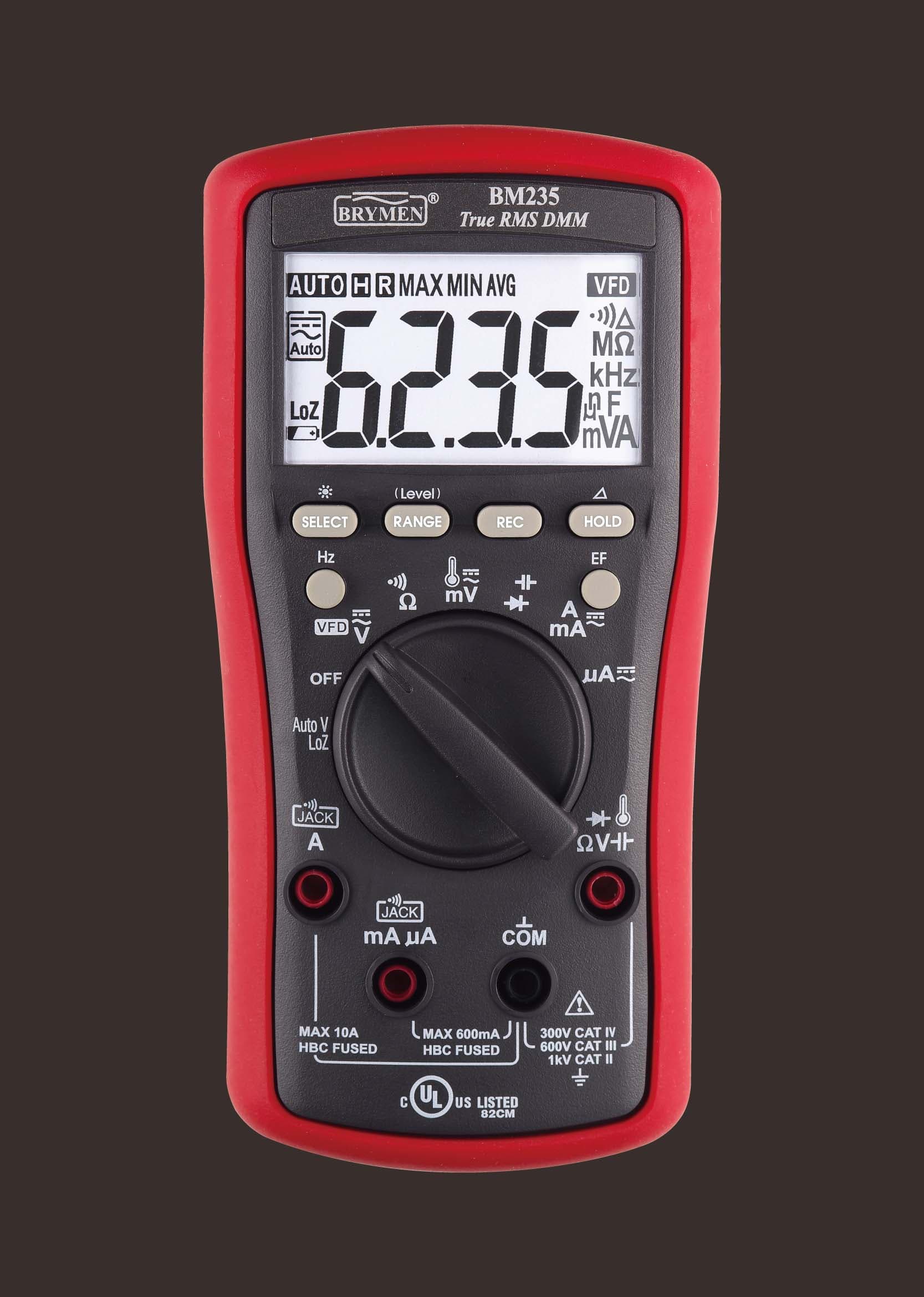
Brymen BM235
True RMS with AutoV LoZ, NCV, VFD mode and temperature: more electrician features than most meters at its price.
Best for:Electricians and enthusiasts who want every feature
Brymen's BM235 packs features usually found on pricier meters: True RMS, a 6,000-count backlit display, AutoV low-impedance voltage, non-contact voltage detection, a VFD mode for variable-speed drives, Type-K temperature, Max/Min/Avg and relative zero, with 1000V-rated HBC fuses. Brymen's catalog and the meter's own markings give CAT III 600V and CAT IV 300V. The US listing is the EEVblog edition, and support runs through Brymen's distributors rather than a big US brand.
Why it fits: AutoV LoZ, NCV, a VFD mode and relative zero make it useful when a repair moves from the board to the appliance's mains wiring, and BeepLit continuity reacts within 15 ms. Its 6,000-count display and 0.1 Ω resolution limit fine comparisons on a PCB.
- Accuracy
- True RMS
- Safety rating
- CAT III 600V / CAT IV 300V
- Auto-ranging
- Yes (manual override)
- Best for
- Electricians and enthusiasts who want every feature
Reasons to buy
- +AutoV LoZ and NCV built in
- +VFD voltage and frequency mode
- +Max/Min/Avg, relative zero and Type-K temperature
Reasons to avoid
- −CAT IV only to 300V, below the Fluke 179 and Klein MM700
- −Less familiar brand in the US; Amazon listing is the EEVblog edition
OWON OW18E
A budget True RMS meter with a 200.00 µA range, 0.01 Ω resolution, Bluetooth and offline logging.
Best for:Arduino and hobby electronics on a budget
The OW18E is a 19,999-count (sold as 20,000) True RMS meter. Its 200.00 µA range resolves 0.01 µA at ±(0.5% + 10 digits) DC and its 200.00 Ω range resolves 0.01 Ω. It adds NCV, a flashlight, Type-K temperature, capacitance to 20 mF and a 20 A range, plus BLE 4.0 and offline recording on the E model. The case is marked 1000V CAT III / 600V CAT IV, but OWON's page doesn't state a rating and doesn't publish burden voltage. Amazon showed only one in stock when we checked.
Why it fits: It matches the pricier meters' 0.01 Ω and 0.01 µA resolution on a low-cost 19,999-count body, with Bluetooth and offline recording. OWON publishes little beyond the basic specs and stock was very low on Amazon when we checked, so it ranks ninth.
- Accuracy
- True RMS, ±(0.1%+2) DC V
- Safety rating
- 1000V CAT III / 600V CAT IV (case marking)
- Auto-ranging
- Yes
- Best for
- Arduino and hobby electronics on a budget
Reasons to buy
- +0.01 µA and 0.01 Ω resolution at a budget price
- +Bluetooth with offline recording
- +NCV, flashlight and temperature included
Reasons to avoid
- −Low stock on Amazon at last check
- −OWON publishes no burden voltage or CAT rating
Fluke 179
Fluke's do-everything bench-and-field meter: CAT IV 600V, True RMS, temperature and a 6,000-count display with bar graph.
Best for:Industrial maintenance, electronics, HVAC
The Fluke 179 is the full-featured member of Fluke's 170 series: True RMS, CAT III 1000V and CAT IV 600V, a 6,000-count backlit display with an analog bar graph, and temperature measurement with the supplied thermocouple. It adds Min/Max-Average recording and both manual and automatic ranging, so it suits industrial maintenance and electronics work where the 117's electrician-focused extras matter less than range and resolution.
Why it fits: A tough CAT IV 600V meter with capacitance to 10,000 µF, Min/Max-Average and temperature covers appliance and power-supply repair well. It has no microamp range at all, its lowest current range being 60.00 mA, so it can't diagnose standby-drain faults and ranks last here.
- Accuracy
- True RMS
- Safety rating
- CAT III 1000V / CAT IV 600V
- Auto-ranging
- Yes (manual override)
- Best for
- Industrial maintenance, electronics, HVAC
Reasons to buy
- +CAT IV 600V for service entrances and outdoor feeds
- +Temperature, capacitance to 10,000 µF and frequency to 100 kHz
- +Min/Max-Average recording and analog bar graph
Reasons to avoid
- −Costs more than the 117 for features many electricians won't use
- −No non-contact voltage detection
Before you buy
Buying advice
Buy resolution for the faults you actually chase
If most of your repairs are dead power supplies and blown fuses, a 6,000-count meter like the Fluke 179 or Brymen BM235 does the job. If you repair laptops, phones or dense consumer boards, shorted rails and leaky capacitors are daily work, and 0.01 Ω or better with relative mode saves hours. That is where the Fluke 289, BM786 and UT61E+ earn their place.
Zero the leads before every low-ohm reading
Test leads and probe contact add a few tenths of an ohm, which swamps the differences you look for when tracing a short. Touch the probes together, press REL or relative zero, then measure. Hold the probes with the same pressure each time, and clean oxidised test points, otherwise the reading drifts more than the board does.
Plan for intermittent faults
A device that fails only when warm, or drains its battery over a weekend, needs a meter that records. The Fluke 289 and 287 graph readings on screen, the UNI-T UT181A stores 20,000 timestamped values, and the OWON B41T+ records offline. A Min/Max mode is the minimum: it at least tells you a dropout happened.
Treat every mains-powered repair as live until proven otherwise
Switch-mode supplies hold dangerous voltage on their bulk capacitors after unplugging. Measure that capacitor's voltage before touching the board, discharge it through a suitable resistor, and use a meter with a published CAT rating and high-energy fuses on that side. Keep the cheapest meter for battery and low-voltage boards.
Add a scope when the fault is in the waveform
A multimeter can't show ripple, ringing or a missing clock. When voltages look right but the device still misbehaves, a scope is the next tool, and our guide to the best oscilloscopes for electronics repair ranks the options.
Methodology
How we chose
We ranked these ten for bench and board-level repair: display counts and low-ohm resolution with lead zeroing first, then capacitance range, microamp current, diode test and logging for intermittent faults, with safety ratings for mains work. All specifications come from the makers' datasheets, manuals and product pages; this is desk research, and only the Fluke 87V carries our Hands-on Tested badge.
Picks marked "Hands-on Tested" have been bought and tested by us; the rest are desk research. A pick only carries that badge once we have actually bought and tested that unit. More on how we research.
Questions
Frequently asked questions
What is the best multimeter for electronics repair?+
For board-level repair we rank the Fluke 289 first, because its 50 Ω range resolves 1 mΩ, which helps pin down which part is shorting a power rail, and it logs readings for intermittent faults. The EEVblog Brymen BM786 is the strongest choice without logging, and the UNI-T UT61E+ gives 0.01 Ω resolution for much less money.
How many counts do I need for electronics repair?+
A 6,000-count meter is enough for confirming supply voltages and checking fuses. For comparing near-identical readings, such as matching two transistors, spotting a few millivolts of drop across a connector or tracing a short by resistance, 20,000 counts or more adds a digit. All the 20,000-plus meters here also offer a relative mode to remove lead resistance.
How do I find a short circuit on a PCB with a multimeter?+
Power the board off, discharge it, and measure resistance between the shorted rail and ground at several points. The reading falls slightly as you get closer to the faulty part, because there is less copper between probe and short. That difference can be only milliohms, so a meter with 0.01 Ω or finer resolution and relative zero makes the search far easier.
Can a multimeter test capacitors in circuit?+
Sometimes, but readings are often wrong because other parts in parallel affect the result. A meter's capacitance range gives the value of a capacitor removed from the board, and a short or very low resistance reading in circuit can point to a failed one. Capacitance meters don't measure ESR, which is a common failure in electrolytic capacitors.
Why does a data logging multimeter help with repair?+
Many faults are intermittent: a supply that drops out when it warms up, or a device that drains its battery overnight. A logging meter such as the Fluke 289, Fluke 287 or UNI-T UT181A records readings with timestamps, so you can leave it connected and see when the fault happened and how long it lasted, instead of watching the display.
Is a cheap multimeter safe for repairing mains-powered electronics?+
Only if it carries a credible CAT rating and good fuses. Repair on TVs, power supplies and appliances can expose you to mains voltage and charged capacitors. The meters in this list have CAT III or CAT IV markings, though OWON doesn't state ratings on its own pages for the B41T+ and OW18E, so we would use the Fluke or Brymen meters on the mains side.

