HOW-TO GUIDE
Why Does My Car's AC Compressor Clutch Not Engage? Electrical Diagnosis
By the OhmSavvy Research Team ·

Safety around a running engine and AC system
- Several checks need the engine running with the AC on. Keep leads, hands and clothing clear of the belt, pulleys and the electric cooling fan, which can start without warning.
- The compressor, its lines and the exhaust nearby get hot enough to burn skin after a drive. Let the engine cool before reaching around the compressor to unplug the clutch connector.
- The AC system holds refrigerant under pressure. Do not open lines or remove switches that thread into a pressurized port; refrigerant work belongs to a shop with recovery equipment, and venting refrigerant is illegal in the US.
- Keep the meter on volts or ohms with the red lead in the V/Ω jack throughout.
Causes at a glance
| Symptom | Likely cause | How to check | Fix or who to call |
|---|---|---|---|
| Clutch never engages, pressure switch open | Low refrigerant lockout | Continuity across the switch, unplugged | Leak search and recharge at an AC shop |
| No voltage at clutch, fuse open | Blown fuse, often from a shorted coil or wire | Both fuse tabs to ground; coil ohms | Fix the short, then replace the fuse |
| No voltage at clutch, fuse good | Relay failed or not commanded | Swap relay; check control side in the socket | Replace relay, or follow the request upstream |
| Battery voltage at clutch, no pull-in | Open coil, poor ground or wide air gap | Coil ohms, ground drop, feeler gauge | Replace coil or clutch; a shop for the gap |
| Fuse blows when AC is switched on | Shorted clutch coil or chafed feed wire | Coil ohms well below spec; wire to ground | Replace the coil or repair the wire |
| Clutch cycles on and off rapidly | Low charge, or a loose connector or worn relay | Watch clutch voltage while it cycles | Recharge, or repair the connection |
| Everything tests good, still no request | HVAC or engine computer withholding the command | Scan tool AC request and clutch command | A shop with a scan tool |
How the compressor clutch circuit works
The clutch is an electromagnet. When its field coil is energized, it pulls a steel plate against the spinning pulley and the compressor shaft turns. Between the battery and that coil sit a fuse, a relay, and a decision: the HVAC panel or engine computer only closes the relay when the driver has asked for AC and every input it monitors (refrigerant pressure, evaporator temperature, engine load, coolant temperature) says it is safe to run.
01
Clutch feed
12 V here? Fault is at the clutch
02
Fuse
Live on both tabs?
03
Relay
Swap, then check the control side
04
Pressure input
Switch closed, or locked out?
05
Request
Scan tool: AC request and command
1Measure voltage at the clutch connector
Start here, because this one test splits the problem in half. Back-probe the clutch connector (or use a breakout lead) with the engine running and the AC on at maximum. Put the black probe on the battery negative post and the red probe on the clutch feed wire. Near battery voltage means the fuse, relay and control side are all doing their job and the fault is at the clutch: skip to step 5. Zero volts means the clutch is not being told to engage, and you work back toward the fuse, relay and module in steps 2 to 4.
2Check the fuse
Find the AC or compressor clutch fuse in the owner's manual or the fuse box lid. With the engine running and the AC requested, put the meter on DC volts and probe the two test points on top of the fuse against the battery negative: both sides should show battery voltage. If one side has voltage and the other has none, the fuse is open; our guide to a fuse with power on one side only explains the readings. A fuse that blows again as soon as the AC is switched on points to a shorted clutch coil or a chafed wire to ground, so test the coil before fitting a third one.
3Check the AC clutch relay
Swapping in a known-good identical relay from the same box is a quick first test. To test the relay itself on the bench (coil resistance, then contact continuity with the coil powered) follow our guide on testing an automotive relay.
In the socket, with the AC requested, check the relay's coil feed and its control side. If the module is not grounding (or powering, on some designs) the control terminal, the relay is not the problem: the module has decided not to engage the clutch, and the reason is usually upstream in the pressure or temperature inputs.
4Check the pressure switch lockout
Low refrigerant is the single most common reason a clutch stays disengaged, and it is not an electrical fault. The low-pressure switch (or a pressure transducer on newer cars) reports system pressure. When the charge is too low, the switch opens or the sensor reports low pressure, and the clutch is kept off deliberately so the compressor does not run without enough refrigerant to carry its lubricating oil around.
A two-wire switch can be checked for continuity with its connector unplugged: closed means it sees enough pressure, open means it does not. Our guide on testing a pressure switch covers the method. An open switch with the system at rest usually means the system is low, which needs a leak search and recharge rather than a new switch.
Static pressure, measured by a shop with the engine off, follows outside temperature as long as some liquid refrigerant remains, which is why a system can show normal-looking static pressure and still be undercharged. The published pressure-temperature figures for R-134a below show the effect; R-1234yf systems read similar but not identical values. Near zero static pressure means the refrigerant has leaked out, and no clutch should engage.
A lockout is the system working
5Test the clutch coil and its ground
With the engine off, unplug the clutch connector and measure resistance across the coil terminals, or from the single terminal to the compressor body on one-wire designs. Expect a low reading of a few ohms, often somewhere around 2 to 5 Ω; the exact specification is in the service manual. OL means an open winding, and a reading well below specification means shorted turns. The method is the same as for any solenoid coil.
The coil's return path matters as much as its feed. On a two-wire clutch, measure from the ground wire to the battery negative while the clutch is commanded on: it should be well under a volt, and typically a few tenths at most. On a one-wire clutch the compressor body is the ground, so a loose or corroded compressor mount can be the fault; see testing a car ground wire. If voltage, ground and coil are all good and the clutch still does not pull in, the air gap between plate and pulley may be too wide, which is a mechanical measurement with a feeler gauge and a specification in the manual.
6Check the HVAC and ECU request signal
If there is no voltage at the clutch, the fuse and relay test good, and the pressure switch is closed, the request itself may be missing. On many cars the HVAC panel and engine computer exchange that request over a data network rather than a single wire. A scan tool that shows the AC request and clutch command status is the practical next step here; a multimeter can confirm wiring continuity between modules once the wiring diagram tells you which pins to check. The computer may also be refusing on purpose: many engines cut the compressor at wide-open throttle or when coolant temperature runs high, so check those inputs before suspecting a module.
Coil current: why the resistance matters
Ohm's law turns the coil reading into the current the circuit must carry. With about 13.5 V from a running engine and a coil of 3.5 Ω, the clutch draws I = V ÷ R = 13.5 ÷ 3.5 ≈ 3.9 A, or P = V × I ≈ 52 W. That is comfortable for a typical clutch fuse and relay. The table shows how the numbers change as the coil fails; the resistances are illustrative, so use the specification for your compressor.
| Coil reading (illustrative) | Current at 13.5 V | Power | What happens |
|---|---|---|---|
| 3.5 Ω (in typical range) | 13.5 ÷ 3.5 ≈ 3.9 A | ≈ 52 W | Normal pull-in |
| 1.0 Ω (shorted turns) | 13.5 ÷ 1.0 = 13.5 A | ≈ 182 W | Likely to blow a 10 A fuse |
| 0.2 Ω (short to case) | 13.5 ÷ 0.2 ≈ 68 A | ≈ 911 W | Fuse blows at once |
| OL (open winding) | 0 A | 0 W | No magnetic pull at all |
A poor ground behaves like extra resistance in series. If the ground path adds 1 Ω to a 3.5 Ω coil, current falls to 13.5 ÷ 4.5 = 3.0 A, and the coil gets only 3.0 × 3.5 = 10.5 V. The magnetic pull drops with it, and a clutch with a worn, wide air gap may then slip or fail to engage when hot.
Reading the results
| What you found | Likely meaning | Next step |
|---|---|---|
| Fuse open | Blown fuse; may be a shorted coil or wire | Test coil ohms before replacing |
| Pressure switch open at rest | Low refrigerant lockout | Leak search and recharge |
| No voltage at clutch, switch closed | Relay, wiring or no request | Relay test, then scan tool |
| Battery voltage at clutch, no pull-in | Coil, ground or air gap | Coil ohms, ground drop, gap |
| Coil reads OL | Open field coil | Replace clutch coil or assembly |
Meters for this job
DC volts and ohms are all the electrical tests need. A temperature function is a useful extra: with a thermocouple in the center vent you can watch the outlet air cool when the clutch engages. These picks come from our verified automotive multimeter list.
Meters for AC clutch diagnosis
True RMS, CAT III 600V and a 6,000-count backlit display, with frequency and capacitance. Hands-on Tested.
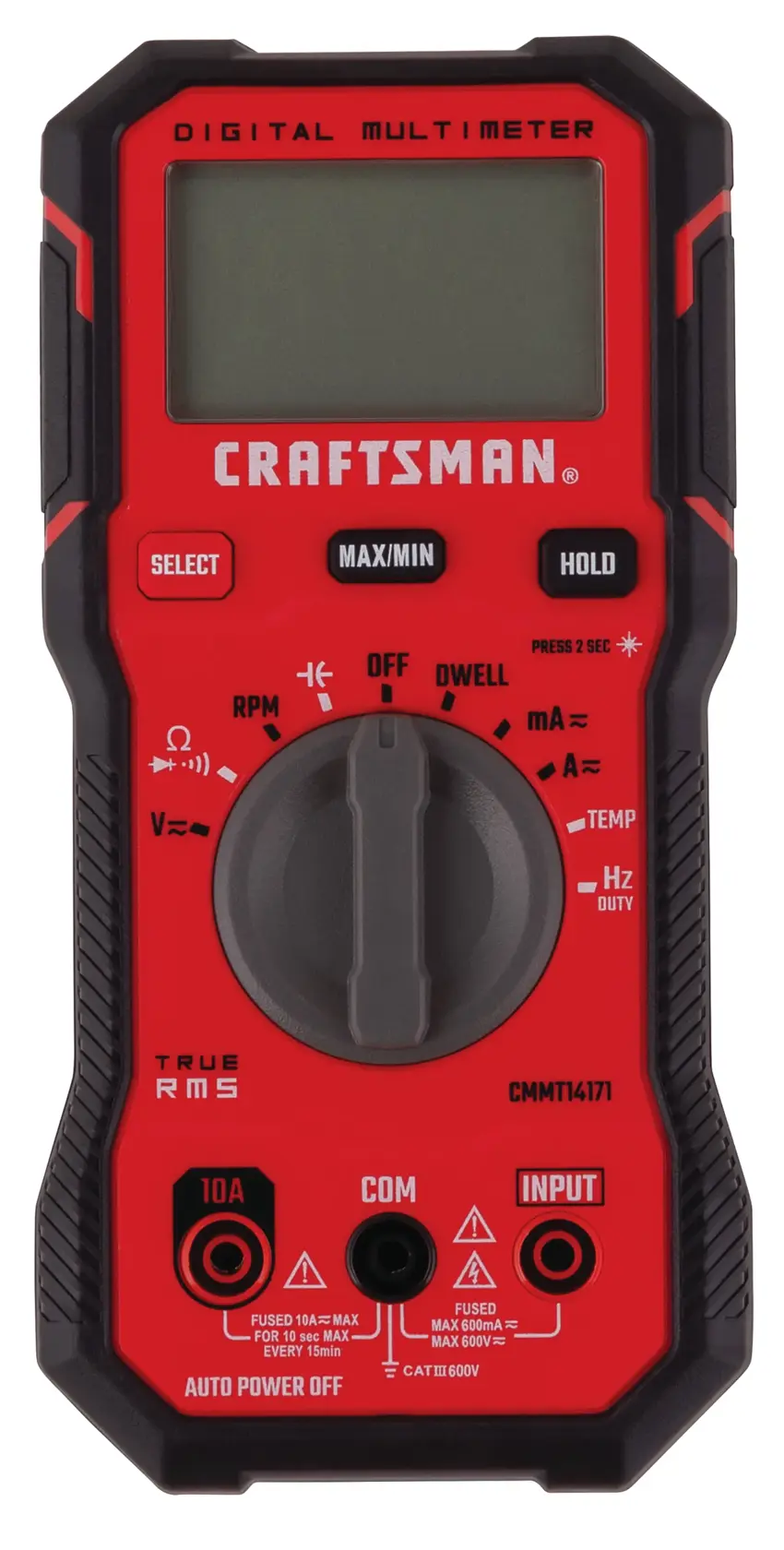
True RMS, CAT III 600V, with temperature, RPM, dwell, duty cycle and frequency.

True RMS, CAT IV 600V, temperature with the supplied thermocouple, and Min/Max-Average recording.
As an Amazon Associate I earn from qualifying purchases. Prices and availability are shown on Amazon.
Frequently asked questions
Can low refrigerant stop the AC compressor clutch from engaging?
Yes, and on most vehicles it is designed to. A low-pressure switch or pressure sensor tells the control module the system is undercharged, and the module withholds the clutch command to protect the compressor from running without enough oil circulation. The electrical parts are working correctly in that case; the fix is finding the leak and recharging, done by someone equipped to handle refrigerant.
Is it safe to jump the low-pressure switch to make the clutch engage?
Briefly bridging a switch connector can confirm whether the rest of the circuit works, but running the compressor with a lockout bypassed and little refrigerant can damage it. Use any bypass only as a momentary test, never as a repair, and follow your service manual: many newer cars use a three-wire pressure sensor that should not be jumped at all.
What should an AC clutch coil read in ohms?
Usually a few ohms, often somewhere around 2 to 5 Ω, but the exact figure depends on the vehicle and is listed in the service manual. OL means the coil winding is open. A reading well below specification suggests shorted turns, which draw extra current and often blow the fuse as soon as the clutch is commanded on.
The clutch has 12 V but does not pull in. What next?
Check the ground side of the coil while it is energized, then the coil resistance. If both are good, the air gap between the clutch plate and the pulley may be too wide for the magnet to pull across, which is common after years of wear. Measuring and adjusting it is a mechanical job with its own specification in the manual.
Why does the clutch engage for a second and then drop out?
Short cycling is often a refrigerant pressure symptom rather than an electrical one: pressure falls quickly once the compressor runs and the low-pressure switch opens again. A worn relay contact or a loose connector can cause a similar on-off pattern, so watching voltage at the clutch while it cycles helps tell them apart. Steady voltage with a slipping plate points to the air gap.
Can a bad AC clutch relay cause the compressor not to turn on?
Yes. If the relay coil is open or its contacts are burned, the clutch never receives power even though the module is asking for AC. Swapping in an identical relay from a non-critical circuit in the same box is the quickest test. If the clutch then engages, replace the relay; if not, measure at the relay socket to see whether the module is commanding it.

