HOW-TO GUIDE
Why Does My Motorcycle Battery Keep Losing Charge? How to Test the Charging System
By the OhmSavvy Research Team ·

Work safely around the battery and running engine
- Run the engine only outdoors or with good ventilation, and keep leads, fingers and clothing away from the chain, sprockets and hot exhaust.
- Shorting the battery terminals with a tool can cause severe burns. Remove rings and watches and work on one terminal at a time, negative off first and on last.
- Regulator-rectifiers run hot by design. Let the bike cool before touching the regulator or its connector.
- Follow the service manual for seat, panel and battery removal, and for any test that involves unplugging the regulator or stator. If a connector has melted, have the wiring repaired properly or take it to a motorcycle shop; it can start a fire.
Symptoms and causes
| Symptom | Likely cause | How to check | Fix or who to call |
|---|---|---|---|
| Flat after a few days parked, fine when ridden daily | Parasitic draw from an accessory or leaky rectifier | DC current in series at the negative terminal, key off | Rewire the accessory to a switched feed; replace the regulator |
| Goes flat while riding, worse at night | Undercharging: stator, regulator or connector | DC volts at the battery at raised revs, lights on | Find the weak link with steps 3 to 5 |
| Battery swells, smells or needs water often | Overcharging regulator | Charging volts climbing well above the manual's range | Replace the regulator-rectifier and the battery |
| Charges to a good voltage but won't hold it | Worn or sulfated battery | Resting volts after a full charge and a few hours' rest | Replace the battery |
| Charging voltage jumps around or drops over a bump | Loose or burnt connector, poor ground | Inspect plugs; voltage drop across them | Replace terminals; clean and tighten grounds |
| One stator pair reads low or shorts to the case | Damaged stator winding | AC volts and ohms per pair; ohms to ground | Replace the stator (shop job on many bikes) |
The test order
01
Battery
Resting voltage after a full charge
02
Charging
Volts at the battery, idle and raised RPM
03
Regulator
Overcharge, undercharge or leakage
04
Stator
AC output and resistance
05
Connectors
Heat damage between them
06
Parked draw
Current with the key off
1Check the battery on its own
Charge the battery fully with a suitable charger, disconnect it or leave the bike off for several hours, then read DC volts directly across the posts. A conventional lead-acid or AGM battery at full charge typically rests a little above 12.6 V, and the table gives approximate figures for lower states of charge. A reading that sags noticeably overnight with nothing connected points at the battery itself rather than the bike. Our guide to testing a car battery with a multimeter walks through the same resting-voltage and cranking checks in more detail.
| Resting voltage, 12 V lead-acid (approx.) | State of charge (approx.) |
|---|---|
| 12.6 V or more | Full |
| About 12.4 V | About 75% |
| About 12.2 V | About 50% |
| About 12.0 V | About 25% |
| 11.9 V or less | Flat |
A voltage reading alone can't prove capacity. A sulfated battery may show a respectable resting figure yet collapse the moment the starter engages, so watch the meter while someone presses the starter: a steep dip well below the manual's cranking figure suggests a worn battery. For a proper capacity check, see testing a 12 V battery under load.
2Measure charging voltage at the battery
With the engine running and the meter on DC volts across the battery posts, take one reading at idle and another at the raised RPM the service manual specifies. On many 12 V bikes the figure at raised revs settles somewhere around 13.5 to 14.5 V, but the manual's range for your model is the one that counts. Switch the headlight to high beam and repeat, since a marginal system often passes with no load and fails with one.
| Reading at raised RPM | What it usually points to |
|---|---|
| Within the manual's range, steady | Charging output is fine; look at the battery or parked draw |
| Barely above resting voltage | Undercharging: stator, regulator-rectifier or wiring |
| Climbs well above the range as revs rise | Overcharging: regulator no longer limiting voltage |
| Jumps around or drops with lights on | Loose or burnt connection, or a weak stator phase |
The headlight test matters because of how small the margin is. A 55/60 W halogen headlight on high beam draws about 60 ÷ 13.5 ≈ 4.4 A on its own. Add a pair of heated grips or a heated vest and the total can reach several more amps, which some smaller stators can't supply at idle. If charging voltage drops toward 12.6 V or below with everything switched on, the bike is running on the battery, and it will eventually go flat on a slow ride or in traffic.
3Check the regulator-rectifier
Most motorcycles use a permanent-magnet alternator: the stator always produces AC in proportion to engine speed, and a combined regulator-rectifier turns it into DC and caps the voltage. Many common designs regulate by shunting surplus power to ground as heat, so the unit runs hot by design, and heat is a leading reason they fail. Mounting spots with poor airflow, missing heat sink compound or corroded mounting points all add to the stress.
A failing unit shows up as overcharging, undercharging, or a battery that drains overnight because a leaky rectifier diode lets current flow backward with the engine off. The diode section can be checked with the meter's diode mode using the same logic described in our guide to testing a bridge rectifier, but follow the manual's terminal table, because pin layouts differ between makers. A quick leakage check: with the bike off, measure parked current (step 6), then unplug the regulator. If the draw drops noticeably with it unplugged, current is leaking back through the regulator.
4Quick stator checks
If charging voltage is low and the regulator is suspect, confirm the stator is actually producing power. Unplug the stator connector from the regulator, set the meter to AC volts, and measure between each pair of stator wires with the engine running. On a three-phase stator, all three pairs should read about the same and rise with RPM. With the engine off, resistance between each pair should be low and equal, and there should be no continuity from any stator wire to the engine case.
Stator resistance is often a fraction of an ohm, so zero out your test lead resistance first, and compare against the manual's specification rather than a generic number. Our full guide to testing a motorcycle stator with a multimeter covers the AC output figures, interpreting unequal phases and the short-to-ground check in depth.
5Look for burnt connectors
The plug between the stator and the regulator-rectifier carries the full charging current, and a slightly loose or corroded pin heats up, which raises resistance, which creates more heat. Look for browned or melted plastic, discolored pins and brittle wire insulation near the plug. A connector in that state can starve the battery even when the stator and regulator are both healthy. The arithmetic is small but relentless: a pin that has degraded to 0.1 Ω, passing an illustrative 15 A, loses 15 × 0.1 = 1.5 V and turns 15² × 0.1 = 22.5 W into heat in a space the size of a sugar cube. Replace the damaged terminals rather than cleaning them, and check the battery leads and main fuse holder for the same signs.
6Measure current draw while parked
Motorcycle batteries are small, so a standby draw that a car would shrug off can flatten a bike in days. Alarms, GPS trackers, USB sockets, heated-grip controllers and some aftermarket gauges are the usual suspects, especially when wired straight to the battery. Connect the meter in series at the negative terminal, starting on the 10 A range, as described in our guide to measuring parasitic battery drain, then step down to the mA range and disconnect accessories or pull fuses one at a time until the reading drops.
The numbers show why a few milliamps matter. Take an illustrative 8 Ah battery and assume it struggles to start the bike once about half its capacity, 4 Ah, is gone. Time to that point is capacity divided by current: 4 Ah ÷ 0.020 A = 200 hours, a little over 8 days, for a 20 mA draw. The chart runs the same sum for other draws; it ignores the battery's own self-discharge and cold weather, both of which shorten the time further.
Your service manual or the accessory maker may quote an acceptable standby figure; where they don't, compare against the bike with every accessory disconnected. A meter with a microamp or fine milliamp range makes the small factory draw readable; our multimeters for motorcycle electrical problems roundup lists the lowest current range of each pick.
A note on lithium batteries
Prove each link before buying parts
Meters for this job
Charging checks need DC and AC volts; parasitic draw needs a low current range. These picks from our verified list cover both, and one is small enough to ride with.
Meters for charging and parasitic-draw checks
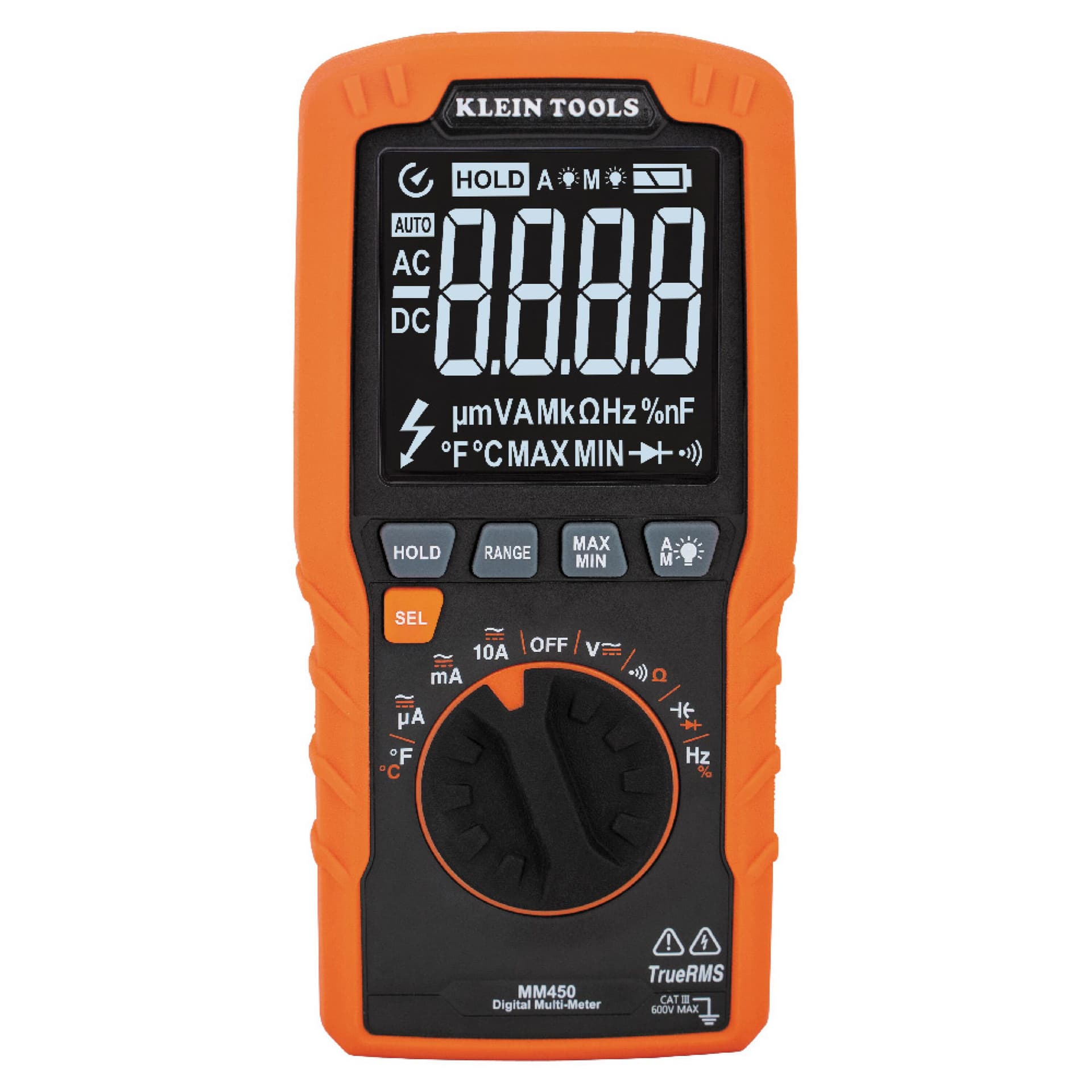
Slim True RMS meter, 2.8 cm thick and 258 g, drop-rated to 2 m, with Lead-Alert jack lights. CAT III 600V.
True RMS, CAT III 600V, 6,000-count backlit display for steady charging-voltage readings. Hands-on Tested.

IP67 and 4 ft drop-rated, with a 400.0 µA range for parked-draw checks and Bluetooth logging.
As an Amazon Associate I earn from qualifying purchases. Prices and availability are shown on Amazon.
Frequently asked questions
How long should a motorcycle battery hold charge when the bike is parked?
A healthy battery on a bike with no accessories and a normal factory standby draw should sit for a few weeks and still start the engine, though cold weather shortens that. If it goes flat in days, measure the parked current draw; if the draw is only a few milliamps, the battery itself or the charging system is the likelier cause. A maintainer helps over winter.
Can a bad regulator-rectifier kill a brand-new battery?
Yes, in either direction. A regulator that stops regulating can push charging voltage too high, which overheats and dries out the battery, while one with a failed rectifier section can undercharge it or let current leak back through it when the engine is off. Fitting a new battery without measuring charging voltage often just repeats the failure within weeks.
Why does my bike charge fine at high RPM but not at idle?
Small permanent-magnet stators make less power at low engine speed, so many bikes only break even with lights and accessories on once revs rise. Heavy accessory loads, a weakening stator or a high-resistance connection all make the idle shortfall worse. Compare your idle and raised-RPM readings with the figures in the service manual rather than a generic number.
Is it safe to disconnect the battery while the engine is running to test the charging system?
No. That old trick removes the battery's buffering effect and can expose the regulator and electronics to voltage spikes that damage them. Measure charging voltage at the battery terminals with everything connected instead, at idle and at the raised RPM the manual specifies, with and without the headlight on high beam.
Do heated grips or a USB charger drain the battery when the bike is off?
Only if they are wired directly to the battery rather than through a switched or ignition-fed circuit. Indicator LEDs, USB sockets and some heated-grip controllers can draw a small current continuously, which matters on a small motorcycle battery. A parked-current measurement shows whether any of them stay powered, and a relay or ignition-switched feed fixes it.
What voltage is too low for a motorcycle battery?
For a 12 V lead-acid or AGM battery, a resting reading near 12.2 V means it is only about half charged, and below roughly 12.0 V it is close to flat and may not start the bike. Charge it fully and recheck after several hours. If it falls back quickly with nothing connected, the battery is worn. Lithium batteries use different figures from their maker.
Where to go next
How to Test a Motorcycle Stator With a Multimeter →
AC output while running, then winding resistance and short-to-ground checks.
How to Test a Car Battery With a Multimeter →
The same resting, cranking and charging checks, explained in more detail for 12 V batteries.
How to Test a Bridge Rectifier →
Diode-mode checks that also explain how the rectifier half of a regulator works.


