HOW-TO GUIDE
How to Check a 230V Transformer With a Multimeter
By the OhmSavvy Research Team ·

Mains voltage: dead tests first, live tests only if competent
- Disconnect the appliance from the mains, or isolate the circuit at the consumer unit and prove it dead, before touching transformer terminals. Fixed wiring work is for competent persons and may fall under Part P in England and Wales.
- Power supplies can store charge in capacitors after the transformer. Discharge them before probing the secondary circuit.
- For the powered test, use a meter and leads rated at least CAT III, keep one hand away, and never measure resistance with power applied.
First: is it really a transformer?
These tests apply to transformers built from copper windings on an iron core. Many modern devices labeled "transformer" contain no such thing:
Laminated (EI) core
Heavy, square stack of steel plates with the windings on a bobbin. Testable this way.
Toroidal
Doughnut-shaped, often in audio amps and lighting. Testable this way, with very low resistances.
Electronic driver
Light plastic box, often for LED or halogen lamps. A switch-mode supply: not testable by winding.
1Identify the primary and secondary
The label usually shows the input (230V or 220–240V) and output voltages and which terminals or wire colors belong to each. On a step-down transformer the primary has many turns of thin wire and the secondary has fewer turns of thicker wire, so the primary always reads the higher resistance.
| Secondary rating | Turns ratio from 230V | Typical uses |
|---|---|---|
| 24V | ≈ 9.6 : 1 | Heating and irrigation controls |
| 12V | ≈ 19.2 : 1 | Low-voltage lighting, bells, older adaptors |
| 9V | ≈ 25.6 : 1 | Small linear power supplies |
| 6V | ≈ 38.3 : 1 | Low-power electronics, older doorbells |
2Measure the primary winding
Disconnect at least one primary wire so you are measuring the transformer alone. Set the meter to Ω and probe across the two primary terminals. A small transformer of a few VA typically reads somewhere from several hundred ohms to a few kilohms; a larger unit reads lower. OL means an open winding, most often a blown internal thermal fuse on small units.
3Measure the secondary winding
Probe across the secondary terminals. Expect a much lower figure, often a few ohms or less, so short the probes together first and subtract that lead resistance. Transformers with several secondaries or a center tap give a reading for each section.
For 24V heating, HVAC and irrigation control transformers, see how to check a 24V transformer with a multimeter.
4Check winding-to-winding and winding-to-core
On the highest Ω range, measure from each primary terminal to each secondary terminal, then from every terminal to the metal core or mounting frame. All of these should read OL. Any reading means breakdown between windings, which can put mains voltage on the low-voltage side: do not reuse that transformer.
OL here is a pass
5Powered test: measure the secondary voltage
If the transformer passes the dead tests, reconnect it, keep the secondary disconnected from its load, and set the meter to AC volts. Restore power and measure across the secondary only. Expect the reading to sit above the rating, because the rating applies at full load.
Reading the results
| Result | Meaning |
|---|---|
| Primary OL | Open primary or blown internal thermal fuse |
| Secondary OL | Open secondary winding or broken lead-out |
| Any reading between windings or to core | Insulation breakdown: unsafe, replace |
| Dead tests pass, no AC output | Check the supply reaching the primary and any external fuse |
| Output collapses under load, unit runs hot | Likely shorted turns: replace |
01
Isolate
Prove dead
02
Primary Ω
Definite, not OL
03
Secondary Ω
Lower than primary
04
Insulation
OL to core
05
AC volts
Secondary, unloaded
Which multimeter you need
The resistance tests suit any meter, but the powered test is a 230V job, so pick a meter rated CAT III 600V or better. See the best multimeters for electricians for options suited to regular mains work.
CAT III meters in our reviews
True RMS, CAT III 600V, with non-contact voltage detection. Hands-on tested by OhmSavvy.
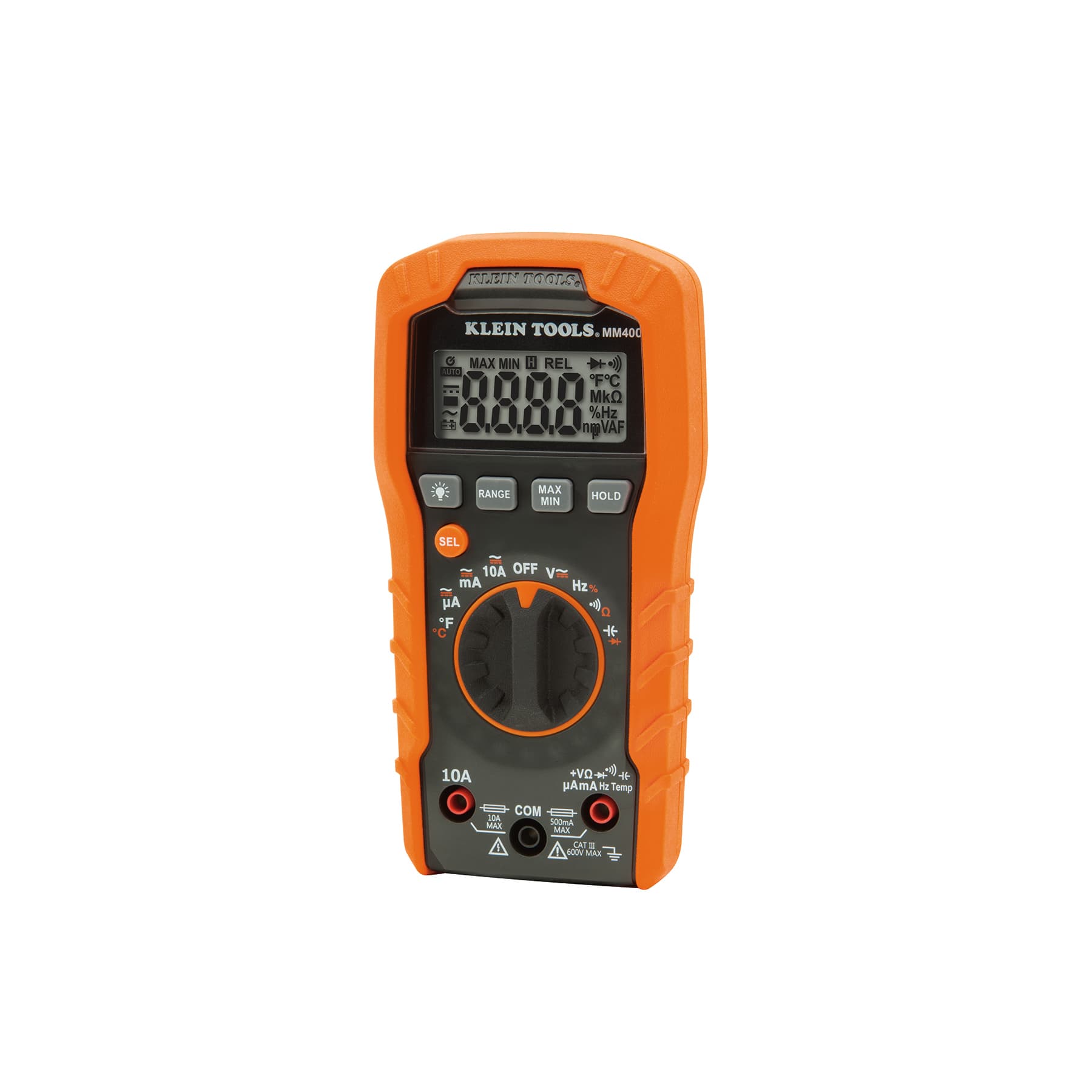
Auto-ranging, CAT III 600V, with temperature and capacitance. Not True RMS; discontinued by Klein.
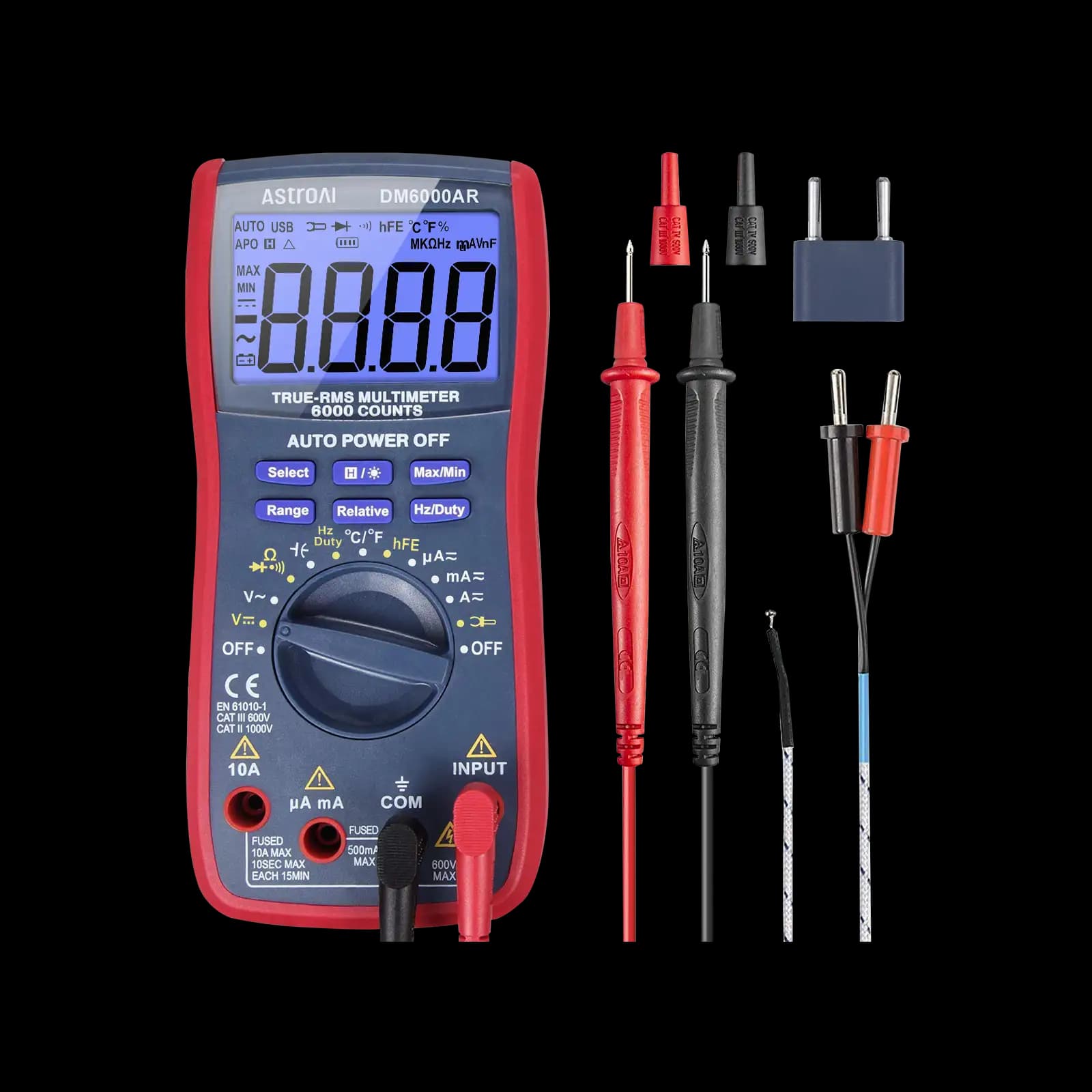
True RMS, 6,000-count, auto-ranging. AstroAI states no CAT rating, so use it on the low-voltage side only.
As an Amazon Associate I earn from qualifying purchases. Prices and availability are shown on Amazon.
Frequently asked questions
What resistance should a 230V transformer primary have?
It depends on the transformer's VA rating. Small transformers of a few VA often read from several hundred ohms to a few kilohms on the primary; larger ones read lower, sometimes only a few ohms for a big toroid. There is no universal figure. What matters is a definite, stable reading rather than OL or zero, and a primary that reads clearly higher than the secondary of a step-down unit.
Why does my 12V transformer read 14V or more?
A transformer's rated voltage is specified at full load. With nothing connected, the output rises above the rating, and the smaller the transformer the bigger the rise. Mains voltage in the UK is also allowed to vary around 230V, which moves the output with it. A reading moderately above rating on an unloaded secondary is normal.
Can a transformer have a blown fuse inside it?
Many small mains transformers have a one-shot thermal fuse buried in the primary winding under the outer wrapping. If it opens through overheating, the primary reads OL and the transformer is usually scrapped, although the fuse is sometimes reachable and replaceable on the bench.
How do I test a halogen lighting transformer?
Most modern units sold as halogen transformers are electronic drivers, which are switch-mode power supplies. They are light, have no measurable winding on the input and often need a minimum load to start. A winding test does not apply. Check the input supply and the lamp, and replace a suspect driver with a matching one.
Can a transformer test fine with a multimeter and still be faulty?
Yes. A shorted turn may change the winding resistance by too little to notice, yet make the transformer hum, run hot and deliver low voltage under load. Signs to look for are heat with no load connected, a burning smell and a voltage that sags sharply when loaded.


