HOW-TO GUIDE
How to Test a Doorbell Transformer With a Multimeter
By the OhmSavvy Research Team ·

Low-voltage side only
- The bell wiring, push and chime carry safe low voltage, but the transformer's primary is connected to 230V. Measure only on its marked low-voltage output terminals.
- If the transformer sits inside the consumer unit, removing the cover exposes live busbars. Leave that to someone competent, and remember any change to fixed wiring may come under Part P.
- Never try to measure resistance on terminals that are powered.
How a wired UK doorbell works
A wired doorbell is a simple series loop. The transformer steps 230V down to a safe low AC voltage, one wire runs to the bell push at the door, the other to the chime, and pressing the push closes the loop so current flows through the chime's coil.
Transformer
230V in, low-voltage AC out. Often DIN-rail, boxed or plug-in.
Bell push
A momentary switch at the front door. Exposed to rain, so a common failure.
Chime
Solenoid ding-dong or an electronic unit. Its label states the voltage it needs.
1Find the transformer
Trace the thin bell cable back from the chime. In many UK homes it ends at a small module in the consumer unit, with low-voltage output screws marked by voltage (for example 0, 4, 8, 12) on its front, separate from the mains terminals. Other homes use a boxed transformer near the consumer unit or a plug-in adaptor. Note which output terminals the bell wires use: that tells you the voltage the system expects.
North American homes and HVAC systems use 16V to 24V transformers instead; for those, see how to check a 24V transformer with a multimeter.
2Measure the AC output
Set the meter to AC volts (V~). On a manual meter, choose a range above 12V, such as 20V or 200V. Touch the probes to the two output screws the bell wires connect to, without touching anything else. Expect the reading to sit at or a little above the tap's rating, because the transformer is idle.
| Tap | Typical idle reading | Verdict |
|---|---|---|
| 8V | ≈ 8–10 V | Transformer working |
| 12V | ≈ 12–14 V | Transformer working |
| Any | 0 V | Dead transformer, tripped breaker or blown supply fuse |
| Any | Well below rating | Failing transformer, or a short pulling it down |
Check the supply before blaming the transformer
3Test the bell push
With a good output, move to the front door. Unscrew the bell push, disconnect its two wires and set the meter to continuity. Touch the probes to the push's terminals: there should be no beep at rest and a clear beep while the button is pressed. Corroded contacts are common on exposed pushes. As a quick cross-check, briefly touching the two disconnected bell wires together should sound the chime, since they only carry low voltage.
4Check the voltage at the chime
If the push works but the chime is silent, measure AC volts across the chime's input terminals while someone holds the push. You should see close to the transformer's output. No voltage means a break in the cable between transformer, push and chime; the full voltage with no sound points to the chime itself, often a jammed plunger on mechanical models. Bell wire can be continuity-tested end to end with the method in how to test electrical wires.
Reading the results
01
Output
8–12V AC at the taps?
02
Bell push
Beeps only when pressed?
03
Wiring
Continuity end to end?
04
At chime
Voltage when pressed?
05
Chime
Voltage but no sound
If you are fitting a wired smart doorbell to the old circuit, the output reading also tells you whether the transformer meets the voltage the doorbell maker specifies. Many need more than an 8V tap can deliver.
Which multimeter you need
Low AC volts and continuity are on every digital meter. A built-in non-contact voltage detector is a useful extra for confirming which nearby cables are live before you start. Our best multimeter for beginners guide covers simple, forgiving options.
Meters in our reviews
True RMS, auto-ranging, with a non-contact voltage detector. Our budget home-use pick.
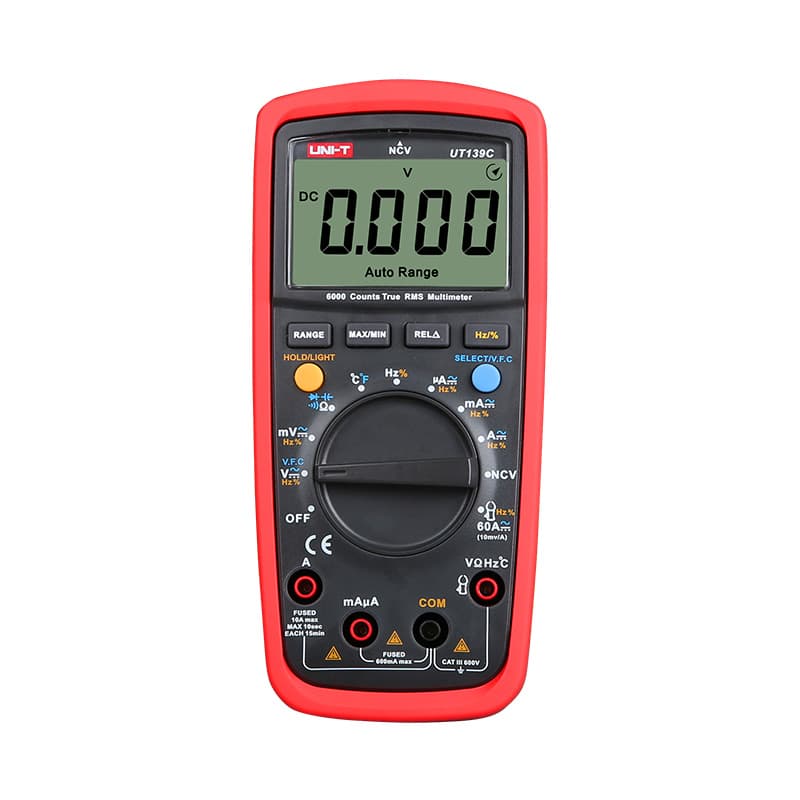
True RMS, 6,000-count, CAT III 600V, with both auto and manual ranging.
Pocket-sized and auto-ranging, with a built-in non-contact voltage detector. Extech doesn't list it as True RMS.
As an Amazon Associate I earn from qualifying purchases. Prices and availability are shown on Amazon.
Frequently asked questions
What voltage is a UK doorbell transformer?
The primary side is 230V mains. The secondary is low-voltage AC, most commonly 8V or 12V, and many units offer several taps such as 4V, 8V and 12V from one set of terminals. The chime's label or manual says which it needs. An idle transformer normally reads a little above its rated output because nothing is drawing current.
Where is my doorbell transformer?
In many UK homes it is a small DIN-rail module inside the consumer unit, next to the circuit breakers. It may also be a boxed unit near the consumer unit, a plug-in adaptor near the chime, or built into the chime itself on some mains-powered models. Following the thin bell wire back from the chime usually finds it.
Is it safe to test a doorbell transformer in the consumer unit?
Measuring its low-voltage output terminals is low-risk, but the consumer unit around it holds live 230V parts. If the transformer is behind the consumer unit's cover, only remove that cover if you are competent to work there; otherwise, test at the chime and bell push, or ask an electrician.
Why does my doorbell buzz constantly?
A chime that sounds non-stop or hums usually means the circuit is permanently closed: a stuck or water-damaged bell push, or the two bell wires touching somewhere along their run. Disconnect one wire at the push. If the noise stops, replace the push; if it continues, the short is in the cable.
Can I test a wireless doorbell this way?
No. Wireless and battery doorbells, and most smart video doorbells running from batteries, have no transformer. Check the batteries and the pairing first. Smart doorbells wired to an existing bell transformer are the exception: they often need a specific minimum voltage and VA, which this test will confirm.



