HOW-TO GUIDE
How to Test a DC Power Supply With a Multimeter: Voltage and Stability
By the OhmSavvy Research Team ·

Respect the supply's rated current when choosing a test load
- Never short a bench supply's output directly unless it has a known, safe current-limit setting enabled.
- Size any test load (like a power resistor) to stay within the supply's rated current and the resistor's power rating.
- Let a test resistor cool before handling it; resistors used as loads can get very hot.
1Check the rated output
Read the supply's labeled output voltage and maximum current. This is the baseline every subsequent measurement gets compared against — there's no universal correct number across different supplies.
2Measure unloaded output voltage
With nothing connected to the output, set the meter to DC volts and measure across the output terminals. This confirms the supply's basic regulation is working before you add any load.
3Measure voltage under a real load
Connect the intended device, or a test load such as a correctly sized power resistor, and measure the output voltage again while current flows. Compare it to the unloaded reading.
Every supply behaves as if it had a small resistance in series with its output, and the regulator's job is to hide it. The more current you draw, the more voltage that hidden resistance can steal, so the gap between your two readings is a direct measure of how well the regulation is working. Here's an illustrative worked example for a 12 V supply. A 12 Ω resistor draws 12 ÷ 12 = 1 A and dissipates 12 × 1 = 12 W, so pick a resistor rated for at least 25 W to keep it from overheating. If the meter shows 12.05 V unloaded and 11.98 V loaded, load regulation is (12.05 − 11.98) ÷ 11.98 × 100 ≈ 0.6%, a good result. A reading that falls to 11.2 V under the same load is a 7.6% sag, well outside what most regulated supplies list in their specifications.
| Behavior | Likely meaning |
|---|---|
| Voltage barely changes from unloaded to loaded | Good regulation |
| Voltage sags noticeably under load | Weak regulation or insufficient current capacity |
| Voltage drifts slowly over several minutes under load | Possible thermal instability inside the supply |
| Voltage unstable even unloaded | Likely a failing regulator — replace or repair the supply |
4Check for AC ripple on the DC output
With the load still connected, switch the meter to AC volts and measure across the same terminals. A low AC reading confirms good filtering; a meaningfully higher one suggests degraded filtering or regulation that a basic DC reading alone wouldn't reveal.
A multimeter reading is an average, not the full picture
Interpreting the results, put together
Stable voltage at both no-load and loaded conditions with low AC ripple means the supply is healthy. Voltage that sags or drifts under load, or shows elevated ripple, means the supply itself is the problem, not whatever device it's powering.
Which meter to use
A meter with both DC and AC volts, and auto-ranging, covers this whole test. See the full best multimeters roundup.
Meters in our reviews
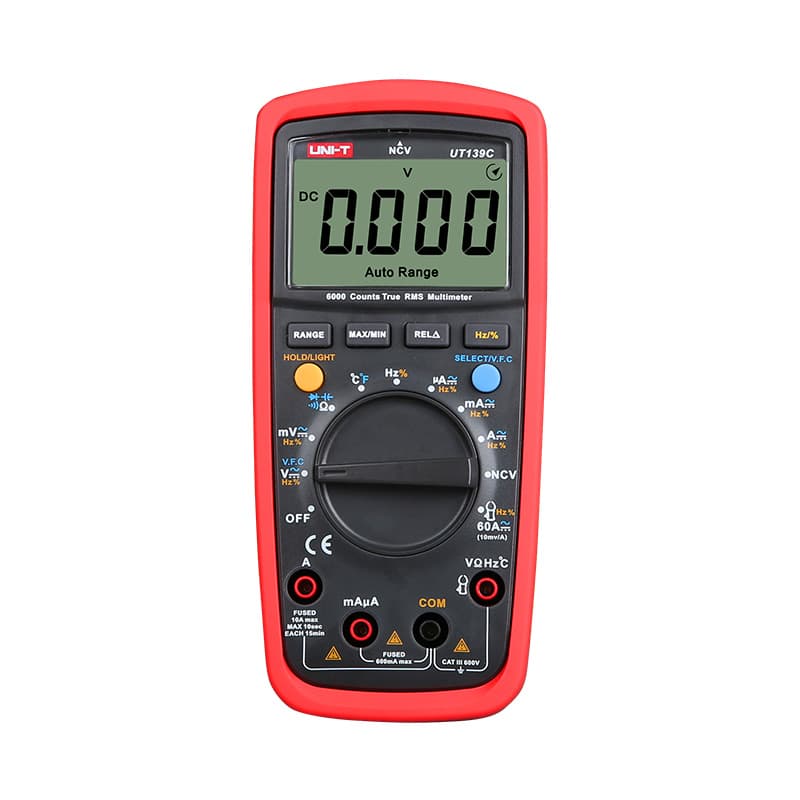
A budget-friendly True RMS option for bench power-supply testing.
As an Amazon Associate I earn from qualifying purchases. Prices and availability are shown on Amazon.
Frequently asked questions
What's a normal voltage tolerance for a DC power supply?
Depends on the supply, but many bench and switching supplies specify tolerance within a few percent of their rated voltage, both unloaded and under their rated load range. Check the supply's own datasheet or label for its specified tolerance rather than assuming a general figure.
Why would voltage read fine with my meter but the connected device still misbehaves?
A standard multimeter reads average DC voltage well but can't show fast voltage fluctuations or ripple the way an oscilloscope can. A supply with a correct average voltage but excessive ripple or transient instability can still cause a sensitive device to misbehave even though the meter shows a steady number.
How do I check for AC ripple on a DC output with just a multimeter?
Set the meter to AC volts (not DC) and measure across the same output terminals with the supply under its normal load. A healthy, well-filtered supply shows very little AC content; a meaningfully higher AC reading suggests the supply's filtering or regulation has degraded.
Can a supply's voltage change meaningfully as it warms up?
Yes, some supplies drift slightly as internal components reach operating temperature, more noticeable in older or lower-quality units. If you suspect drift, measure voltage right after power-on and again after it's been running under load for ten minutes or more.
What's the safest way to load-test a bench supply if I don't have the actual device it's meant to power?
A power resistor rated for the expected current and power dissipation makes a simple, controllable test load; choose its value using Ohm's law for the current you want to draw at the supply's rated voltage, and make sure its power rating comfortably exceeds the heat it will generate.


