COMPARISON · MULTIMETERS
Southwire 14070T vs Craftsman CMMT14171
The Southwire 14070T vs Craftsman CMMT14171 decision follows the work, not the spec sheet. Both are True RMS, auto-ranging meters, but the Southwire is an IP67 job-site meter rated CAT IV 600V / CAT III 1000V with Low Z and a work light, while the Craftsman adds RPM, dwell and duty cycle for vehicles at CAT III 600V. One catch: Amazon currently lists the Southwire as unavailable, so the Fluke 179 is our in-stock stand-in for that side.
By the OhmSavvy Research Team ·
Disclosure: OhmSavvy earns a commission from qualifying Amazon purchases made through these links, at no extra cost to you. How we're funded.

Southwire 14070T
4.5★★★★★The pick for anyone working outdoors, on job sites, or anywhere a meter might get wet or dropped.
No longer sold on Amazon. Amazon lists the Southwire 14070T as currently unavailable. The Fluke 179 is the closest in-stock alternative here with CAT IV 600V and True RMS.
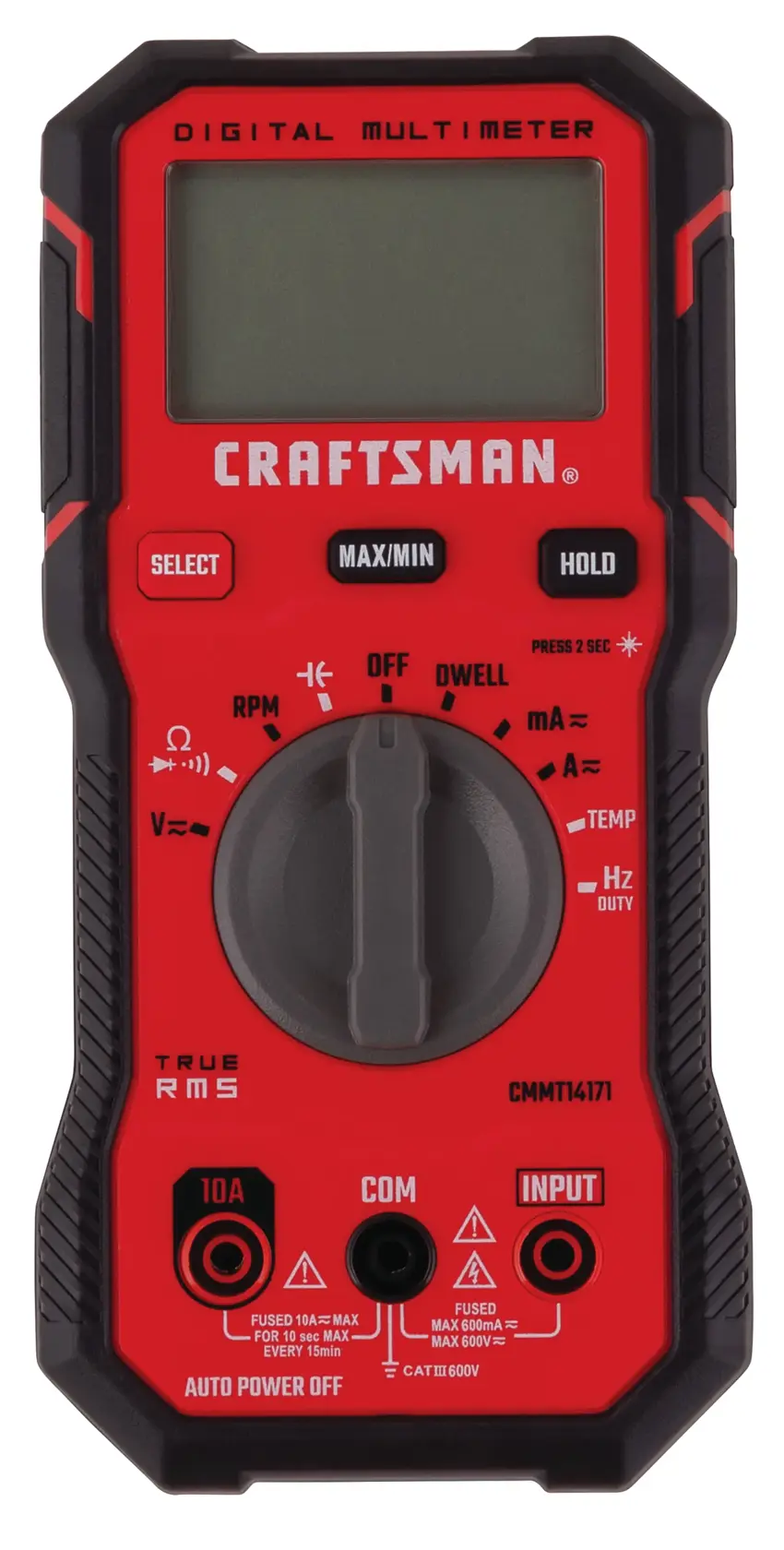
Craftsman CMMT14171
4.4★★★★☆The one pick here built specifically for diagnosing cars, not just household wiring.
Specs side by side
| Southwire 14070T | Craftsman CMMT14171 | |
|---|---|---|
| Rating | 4.5★★★★★ | 4.4★★★★☆ |
| Accuracy | True RMS | True RMS |
| Safety rating | CAT III 1000V / CAT IV 600V | CAT III 600V |
| Auto-ranging | Yes | Yes |
| Best for | Outdoor and job-site work, drop/water risk | Automotive diagnostics |
| IP rating | IP67 (dust-tight, temporary submersion) | Not stated |
| Low Z (ghost voltage) | Yes | Not listed |
| Automotive modes | None listed | RPM, dwell, duty cycle |
| Temperature | Not stated in our sources | Yes |
| Frequency | Not stated in our sources | Yes |
| Work light / backlight | LED work light; backlit display | Not stated |
| Functions (maker count) | 11, per the Amazon listing title | Not stated |
| Display counts | Not stated | Not stated |
| Amazon availability | Currently unavailable (Fluke 179 suggested) | In stock when checked |
Specs checked against manufacturer documentation and official Amazon listings. Desk research, not bench testing. How we research.
Key differences
- →Safety rating: CAT IV 600V / CAT III 1000V on the Southwire against CAT III 600V on the Craftsman, so only the Southwire is rated for service-entrance work.
- →The Southwire is IP67-rated and adds an LED work light and a Low Z function against ghost voltage; the Craftsman's listing claims neither.
- →The Craftsman adds RPM, dwell angle and duty cycle for engine diagnostics, plus temperature and frequency.
- →Both are True RMS and auto-ranging, so AC readings on distorted waveforms hold up on either.
- →Amazon lists the Southwire 14070T as currently unavailable; buy buttons on this page send you to the Fluke 179, which keeps CAT IV 600V and True RMS but has no IP67 rating or work light.
14070T vs CMMT14171 spec by spec
Neither maker publishes a full accuracy table we could check: Southwire's 14070T page now returns an error and Craftsman's product URL does too, so we compare what each maker and official listing actually state. That still separates them clearly, because the differences are in ratings and functions, not in decimal places.
| Spec | Southwire 14070T | Craftsman CMMT14171 |
|---|---|---|
| True RMS | Yes | Yes (voltage and current) |
| Auto-ranging | Yes | Yes |
| Highest CAT rating | CAT IV 600V | CAT III 600V |
| CAT III voltage | 1000V | 600V |
| Water and dust | IP67 | Not stated |
| Ghost-voltage check | Low Z mode | Not listed |
| RPM and dwell | No | Yes |
| Duty cycle | Not stated | Yes |
| Temperature | Not stated | Yes |
| Work light | Built-in LED | Not stated |
The second chart uses the transient levels commonly published for the IEC 61010 categories, not a figure either maker prints, so treat it as typical. The point is the gap: a CAT IV 600V meter is built to survive a larger surge than a CAT III 600V meter, which is why the rating, not the display, decides whether a meter belongs at a meter base.
What CAT IV buys you on a job site
Measurement categories describe where in a building a meter is used. Closer to the utility supply, a lightning strike or switching surge has more energy behind it, so the category climbs. The Craftsman's CAT III 600V covers distribution panels, feeders and fixed wiring, which is everything inside a typical house. The Southwire adds CAT IV 600V, the category for the service drop, meter base and outdoor feeds.
Add IP67 and the gap widens for outdoor work. The 6 means dust-tight and the 7 means protection against temporary immersion, so rain, puddles and drywall grit are routine rather than fatal. The Low Z function draws enough current to collapse a phantom reading on an abandoned conductor; our guide to spotting phantom voltage on a floating circuit explains the mechanism.
What RPM, dwell and duty cycle do in the garage
The Craftsman's extra modes read the timing of a switched signal rather than just its voltage. Duty cycle is the percentage of each cycle a signal is on. Dwell is the same idea in degrees of distributor rotation: dwell = duty cycle × 360 ÷ number of cylinders. On a four-cylinder engine each firing cycle spans 90°, so a 50% duty cycle works out to 45° of dwell. Those numbers are worked arithmetic, not a spec for any engine; check your service manual for the target.
Dwell matters mostly on older engines with points or a distributor. Duty cycle is the more useful mode on modern cars: fuel injectors, idle-air valves, purge solenoids and many fans are driven by PWM signals, and the percentage tells you what the engine computer is commanding. Our guides to testing a fuel injector and testing a solenoid coil put those modes to work. The Southwire's listing names no automotive modes, so it can check battery voltage and continuity on a car but not these timing measurements.
The Southwire is unavailable: what replaces it
Southwire 14070T vs Craftsman CMMT14171: which should you buy?
| You are… | Better fit | Why |
|---|---|---|
| DIY mechanic on a classic car with points | Craftsman CMMT14171 | Dwell and RPM read the ignition directly |
| Technician checking injectors and PWM solenoids | Craftsman CMMT14171 | Duty cycle shows what the computer commands |
| Electrician working at meter bases and outdoor feeds | Southwire 14070T (or Fluke 179) | Only these carry CAT IV 600V |
| Irrigation, pool or outdoor lighting installer | Southwire 14070T | IP67 survives rain and puddles |
| Homeowner fixing outlets and switches | Either | Both are True RMS and CAT III 600V or better |
| Someone who needs a meter this week | Craftsman CMMT14171 | In stock on Amazon; the Southwire is not |
| Electrician chasing ghost voltage | Southwire 14070T | Low Z collapses phantom readings |
For a broader shortlist, see our best multimeter for automotive and best multimeter for electricians guides.
Safety: match the rating to the point you probe
Choose the Southwire 14070T if…
- ✓You work outdoors or on job sites where water, dust and drops are a daily risk
- ✓You measure at service entrances or outdoor feeds, where CAT IV 600V applies
- ✓You chase ghost voltage on building wiring and want a Low Z mode built in
Choose the Craftsman CMMT14171 if…
- ✓You diagnose cars and need RPM, dwell angle or duty-cycle readings
- ✓Your household electrical work stays at panels and branch circuits, inside CAT III 600V
- ✓You want a meter that is in stock on Amazon today
The bottom line
Pick by the work. For vehicles, the Craftsman CMMT14171 is the one with dedicated RPM, dwell and duty-cycle modes, and it is in stock. For outdoor electrical work or anything that needs CAT IV protection, the Southwire 14070T was built for it, but with Amazon listing it as unavailable, the Fluke 179 is the CAT IV True RMS meter to buy instead. Either way, buying the wrong one means paying for features you won't use.
Frequently asked questions
Which meter has the higher safety rating?+
The Southwire 14070T, rated CAT IV 600V and CAT III 1000V. The Craftsman CMMT14171 is rated CAT III 600V, which covers household panels and building wiring but not the service entrance or outdoor feeders. If you need that higher rating and the Southwire is unavailable, the Fluke 179 carries the same pair of ratings.
Can the Craftsman CMMT14171 be used on household wiring?+
Yes, within its CAT III 600V rating, which covers receptacles, switches, panels and branch circuits. Its True RMS function keeps readings honest on dimmers and LED drivers. It has no Low Z mode in its listing, so a disconnected wire next to a live one can show a misleading phantom voltage; confirm with a load before trusting it.
Is the Southwire 14070T discontinued?+
We can't confirm that from Southwire, whose product page for it now returns an error. What we can confirm is that Amazon's listing for it shows currently unavailable, with no date for restocking. Until that changes we point buyers to the Fluke 179, which matches its CAT IV 600V and CAT III 1000V ratings.
How do I convert duty cycle to dwell angle?+
Multiply the duty cycle by 360 and divide by the number of cylinders. On a four-cylinder engine each firing cycle is 90 degrees, so 40% duty is 36 degrees of dwell and 50% is 45 degrees. A meter with a dwell mode, like the Craftsman, does that arithmetic for you once you select the cylinder count.
Do I need RPM on a multimeter if my car has a tachometer?+
Not for a quick idle check, since the dash gauge shows engine speed. A meter's RPM mode helps on vehicles without a tach, on small engines and equipment, and when you want to log idle speed while adjusting something under the hood. For most modern cars, duty cycle is the more useful of the Craftsman's automotive modes.
Related



