COMPARISON · SOLDERING IRONS
Weller WE1010NA vs YIHUA 862BD+
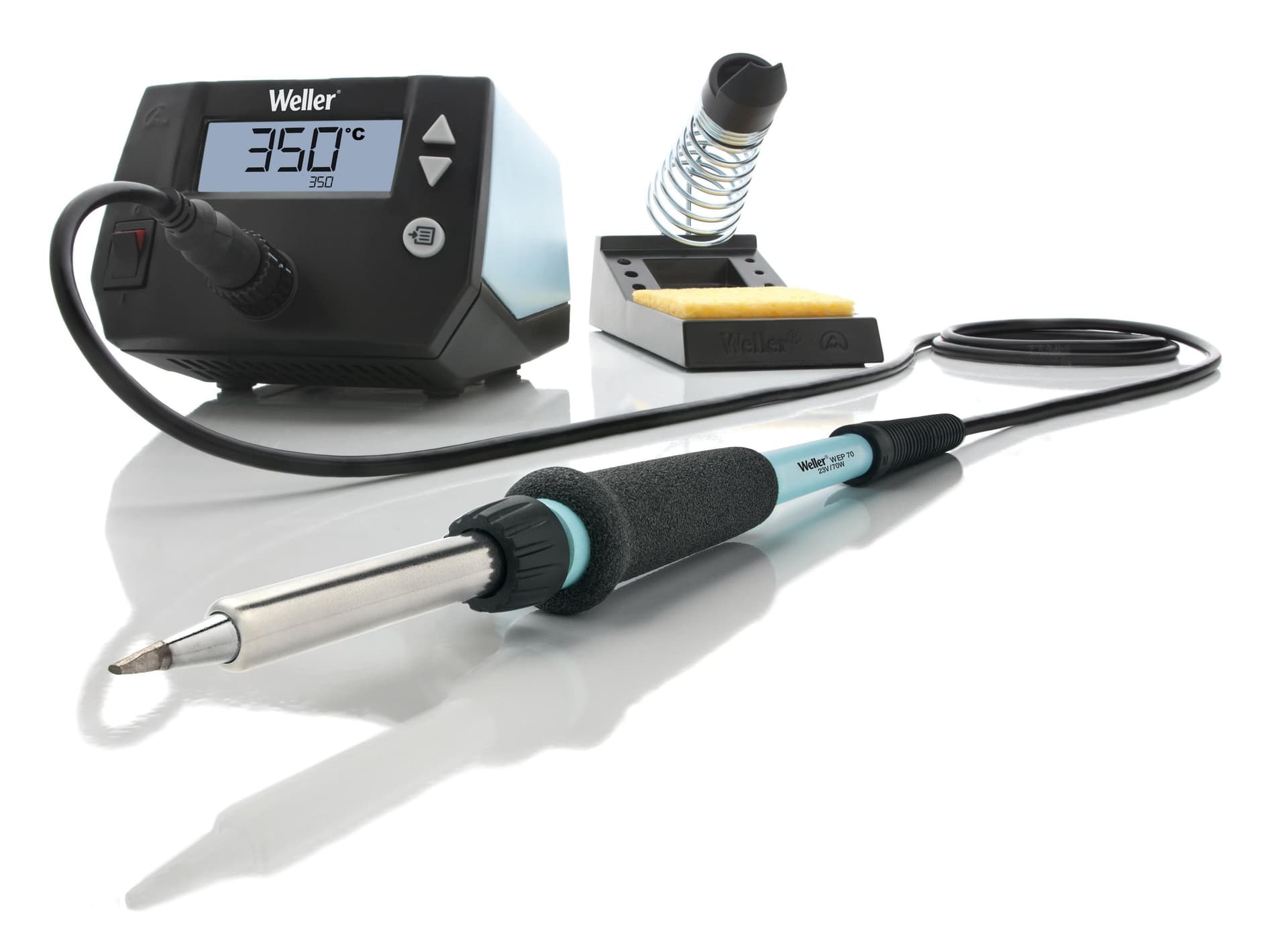
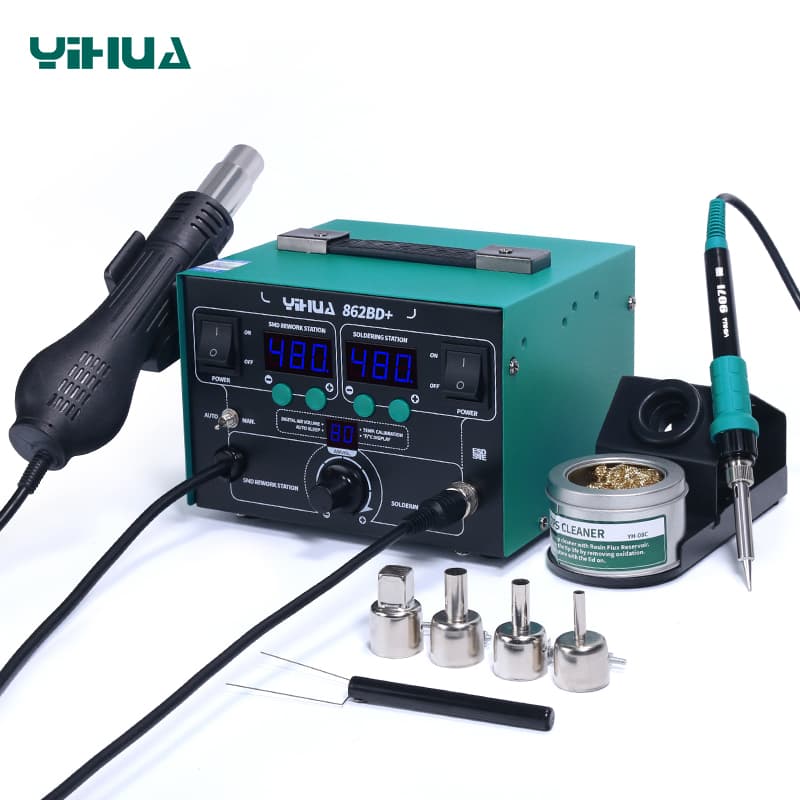
Choose the Weller WE1010NA if you only solder and want a documented, ESD-safe, temperature-stable bench iron; choose the YIHUA 862BD+ if you also need to remove or reflow surface-mount parts, because only it has a hot air gun. The WE1010NA is an 85W station with a 70W iron, 100–450°C, a published 28-second heat-up and ±5°C accuracy. The 862BD+ pairs a 75W iron with a 500W hot air gun, both adjustable to 480°C.
By the OhmSavvy Research Team ·
Disclosure: OhmSavvy earns a commission from qualifying Amazon purchases made through these links, at no extra cost to you. How we're funded.
Weller WE1010NA
4.6★★★★★ESD-safe construction and tight temperature stability for a dedicated electronics bench.
YIHUA 862BD+
4.3★★★★☆A soldering iron and a hot air rework station in one box, for SMD and BGA work a plain iron can't touch.
Specs side by side
| Weller WE1010NA | YIHUA 862BD+ | |
|---|---|---|
| Rating | 4.6★★★★★ | 4.3★★★★☆ |
| Power | 85W station (70W iron) | 75W iron / 500W hot air (720W total) |
| Heat-up time | ~28 seconds (50–350°C) | 200–480°C iron, 100–480°C hot air |
| Temperature control | Digital, 100–450°C, ESD-safe | LED, independent iron/air readouts |
| Best for | Dedicated workbenches, professional use | SMD/BGA rework alongside general soldering |
| Station type | Single-channel soldering station | Soldering iron + hot air rework |
| Rated power | 85W station, 70W WEP 70 iron | 75W iron, 500W hot air, 720W total |
| Iron temperature range | 100–450°C | 200–480°C |
| Hot air range | None | 100–480°C |
| Heat-up time | About 28 s, 50 to 350°C | Not stated |
| Temperature accuracy / stability | ±5°C / ±6°C | Not stated |
| ESD safe | Yes, per Weller | US listing says yes; YIHUA spec sheet makes no claim |
| Tips | Weller ET series | Not stated in our sources |
| Standby / lock | Standby, auto setback, password-protected settings | Not stated |
| Mains voltage | 120V | 110–127V on the linked listing; spec sheet lists 220V |
| Station size / weight | 150 × 120 × 98 mm; 1.40 kg | Not stated in our sources |
Specs checked against manufacturer documentation and official Amazon listings. Desk research, not bench testing. How we research.
Key differences
- →Only the 862BD+ has hot air: a 500W gun adjustable from 100 to 480°C for lifting and reflowing surface-mount parts. The WE1010NA is a contact iron only.
- →Weller publishes accuracy (±5°C), stability (±6°C) and a 28-second heat-up from 50 to 350°C. YIHUA publishes no equivalent figures for the 862BD+.
- →Weller lists the WE1010NA as ESD safe. For the 862BD+, the US Amazon listing says ESD safe, but YIHUA's own spec sheet makes no ESD claim.
- →Iron power is close: 70W on the Weller's WEP 70 against 75W on the YIHUA. The Weller station is rated 85W in total.
- →The Weller iron reaches down to 100°C; the YIHUA iron starts at 200°C and tops out higher, at 480°C against 450°C.
- →The linked 862BD+ listing is the 110–127V US version, while YIHUA's spec sheet lists 220V for the model family, so check the listing you buy.
At a glance
Different tools
A dedicated iron station against an iron plus hot air rework unit.
Weller strength
Documented ESD safety, ±5°C accuracy, standby and setback.
YIHUA strength
A 500W hot air gun for SMD removal and reflow.
Iron power
70W Weller WEP 70 against 75W on the YIHUA iron.
Documentation
Weller publishes far more numbers than YIHUA does.
Verdict
Solder only: Weller. Solder and rework SMD: YIHUA.
This comparison is desk research against Weller's product page, the official Amazon listing for the 862BD+ and YIHUA's spec sheet; we haven't bench-tested either station. The single-product write-ups are the Weller WE1010NA review and the YIHUA 862BD+ review.
WE1010NA vs 862BD+ spec by spec
On the soldering side the two irons are close in power. The gap is in what else the box does and how much the maker is willing to put in writing.
What the numbers mean in use: Weller's ±5°C accuracy means a 350°C setting should put the tip between 345 and 355°C, and the ±6°C stability figure bounds how far it drifts while you work. That predictability matters with lead-free solder, where common SAC alloys melt around 217 to 220°C and most people work at 330 to 370°C. YIHUA gives no comparable tolerance, so treat its displayed iron temperature as a guide. The Weller's lower 100°C floor also suits heat-sensitive parts and low-melt alloys; the YIHUA iron can't be set below 200°C.
Why an iron can't replace hot air
To lift a surface-mount part, every one of its joints has to be molten at the same moment. An iron touches one or two pins at a time, and the first joint has frozen again before you reach the last. A hot air nozzle bathes the whole part, so on an 8-pin SOIC or a QFN with a thermal pad under it, all joints melt together and the part comes away cleanly. The WE1010NA can still hand-solder individual SMD pins with a fine tip, which covers assembly; rework is where hot air earns its place.
Two stations can beat one
Weller WE1010NA vs YIHUA 862BD+: which should you buy?
| Your work | Better fit | Why |
|---|---|---|
| Through-hole kits and wiring | Weller WE1010NA | Hot air adds nothing; the Weller documents its accuracy |
| Phone and laptop board repair | YIHUA 862BD+ | Shields, connectors and QFNs need hot air to remove |
| Static-sensitive production bench | Weller WE1010NA | ESD safety stated by the maker, password-locked settings |
| Replacing SMD capacitors and ICs | YIHUA 862BD+ | Hot air lifts multi-pin parts without lifting pads |
| Shrinking heat-shrink tubing | YIHUA 862BD+ | The hot air gun doubles as a small heat gun |
| Classroom or shared bench | Weller WE1010NA | Standby, auto setback and locked settings |
| Outside North America | Check the listing | Weller sells 120V here; YIHUA lists 220V for the family |
For technique, see soldering fine-pitch SMD components and soldering surface-mount resistors without hot air. To compare the Weller with Hakko's current station, read Weller WE1010 vs Hakko FX-888DX.
Safety: 480°C air and a 720W heater
Choose the Weller WE1010NA if…
- ✓You work on static-sensitive boards and want ESD-safe construction the maker documents
- ✓Your work is hand soldering only: through-hole, wires, connectors and individual SMD pins
- ✓You want published accuracy and stability figures, standby with auto setback and locked settings
Choose the YIHUA 862BD+ if…
- ✓You need to remove or reflow multi-pin SMD parts, QFNs or shields, which an iron alone can't do
- ✓You want an iron and a hot air gun in one box instead of two stations
- ✓You're in the US and buy the linked 110–127V listing
Neither if…
Neither if you need both documented ESD safety and hot air rework in one station: the WE1010NA has no hot air, and the 862BD+'s ESD claim is unverified, with YIHUA's own spec sheet making no such claim. That combination needs a separate ESD-safe hot air station, not either of these two.
The bottom line
If your work is purely soldering, especially anything static-sensitive, the Weller WE1010NA is the more trustworthy tool: its maker documents ESD safety, accuracy, stability and heat-up time. If you regularly remove or reflow surface-mount parts and want one unit on the bench, the YIHUA 862BD+ does a job the Weller can't, as long as you confirm the voltage on the listing you buy.
Frequently asked questions
Can the Weller WE1010NA do SMD rework?+
Not hot air rework. It's a contact iron with no hot air function, so lifting a multi-pin part such as an IC or a QFN is beyond it. You can still hand-solder and touch up individual SMD pins with a fine ET tip. For true rework, where every joint must melt at once, you need hot air like the 862BD+.
What voltage does the YIHUA 862BD+ run on?+
The US Amazon listing we link to states 110–127V with a US plug, while YIHUA's own spec sheet lists AC 220V ±10%, 50Hz for the model family. Regional versions exist, so confirm the voltage on the exact listing before you buy, and never run a 220V unit on 120V or the reverse.
Is the YIHUA 862BD+ ESD safe?+
The sources disagree. The US Amazon listing calls it ESD safe, but YIHUA's own spec sheet makes no ESD claim and its official photo shows no ESD-safe badge. If static-sensitive work is your priority, a station whose maker documents ESD safety, such as the Weller WE1010NA, is the safer choice.
What temperature should I set the hot air to for SMD removal?+
Start lower than the maximum. Many technicians begin around 300 to 350°C with moderate airflow for leaded solder and nudge up for lead-free, which melts at roughly 217 to 220°C. Heat the whole part evenly, use flux, and lift with tweezers once all joints are shiny. The 862BD+ allows up to 480°C, rarely needed.
Is the Weller WE1010NA 70W or 85W?+
Both figures appear because they describe different parts. Weller rates the WE1010NA station at 85W and its WEP 70 soldering iron at 70W. The iron figure is what heats the tip; the station figure includes the power supply and electronics. Listings that call it a 70W station are quoting the iron.
Related