COMPARISON · MULTIMETERS
Fluke 787B vs Fluke 789: Which ProcessMeter Is Better?
The Fluke 789 is the better ProcessMeter if you ever work on 2-wire transmitters away from a powered panel: Fluke's data sheet lists a 24 V loop power supply and a HART mode that adds a 250 Ω resistor as 789-only features. Everything else Fluke publishes is shared. Both are 1000 V True RMS multimeters with the same accuracy table, both source or simulate 0–20 or 4–20 mA at 0.05% of span with 1,200 Ω drive, and both share the step and ramp modes, CAT IV 600V / CAT III 1000V rating, battery life and 3-year warranty. If you only feed signals into PLC inputs and valves, the 787B does that job.
By the OhmSavvy Research Team ·
Disclosure: OhmSavvy earns a commission from qualifying Amazon purchases made through these links, at no extra cost to you. How we're funded.

Fluke 789
4.7★★★★★A full multimeter that also sources, simulates and powers 4-20 mA loops, with 0.001 mA resolution.
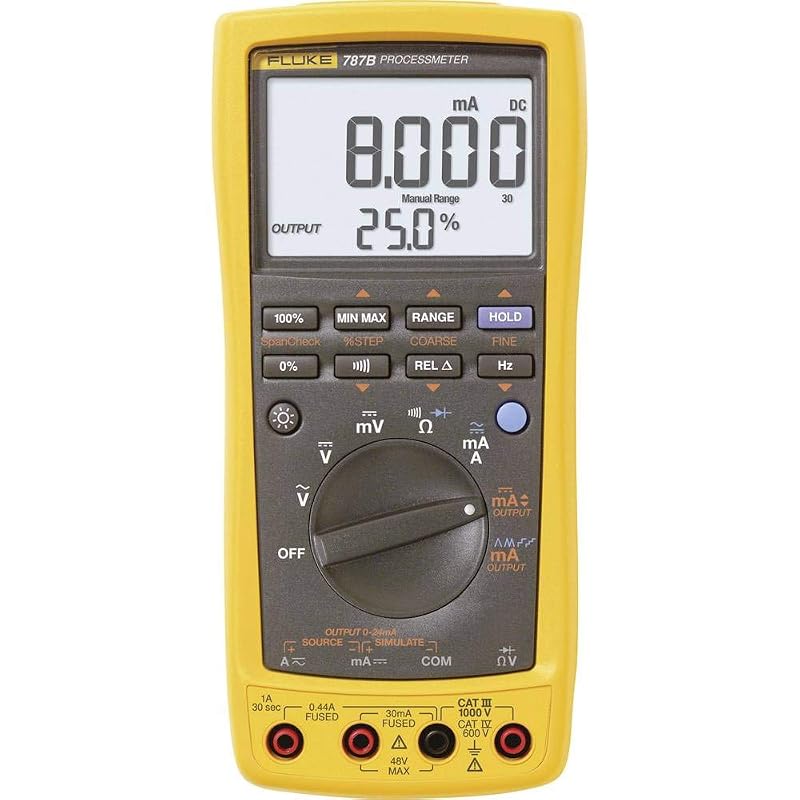
Fluke 787B
4.6★★★★★A True RMS ProcessMeter that measures, sources and simulates 0-20 or 4-20 mA, without the 789's built-in loop supply.
Specs side by side
| Fluke 789 | Fluke 787B | |
|---|---|---|
| Rating | 4.7★★★★★ | 4.6★★★★★ |
| Accuracy | True RMS AC volts; 0.05% DC mA | True RMS; 0.05% of span mA source |
| Safety rating | CAT IV 600V / CAT III 1000V | CAT IV 600V / CAT III 1000V |
| Auto-ranging | Yes (manual RANGE) | Yes (manual RANGE) |
| Best for | Instrument techs: 4-20 mA loops and transmitters | Sourcing and simulating 4-20 mA signals |
| 24 V loop power supply | Yes | No (data sheet: 789 only) |
| HART 250 Ω resistor | Yes, switched in with loop power | Not listed |
| mA source | 0–20 / 4–20 mA, to 24 mA; 0.05% of span | 0–20 / 4–20 mA, to 24 mA; 0.05% of span |
| Source drive | 24 V compliance or 1,200 Ω at 20 mA | 24 V compliance or 1,200 Ω at 20 mA |
| mA simulate | External 15–48 V supply, 1000 Ω at 20 mA | External 15–48 V supply, 1000 Ω at 20 mA |
| mA measure | 30.000 mA, 0.05% + 2 | 30.000 mA, 0.05% + 2 |
| Step / ramp | Coarse, fine, 25%, 100%; auto step, slow and fast ramp | Same |
| DC volts / AC volts | 0.1% + 1 / 0.7% + 2 True RMS, to 1000 V | 0.1% + 1 / 0.7% + 2 True RMS, to 1000 V |
| Current input | 1 A (0.44 A continuous) | 1 A (0.44 A continuous) |
| Display | Dual, two backlight levels | Backlit (details not stated) |
| Fluke Connect | With optional IR3000FC module | Not stated |
| Battery life | 140 h measuring; 10 h sourcing | 140 h measuring; 10 h sourcing |
| Weight | 610 g (product page) / 600 g (data sheet) | 600 g |
| Warranty | 3 years | 3 years |
Specs checked against manufacturer documentation and official Amazon listings. Desk research, not bench testing. How we research.
Key differences
- →Loop power: Fluke's data sheet lists the 24 V loop power supply as 789 only, so the 789 can power a 2-wire transmitter by itself.
- →HART: the 789 has a HART mode that adds a 250 Ω resistor in series with its loop supply; Fluke lists nothing similar for the 787B.
- →Display and logging: Fluke's 789 page describes a dual display with two backlight levels and optional Fluke Connect logging through an IR3000FC module; the 787B page says only "backlit display".
- →Identical in the shared spec table: every DMM range and accuracy, the 30 mA measure range, source and simulate accuracy and drive, step and ramp modes, battery life, size, drop rating and safety rating.
Two ProcessMeters, one spec table
Fluke sells these as a pair and describes the split in one sentence of its data sheet: whether you only need to source and simulate mA, or need a 24 V loop power supply, there is a ProcessMeter for you. The data sheet then prints a single accuracy table for both models and a short list headed "789 additional features" with two entries, the loop supply and the HART resistor. That is the whole difference in measuring and output capability.
789: powers the loop
Built-in 24 V supply runs a 2-wire transmitter with nothing else.
789: HART-ready
Selectable internal 250 Ω resistor for a HART communicator.
Both: source
0–20 or 4–20 mA at 0.05% of span, 1,200 Ω at 20 mA.
Both: simulate
Act as a transmitter in a loop powered by a 15–48 V supply.
Both: full DMM
1000 V True RMS, 30 mA range at 0.05% + 2, 1 A input.
Both: rating
CAT IV 600V / CAT III 1000V, 1 m drop, 3-year warranty.
We haven't hands-on tested either ProcessMeter. The 4.7 for the 789 and 4.6 for the 787B come from desk research, and every number on this page is from Fluke's data sheet, the two product pages, the 789 manual or the official Amazon listings. Both Amazon offers were from third-party sellers when we checked.
Fluke 787B vs 789 spec by spec
| Spec | Fluke 789 | Fluke 787B | Same? |
|---|---|---|---|
| 24 V loop supply | Yes | No | 789 only |
| HART 250 Ω resistor | Yes | Not listed | 789 only |
| mA source range | 0–20 or 4–20 mA, to 24 mA | 0–20 or 4–20 mA, to 24 mA | Same |
| Source accuracy | 0.05% of span | 0.05% of span | Same |
| Source drive | 24 V compliance or 1,200 Ω at 20 mA | 24 V compliance or 1,200 Ω at 20 mA | Same |
| Simulate | 1000 Ω at 20 mA, external 15–48 V | 1000 Ω at 20 mA, external 15–48 V | Same |
| mA and % of span together | Yes | Yes | Same |
| Step / ramp | Coarse, fine, 25%, 100%; auto step, slow and fast ramp | Same set | Same |
| mA measure | 30.000 mA, 0.05% + 2 | 30.000 mA, 0.05% + 2 | Same |
| DC volts | 400.0 mV to 1000 V, 0.1% + 1 | 400.0 mV to 1000 V, 0.1% + 1 | Same |
| AC volts (True RMS) | 0.7% + 2 | 0.7% + 2 | Same |
| Amps | 1.000 A (0.440 A continuous) | 1.000 A (0.440 A continuous) | Same |
| Resistance | 400.0 Ω to 40 MΩ, 0.2% + 1 | 400.0 Ω to 40 MΩ, 0.2% + 1 | Same |
| Frequency | 0.5 Hz to 20 kHz, 0.005% + 1 | 0.5 Hz to 20 kHz, 0.005% + 1 | Same |
| Display | Dual, two backlight levels | Backlit | 789 more detailed |
| Fluke Connect | Optional IR3000FC | Not stated | 789 |
| Battery | 4 × AA; 140 h measure; 10 h source | 4 × AA; 140 h measure; 10 h source | Same |
| Operating range / drop | −20 to 55 °C / 1 m | −20 to 55 °C / 1 m | Same |
| Safety rating | CAT IV 600V / CAT III 1000V | CAT IV 600V / CAT III 1000V | Same |
Fluke's 789 product page gives the sourcing figure at 20 mA instead of 12 mA, and its weight as 610 g instead of the data sheet's 600 g; neither changes the comparison. Source accuracy works out the same on both: 0.05% of a 16 mA span (4–20 mA) is ±0.008 mA, and on the 0–20 mA span it is ±0.010 mA.
One line on Fluke's 787B page to read carefully
Powering a transmitter on the bench
A 2-wire transmitter takes its power from the same pair of wires that carries its 4–20 mA signal, so it needs a DC supply in the loop before it outputs anything. In a plant, that supply lives in the control system. On a bench, in a shop, or when a new instrument arrives before the panel is energized, it doesn't exist yet, and that is the moment the two ProcessMeters part ways.
With a 787B you wire a separate 24 V supply, a 250 Ω resistor and the 787B on its mA measure range in series with the transmitter, then clip the HART communicator across the resistor. With a 789 you connect the transmitter to the meter, select loop power, and switch in the internal 250 Ω resistor; the 789 supplies the loop and reads the current the transmitter draws, with % of span on the second line of the display.
The resistor costs voltage, so check the budget. At 20 mA, 250 Ω drops 250 × 0.020 = 5 V, leaving about 19 V of a 24 V supply for the transmitter and the test leads. At 4 mA the drop is only 1 V. Most 2-wire transmitters need somewhere around 10 to 12 V at their terminals to operate, but that figure varies by model, so confirm the minimum supply voltage in your transmitter's data sheet before relying on either setup.
Jobs where the 787B is all you need
Much loop work never touches a transmitter's power. Sourcing 4, 12 and 20 mA into a PLC or DCS analog input to check scaling and alarms uses the internal source, which both meters drive into up to 1,200 Ω. Stroking a valve through an I/P converter or positioner is the same. Simulating a transmitter inside a live loop, so you can check the wiring and the input card with the field device disconnected, uses the plant's own 15–48 V supply, which both meters accept. Reading loop current in series, with % of span alongside, is also identical.
| Task | Fluke 787B | Fluke 789 |
|---|---|---|
| Source 4–20 mA into a PLC input | Yes | Yes |
| Stroke a valve via I/P or positioner | Yes | Yes |
| Simulate a transmitter in a powered loop | Yes | Yes |
| Measure loop current, mA and % | Yes | Yes |
| Power a 2-wire transmitter alone | Needs external supply | Yes, 24 V |
| HART communication on the bench | Needs supply and 250 Ω resistor | Yes, internal resistor |
| Check 120 V control power or a 24 V DC rail | Yes, to 1000 V | Yes, to 1000 V |
For a side-by-side of the 789 against a pure industrial multimeter, including its 440 mA current limit, see Fluke 789 vs Fluke 87V. For clamp-on loop testers and other options, see our best multimeters for 4–20 mA loop testing guide.
Fluke 787B vs 789: which should you buy?
| You are… | Buy | Why |
|---|---|---|
| Instrument tech commissioning new transmitters | Fluke 789 | Powers and HART-connects them without extra kit |
| Calibration shop with a bench supply and resistor | Fluke 787B | Same accuracy; bench already has the loop power |
| PLC or controls technician checking analog inputs | Fluke 787B | Source and simulate are identical |
| Valve and positioner technician | Fluke 787B | Sourcing into an I/P is the same on both |
| Field tech covering remote skids and wellheads | Fluke 789 | One tool can power a transmitter anywhere |
| Team that logs results to Fluke Connect | Fluke 789 | IR3000FC option listed only for the 789 |
If your loop work is mostly troubleshooting live loops without breaking them, a mA clamp may suit you better than either; the 4–20 mA guide above compares those. For general electrical work the full best multimeters roundup is the place to start, and our walkthrough on measuring milliamps with a multimeter covers series connections.
Safety: loop wiring often shares a cabinet with mains
Choose the Fluke 789 if…
- ✓You bench-test, configure or commission 2-wire transmitters and want the meter to power them
- ✓You use a HART communicator and don't want to carry a loose 250 Ω resistor and a separate supply
- ✓You want the two-level backlight and the optional IR3000FC Fluke Connect logging Fluke lists for the 789
Choose the Fluke 787B if…
- ✓Your mA work is sourcing into PLC analog inputs, I/P converters and valve positioners
- ✓You simulate transmitters inside live loops that already have a 15–48 V control-system supply
- ✓You don't use HART, or you already carry a loop supply and resistor in your kit
The bottom line
Buy the Fluke 789 if you work on 2-wire transmitters away from a powered control panel or use HART: its built-in 24 V loop supply and switchable 250 Ω resistor replace a separate supply and resistor. Buy the Fluke 787B if your mA work is sourcing into PLC inputs and valves or simulating transmitters in live loops; Fluke publishes identical measurement, source and simulate specs, safety rating, battery life and warranty for both.
Frequently asked questions
What is the difference between the Fluke 787B and 789?+
Fluke's joint data sheet lists two 789-only features: a 24 V loop power supply and a HART mode that adds a 250 Ω resistor. Everything in the spec table is shared, including DMM accuracy, the 30 mA range, 0.05%-of-span source and simulate, 1,200 Ω drive, step and ramp modes, battery life and the CAT IV 600V / CAT III 1000V rating.
Can the Fluke 787B power a 4-20 mA transmitter?+
No. Fluke's data sheet marks the 24 V loop power supply as 789 only, even though one bullet on the 787B product page mentions powering the loop. The 787B can source current into passive inputs and simulate a transmitter in a loop that already has a 15–48 V supply, but a 2-wire transmitter on the bench needs an external supply.
Does the Fluke 787B have a HART resistor?+
Fluke doesn't list one. The HART mode, which switches a 250 Ω resistor in series with the loop supply, is listed only for the 789. With a 787B, carry a separate 250 Ω resistor and a supply when you need a HART communicator to talk to a transmitter that isn't in a powered loop.
Are the Fluke 787B and 789 equally accurate?+
Yes, according to Fluke's single spec table: DC volts 0.1% + 1, True RMS AC volts 0.7% + 2, the 30.000 mA range at 0.05% + 2, resistance 0.2% + 1, and source and simulate at 0.05% of span. On a 4–20 mA span, 0.05% works out to ±0.008 mA from either meter.
How long do the batteries last on the 787B and 789?+
Fluke's data sheet gives the same figures for both: about 140 hours measuring and about 10 hours sourcing 12 mA, on four AA cells. Fluke's 789 page quotes the 10 hours at 20 mA. Simulating draws on the loop's own supply, so on a long commissioning day, simulate rather than source wherever the plant supply is available.
Can either ProcessMeter measure motor current?+
Only small currents. Both have a 1.000 A range rated 0.440 A continuous and no 10 A input, so motor, heater and contactor currents need a clamp meter. Both still measure AC and DC volts to 1000 V as True RMS, which covers control power and supply checks inside a panel.
Related



