COMPARISON · SOLDERING IRONS
Weller WE1010 vs Hakko FX-888DX
Weller WE1010 vs Hakko FX-888DX is the current-generation bench station match-up. Both are ESD safe digital stations with a 65–70W iron. The Hakko adds a 100W station, a wider 50–480°C range and five presets; the Weller (sold in the US as the WE1010NA kit) answers with standby and auto setback, password-protected settings and a published 28-second heat-up. Pick the Hakko for range, presets and T18 tips; pick the Weller for a shared bench where idle tips and fiddled settings cost money.
By the OhmSavvy Research Team ·
Disclosure: OhmSavvy earns a commission from qualifying Amazon purchases made through these links, at no extra cost to you. How we're funded.
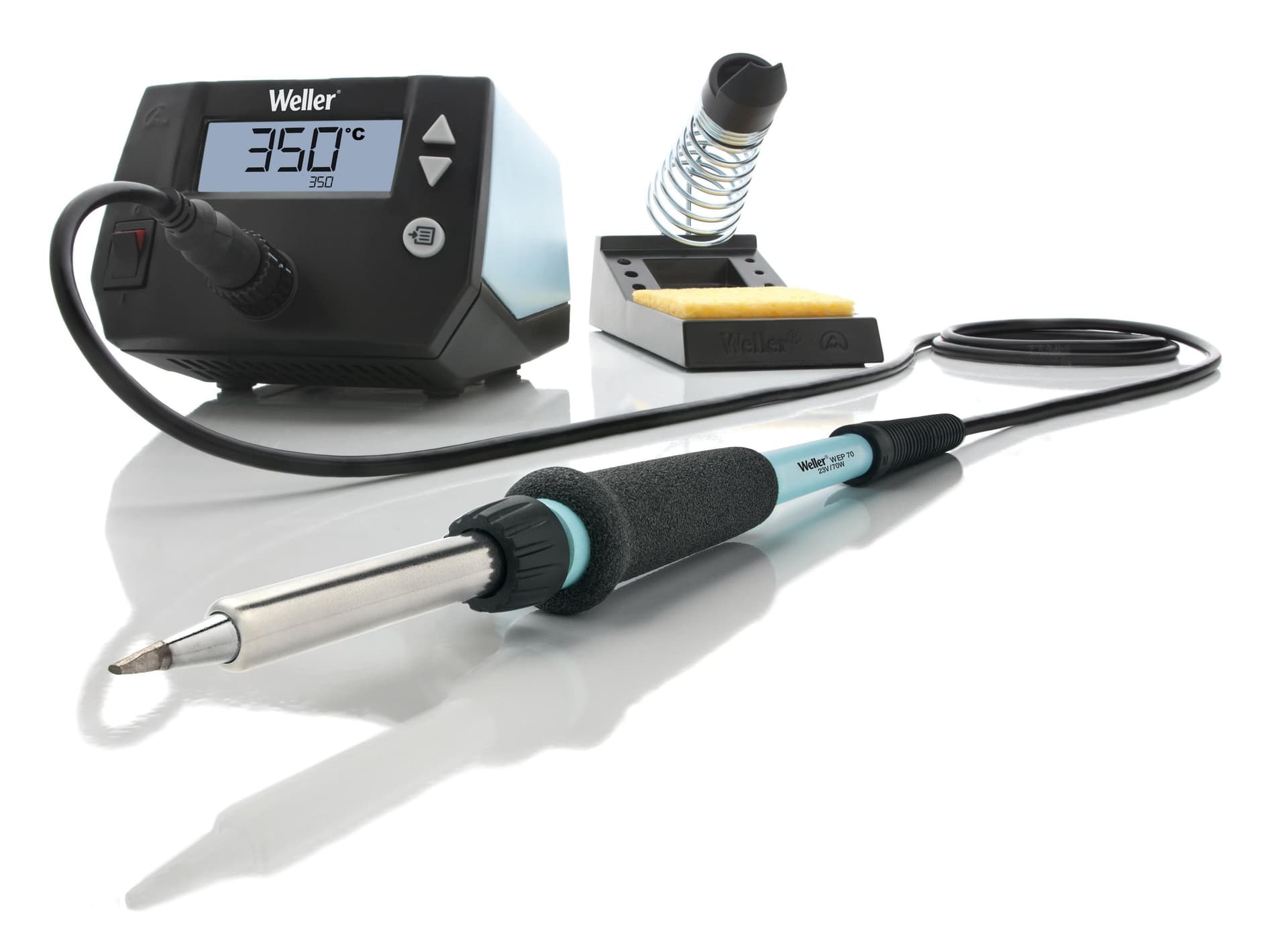
Weller WE1010NA
4.6★★★★★ESD-safe construction and tight temperature stability for a dedicated electronics bench.

Hakko FX-888DX
4.7★★★★★The FX-888D's replacement: the same T18 tips and handpiece, with a 100W station, a proper dial and five presets.
Specs side by side
| Weller WE1010NA | Hakko FX-888DX | |
|---|---|---|
| Rating | 4.6★★★★★ | 4.7★★★★★ |
| Power | 85W station (70W iron) | 100W station (65W iron) |
| Heat-up time | ~28 seconds (50–350°C) | Not stated by Hakko |
| Temperature control | Digital, 100–450°C, ESD-safe | Digital, closed-loop, 50–480°C |
| Best for | Dedicated workbenches, professional use | Serious hobbyists, repair benches |
| Station power | 85W station (70W WEP 70 iron) | 100W station (65W FX-8801 iron) |
| Temperature range | 100–450°C (200–850°F) | 50–480°C |
| Heat-up time | About 28 s (50–350°C) | Not stated by Hakko |
| Temperature figures | Accuracy ±5°C, stability ±6°C | ±1°C at idle |
| Tips | Weller ET series | Hakko T18 series |
| Presets / lock | Password-protected settings | Five presets, parameter lock |
| Standby | Standby with auto setback | Not stated by Hakko |
| Other handpieces | Not stated | Drives Hakko tweezers, solder gun and larger irons |
| ESD safe | Yes | Yes, tip-to-ground under 2 Ω |
| Station size / weight | 150 × 120 × 98 mm; 1.40 kg | 100 × 120 × 120 mm; 1.2 kg |
Specs checked against manufacturer documentation and official Amazon listings. Desk research, not bench testing. How we research.
Key differences
- →The Hakko station is rated 100W against the Weller's 85W station; the irons themselves are 65W (Hakko) and 70W (Weller).
- →Hakko's 50–480°C range is wider at both ends than Weller's 100–450°C.
- →Weller lists standby with automatic setback; Hakko doesn't state a sleep or standby mode for the FX-888DX.
- →Hakko stores five temperature presets; Weller protects its settings with a password.
- →They use different tips: Weller ET versus Hakko T18, which matters if you already own one system.
At a glance
Shared ground
ESD-safe digital stations, single channel, 65–70W pencil irons.
Hakko lead
100W station, 50–480°C, five presets, ±1°C idle figure.
Weller lead
Standby with setback, password lock, 28 s published heat-up.
Tips
Weller ET against Hakko T18: the long-term running cost.
Footprint
Weller is wider and heavier: 1.40 kg against 1.2 kg.
Verdict
Home or repair bench: Hakko. Shared or production bench: Weller.
Neither station has been bought and tested by OhmSavvy, so this comparison is desk research against Weller's and Hakko's published specifications. Where a maker doesn't publish a number, the table says so instead of guessing.
Weller WE1010 vs Hakko FX-888DX spec by spec
On raw numbers the Hakko leads on station power and on range at both ends, while the Weller is the only one of the pair with a published warm-up time. The two figures below show the gaps that actually change how the stations behave on a bench.
Reading the tolerance numbers fairly
Where the temperature ranges differ
Most electronics work happens well inside both ranges. Lead-free solder is commonly run somewhere around 320 to 380°C and tin-lead lower, so either station covers everyday joints. The extra Hakko range lives at the edges: settings under 100°C suit gentle jobs such as working with low-melt alloys near heat-sensitive plastic, and the top 30°C helps when a large tip has to push heat into a big ground pour.
Turning the iron up is rarely the best fix for a stubborn joint, though. A wider tip carries more heat at a lower setting and is kinder to pads. Our chart of soldering iron temperature by metal gives starting points by alloy.
What standby and setback actually save
A tip sitting at full heat in its stand oxidizes faster, and flux burns off between joints. Weller's standby mode with auto setback drops the tip to a lower temperature when the iron has been idle, then brings it back up when you pick it up again. Weller says this conserves energy and protects the equipment. Hakko doesn't state an equivalent feature for the FX-888DX, so on that station the habit falls to you: tin the tip and turn the dial down when you step away.
On a bench used all day by several people, those idle stretches add up to hours, which is where setback earns its keep. If your own iron seems to switch itself off or cool unexpectedly, read why a soldering iron keeps switching off; standby features are a common cause. Tip life tips are in our soldering iron tip care guide.
Weller WE1010 vs Hakko FX-888DX: which should you buy?
| Bench | Better fit | Why |
|---|---|---|
| Shared lab or classroom | Weller WE1010 | Password-protected settings, standby and setback |
| Mixed work with frequent temperature changes | Hakko FX-888DX | Five presets and a rotary dial |
| Very low-temperature work | Hakko FX-888DX | Settings from 50°C |
| Upgrading from an FX-888D | Hakko FX-888DX | Same T18 tips and FX-8801 handpiece |
| Already stocked with Weller ET tips | Weller WE1010 | Stay in the tip system you own |
| Plans to add tweezers or a heavier iron later | Hakko FX-888DX | Hakko says it drives other Hakko handpieces |
| Tight bench space | Hakko FX-888DX | 100 mm wide and 1.2 kg |
| Wants a published heat-up figure | Weller WE1010 | About 28 s from 50 to 350°C |
Use cases in practice
A home repair bench that moves from fine SMD rework to a chunky XT60 connector in one evening benefits most from the Hakko's presets: store a low, a middle and a high setting and switch with a press instead of spinning through 100 degrees. The FX-888DX's ability to drive other Hakko handpieces also gives a growth path without a second station.
A school lab, maker space or production line has different problems: settings that wander because someone turned them up, and tips left baking at full heat. The WE1010's password lock and auto setback answer both, and its published accuracy and stability figures make it easier to document a process.
Tip ecosystems matter more than the station
Safety: both tips reach 450°C or more
Choose the Weller WE1010NA if…
- ✓You want standby with automatic setback to save tips between joints
- ✓You want password-protected settings on a shared bench
- ✓You want a published heat-up time: about 28 seconds from 50 to 350°C
Choose the Hakko FX-888DX if…
- ✓You want five temperature presets and a rotary dial
- ✓You need settings below 100°C or up to 480°C
- ✓You already own T18 tips from an FX-888D
The bottom line
Choose the Hakko FX-888DX for more power, a wider range, presets and compatibility with FX-888D tips. Choose the Weller WE1010 for a shared or professional bench where standby, auto setback and password-protected settings matter more than raw range.
Frequently asked questions
Is the Weller WE1010 the same as the WE1010NA?+
Yes, in the US. WE1010NA is the North American 120V kit of the WE1010 station, supplied with the 70W WEP 70 iron and PH 70 safety rest. The specs on this page come from Weller's WE1010NA 120V product page, so check the voltage on any listing that isn't marked NA before you buy.
Which station heats up faster, the WE1010 or FX-888DX?+
Weller states about 28 seconds to go from 50 to 350°C. Hakko doesn't publish a heat-up time for the FX-888DX, so there's no fair way to compare them on paper. The Hakko's 100W station gives it more power in reserve, but warm-up also depends on the heater, tip size and control loop.
Are both stations ESD safe?+
Yes. Weller lists the WE1010 as an ESD-safe station with a heat-resistant silicone cable, and Hakko lists the FX-888DX as ESD safe with tip-to-ground resistance under 2 Ω. That protection only works when the station is plugged into a properly grounded three-prong outlet, not through a two-prong adapter.
Can I use FX-888D tips on the FX-888DX?+
Yes. The FX-888DX keeps the FX-8801 handpiece and T18 tips used by the FX-888D, so a drawer of existing tips carries straight over. That compatibility is the strongest reason for an FX-888D owner to stay with Hakko rather than switch to the Weller, whose WEP 70 iron takes ET-series tips instead.
Does the Hakko FX-888DX have a sleep mode?+
Hakko doesn't state a sleep, standby or auto-off mode for the FX-888DX on its product page, so assume it holds the set temperature until you turn it down. Weller lists standby with automatic setback for the WE1010, which lowers the tip temperature during idle periods to save energy and tip life.
Related