HOW-TO GUIDE
Soldering Iron vs. Soldering Station: What's Actually Different?
By the OhmSavvy Research Team ·

The core difference is closed-loop temperature control
Every soldering tool has to replace the heat a joint pulls out of the tip while you're soldering. The question is whether the tool measures its own tip temperature and actively corrects it in real time (closed loop), or simply applies a fixed amount of power and leaves the resulting temperature to settle wherever it does (open loop). That one distinction — not size, price, or how many parts the box has — is what separates a "station" from a basic "iron" in practice.
What a simple soldering iron is
A basic wand-style iron is a heating element and tip in one handpiece, often with a simple analog dial that sets power level rather than a true target temperature. There's typically no sensor reading actual tip temperature and feeding it back to a controller — the dial sets how hard the element runs, and the resulting tip temperature depends on how much heat the joint is currently drawing away.
Control
Fixed power level or rough analog dial, usually open loop.
Feedback
Little to none — tip temperature isn't actively measured and corrected.
Footprint
Single handpiece, often with a simple stand.
Typical cost
Lowest in the category.
What a soldering station is
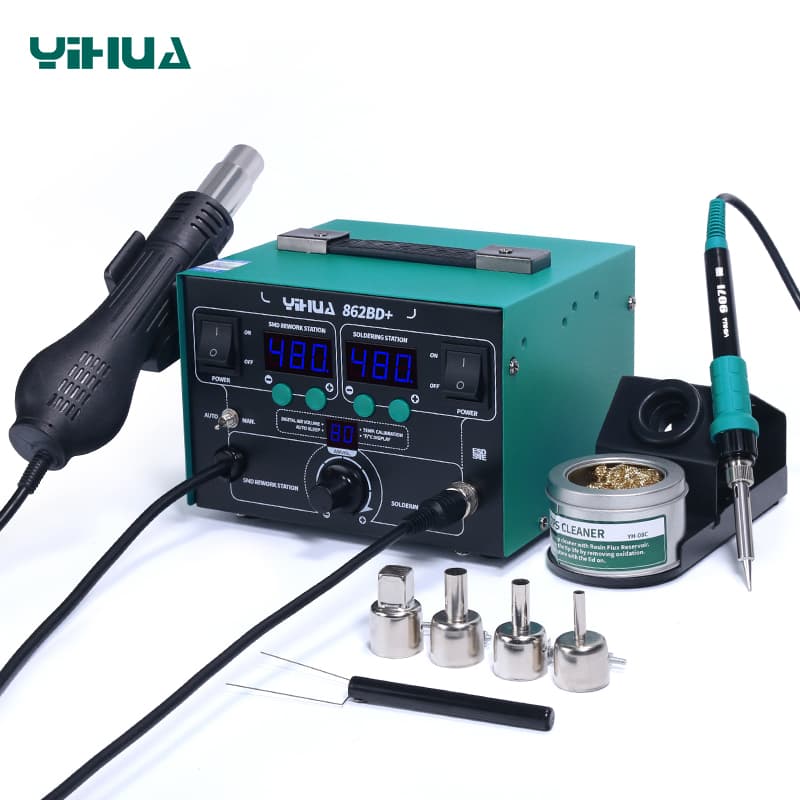
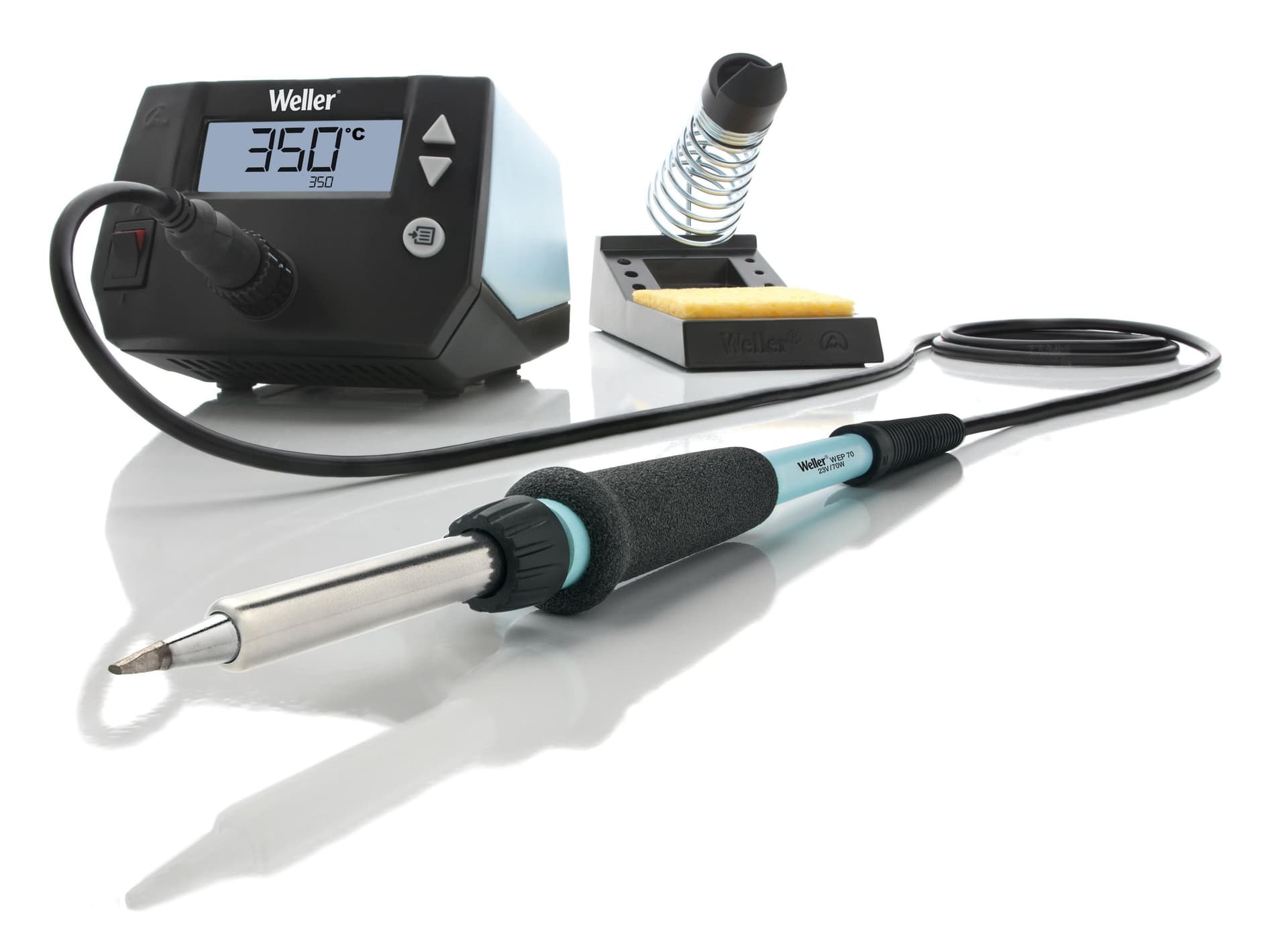
A station splits the tool into a base unit (power supply, controller, display) and a handpiece, with a temperature sensor built into or right next to the tip. The controller reads that sensor many times a second and adjusts power to the element continuously, holding the tip at a genuine target temperature even as a joint pulls heat away mid-solder. Many stations also add ESD-safe grounding and a digital numeric display showing the actual setpoint.
Control
Closed loop — a sensor at the tip feeds back to active control electronics.
Feedback
Continuous; temperature is measured and corrected many times per second.
Footprint
Separate base unit plus handpiece, or sensor-equipped handpiece.
Typical cost
Higher, reflecting the added sensing and control hardware.
Side-by-side comparison
| Simple iron | Soldering station | |
|---|---|---|
| Temperature control | Open loop / fixed power level | Closed loop, sensor-driven |
| Recovery under load | Can sag noticeably on demanding joints | Actively corrects to hold setpoint |
| Readout | Often none, or a rough dial marking | Usually a digital numeric display |
| ESD-safe option | Less common at this tier | Common on dedicated bench stations |
| Typical use case | Occasional repairs, light hobby work | Daily bench work, sensitive components |
When closed-loop control actually matters
The practical benefit shows up on demanding joints: large ground-plane connections, thick wire, or any joint that pulls a lot of heat out of the tip quickly. On a simple open-loop iron, the tip temperature can sag noticeably mid-joint as heat is drawn away, right when you need it most. A station's controller detects that sag and pushes more power to the element immediately, holding the setpoint through the joint instead of after it. This matters most for anyone soldering daily, working with ESD-sensitive components, or regularly hitting joints with large thermal mass.
When a simple iron is genuinely fine
For occasional repairs, small through-hole joints, and general hobby soldering that doesn't regularly hit large thermal-mass joints, a well-made simple iron does the job without the added cost of closed-loop electronics. A complete starter kit, like the Q-MING 60W Kit, is a sensible first purchase precisely because most beginner projects don't yet demand sensor-driven temperature stability.
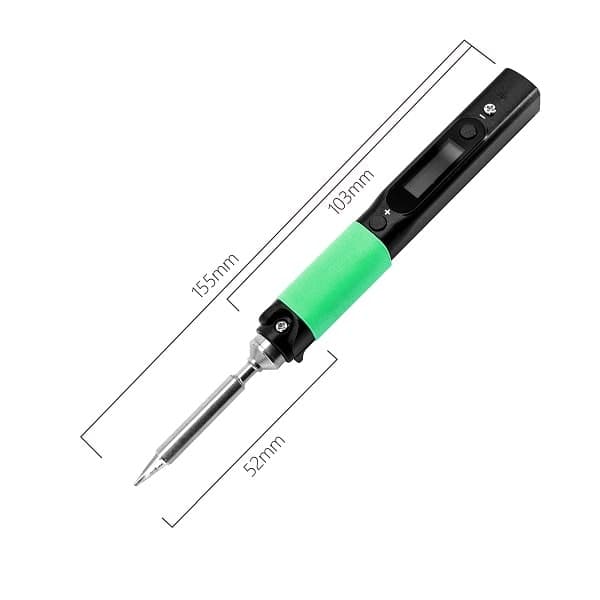
A portable, sensor-driven iron blurs the line
Which one should you buy?
If you solder often, work on ESD-sensitive boards, or regularly hit large joints, a station like the Hakko FX-888DX or Weller WE1010NA earns its price through more consistent joints over time. For occasional use or field repairs, the Pinecil V2 gets you sensor-driven control in a pocketable form. See the full buying guide for wattage and tip-ecosystem considerations beyond control type.
Stations and irons compared here
As an Amazon Associate I earn from qualifying purchases. Prices and availability are shown on Amazon.
Frequently asked questions
Is a USB-C iron like the Pinecil a "simple iron" or a "station"?
By control method, it behaves like a station: the Pinecil V2 has a built-in temperature sensor and firmware that actively regulates tip temperature, the same closed-loop principle as a bench station, just packaged into the handpiece itself instead of a separate base unit. It's a station's control logic in an iron's form factor.
Does a higher price always mean better temperature control?
Not directly — price also reflects things like ESD-safe construction, tip ecosystem size, build quality, and brand support, which don't by themselves improve temperature regulation. The specific spec to check is whether the product states closed-loop or PID temperature control with a tip-embedded sensor, rather than inferring it from price alone.
Can I upgrade a simple iron into something like a station?
Not really, in any practical sense. Closed-loop control requires a temperature sensor built into or very near the tip, feeding back to active control electronics — this is a design decision baked into the hardware, not something addable afterward. If you need the control a station provides, that means buying a station-class tool, not modifying an existing simple iron.
Do stations heat up faster than simple irons?
Not inherently — heat-up time is mostly a function of the heating element's wattage and the tip's thermal mass, which both simple irons and stations can have in either direction. What a station adds is holding temperature steady once at the setpoint, under the load of an actual joint pulling heat away, rather than reaching temperature faster in the first place.
What does "PID control" mean on a station's spec sheet?
PID stands for Proportional-Integral-Derivative, a standard feedback-control algorithm that adjusts power based on how far the tip is from the setpoint (proportional), how long it's been off target (integral), and how fast the temperature is currently changing (derivative). In practice it just means the station's closed-loop correction is tuned to respond smoothly rather than overshooting or oscillating around the setpoint.